44 1

AI-Powered Education: Pedagogy and AI in the Workplace 

AI-Powered Education: Pedagogy and AI in the Workplace

Learning Issues Nobody Discusses

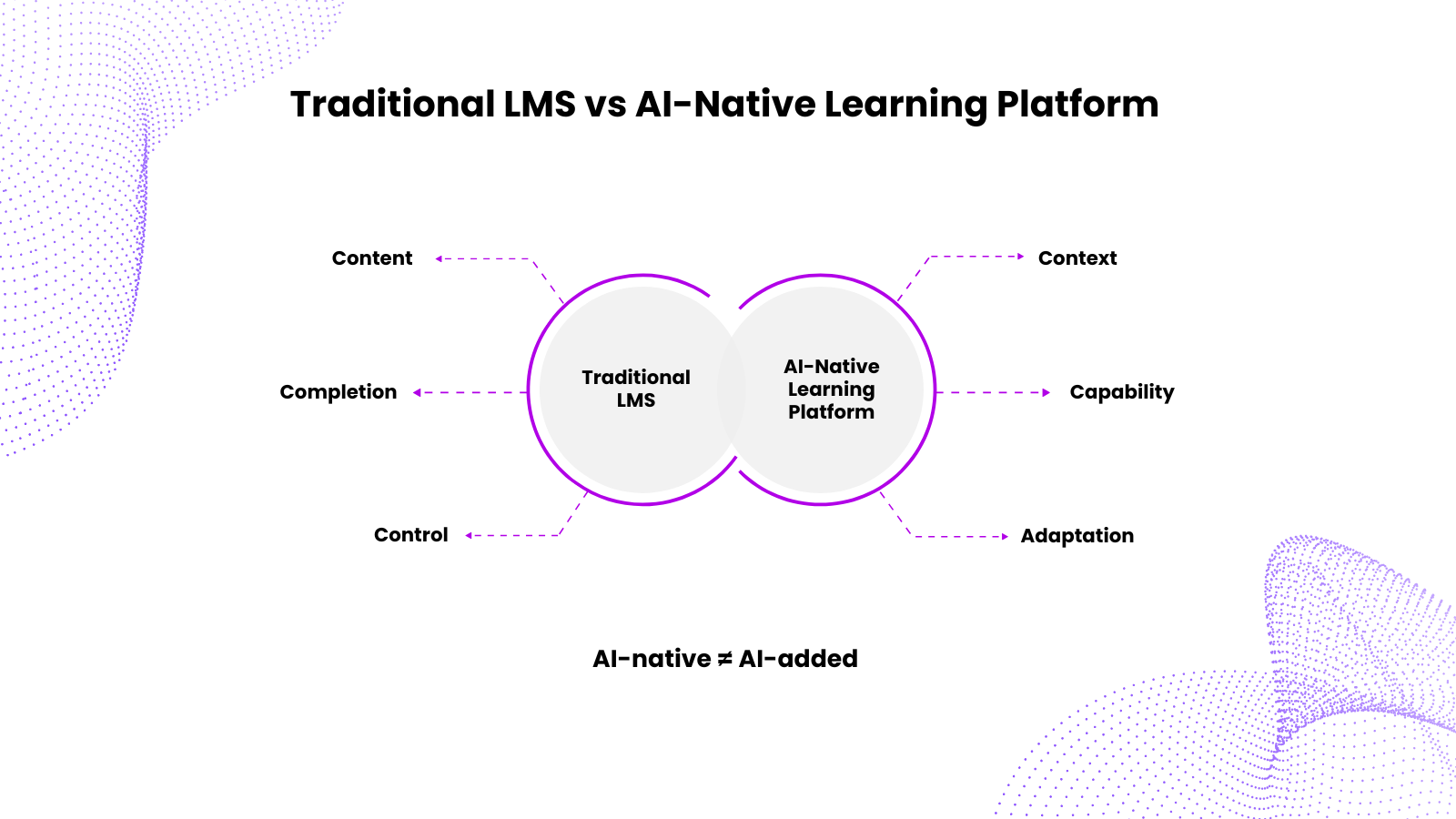
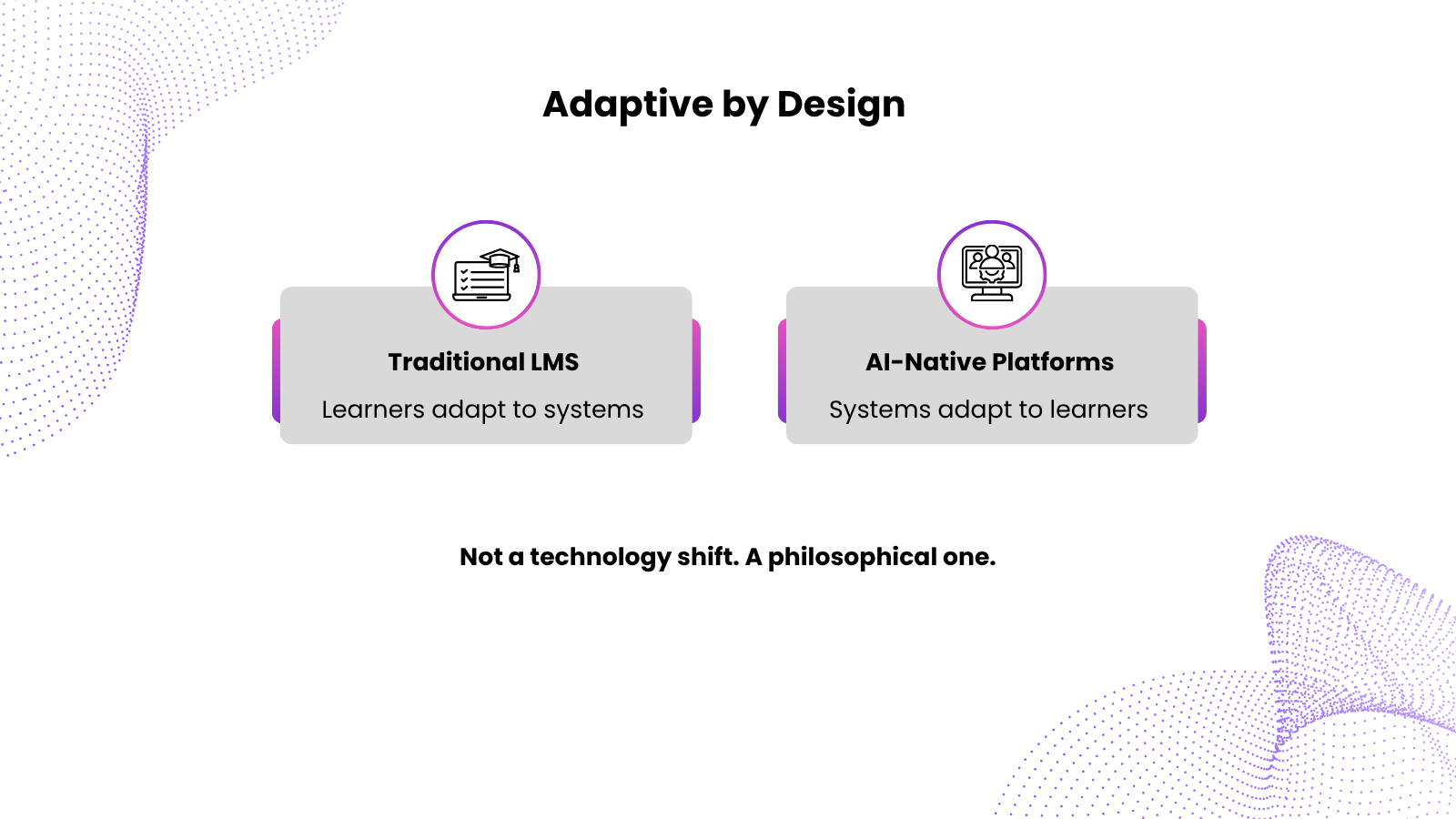
Despite the widespread availability of corporate learning, most workers forget what they have learned in a matter of weeks. Lack of content is not the problem. It’s the lack of science in the instruction of that subject. The way the human brain collects and stores information is ignored by traditional programs, which present static content. A new era is now beginning to emerge. Technology is not the only source of true transformation. It occurs when an AI-powered learning tool is paired with tried-and-true pedagogical frameworks to produce an intelligent, flexible, and efficient platform.

Why Existing Learning Is Inadequate

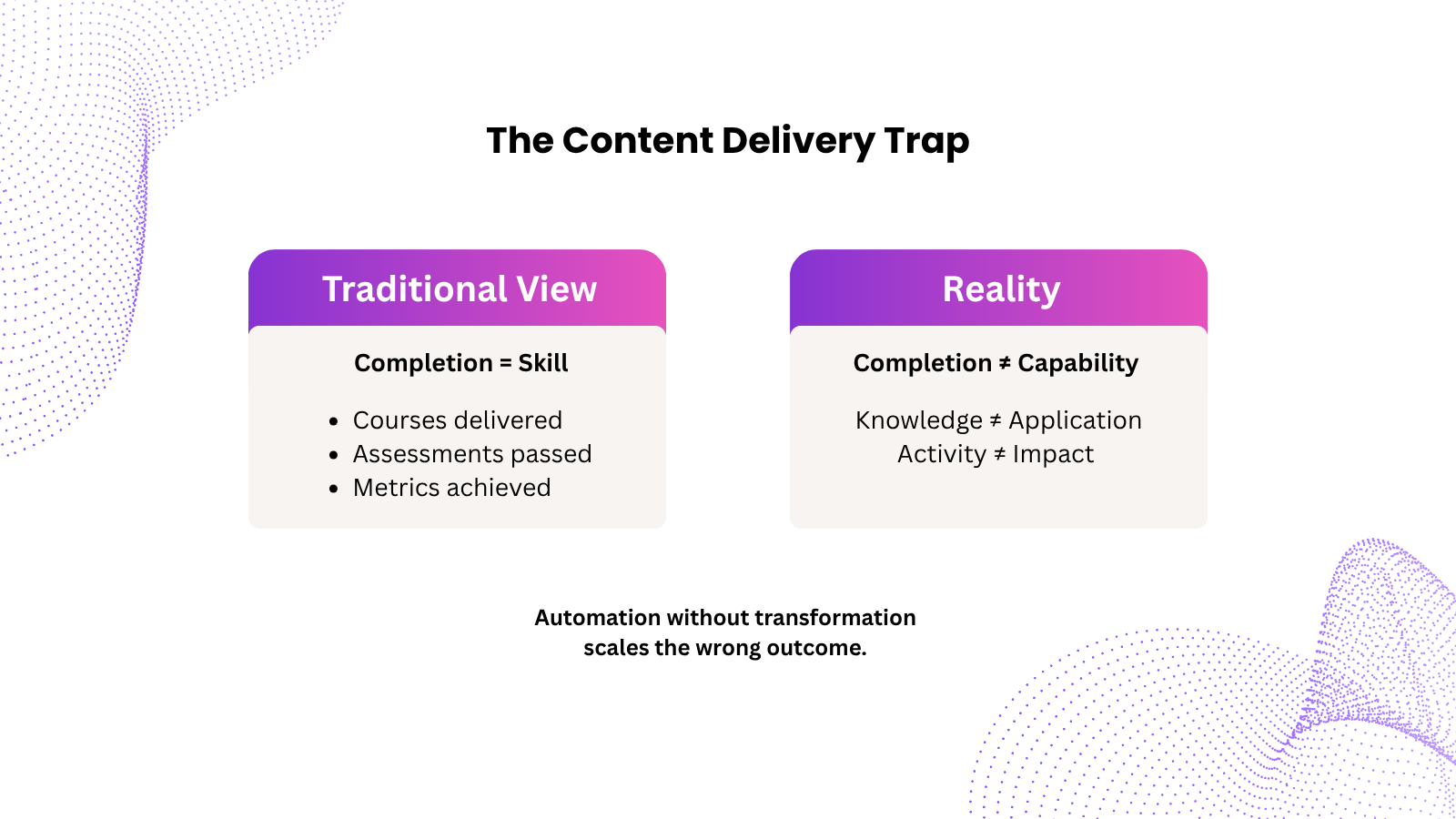
Most e-learning platforms use one-size-fits-all models. They convey information, but they don’t offer prompt reinforcement, adaptive navigation, or feedback. Employees finish learning without developing long-term skills as a result. 
In addition to wasting money, this lack of personalization irritates students. Organizations perceive little return on investment, and content distribution does not transfer into capability development in the absence of a data-driven learning strategy.

Pedagogy: The Science of Long-Term Learning

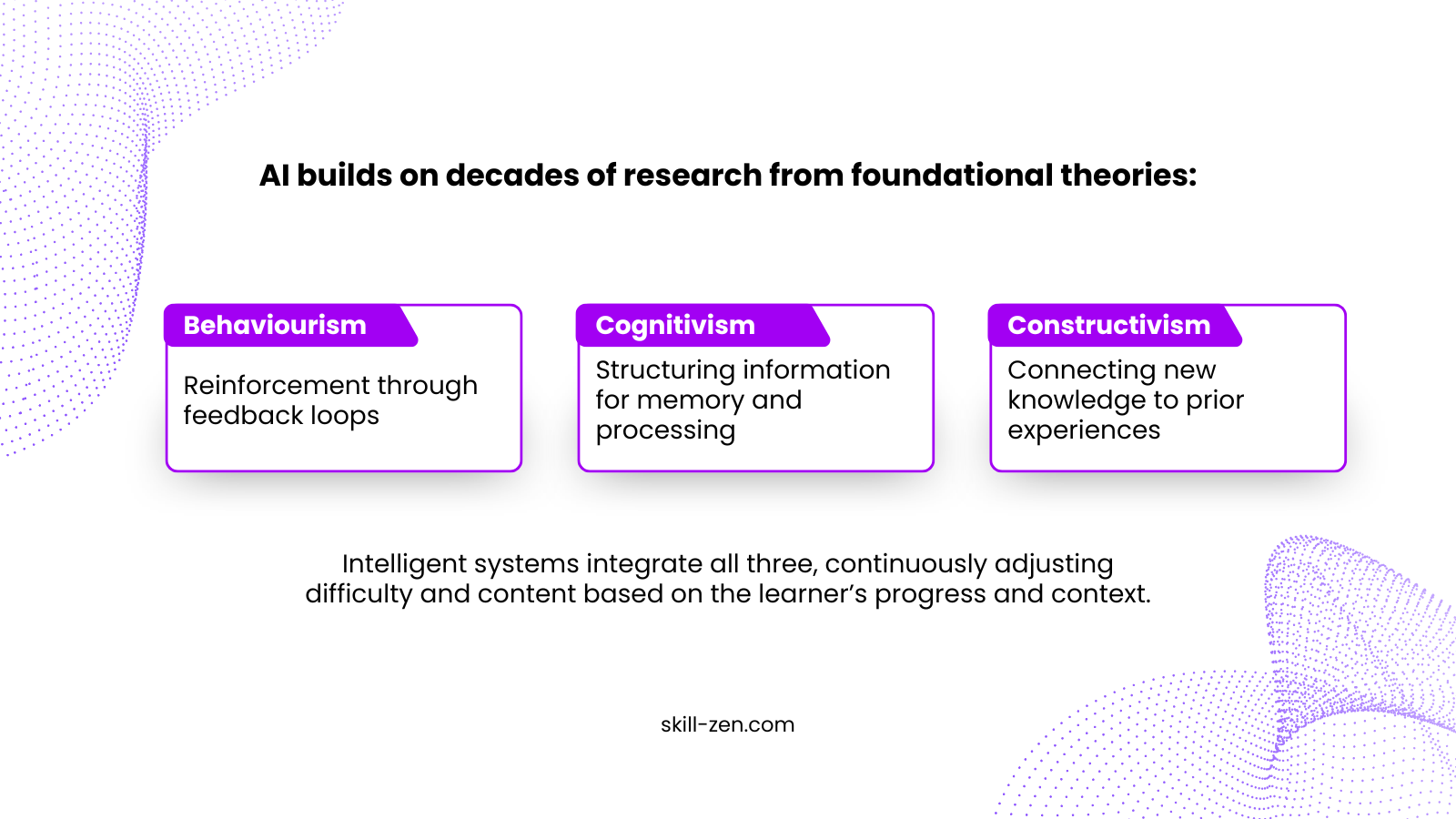
Effective learning is built on pedagogy. The design of the experience is more important than adding additional content. Proven techniques are highlighted by decades of research: By periodically reviewing important ideas, spaced repetition reverses the forgetting curve. According to Dual Coding Theory, combining text and images improves recall. Expert modelling and guided practice are key components of cognitive apprenticeship. By granting students autonomy, competence, and mastery, Self-Determination Theory increases motivation. These frameworks guarantee that information is applied, kept, and influential in the workplace.

Where Pedagogy and AI Collide

It takes effort and experience to design courses around pedagogy. Large volumes of information can be produced by generative AI alone, but speed without science runs the risk of creating “fast junk.” 
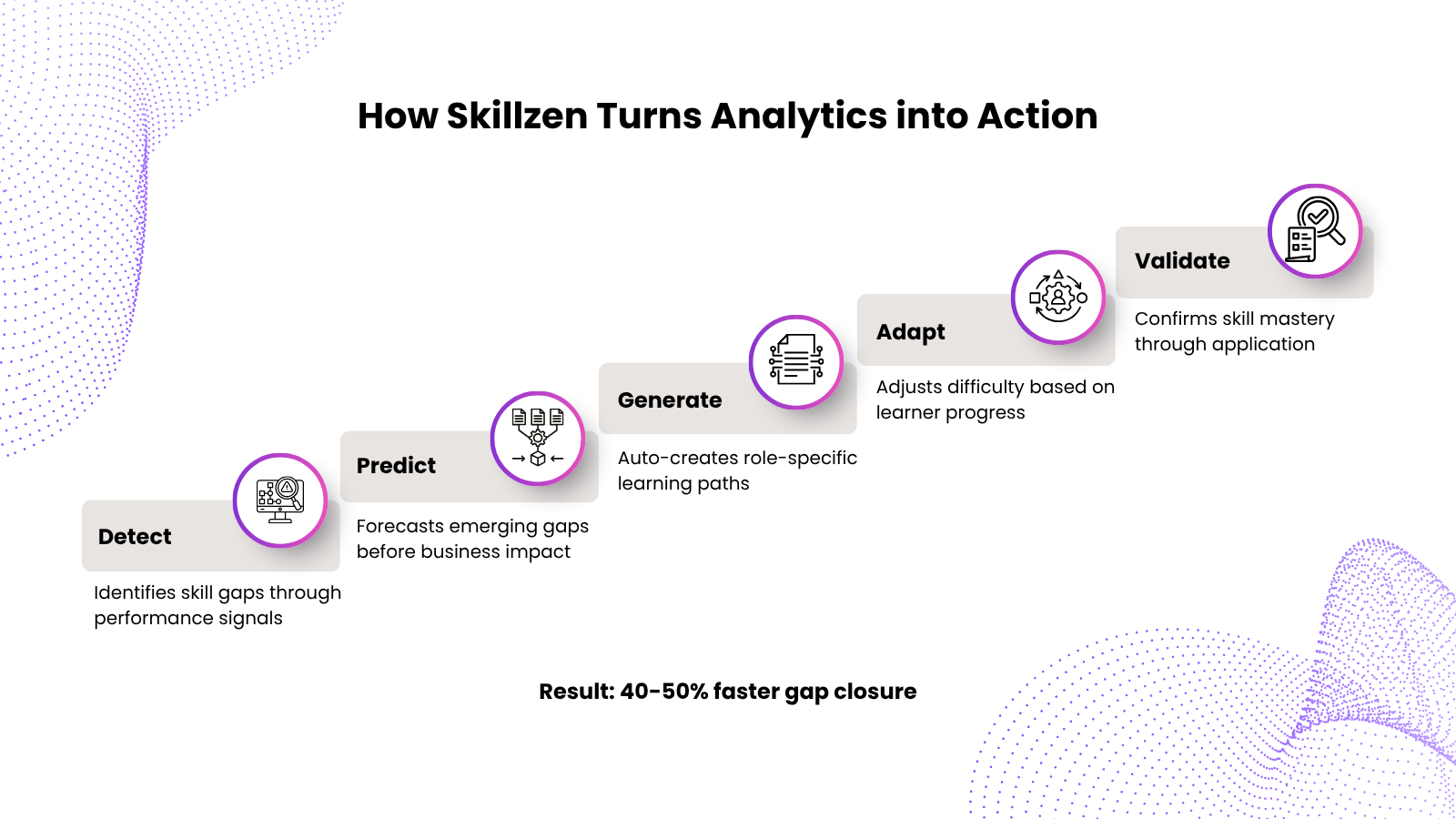
In order to address this, Skillzen integrates education with conversational, generative, and agentic AI. Together, they analyse knowledge bases or prompts, create customized courses in a matter of minutes, and organize modules utilizing dual coding and spaced repetition. Additionally, the platform creates case studies, simulations, and exams that are suited to jobs and competencies. 
Conversational AI, on the other hand, serves as a real-time coach by offering explanations and prodding’s that mimic cognitive apprenticeship on a large scale. By proactively assisting students in making decisions and dynamically adjusting to their requirements and behaviour, agentic AI goes one step further. 
As a result, real-time adaptive learning is produced, resulting in an AI learning tool that gauges actual capability progress rather than surface-level accomplishments.

AI's Changing Role in Education

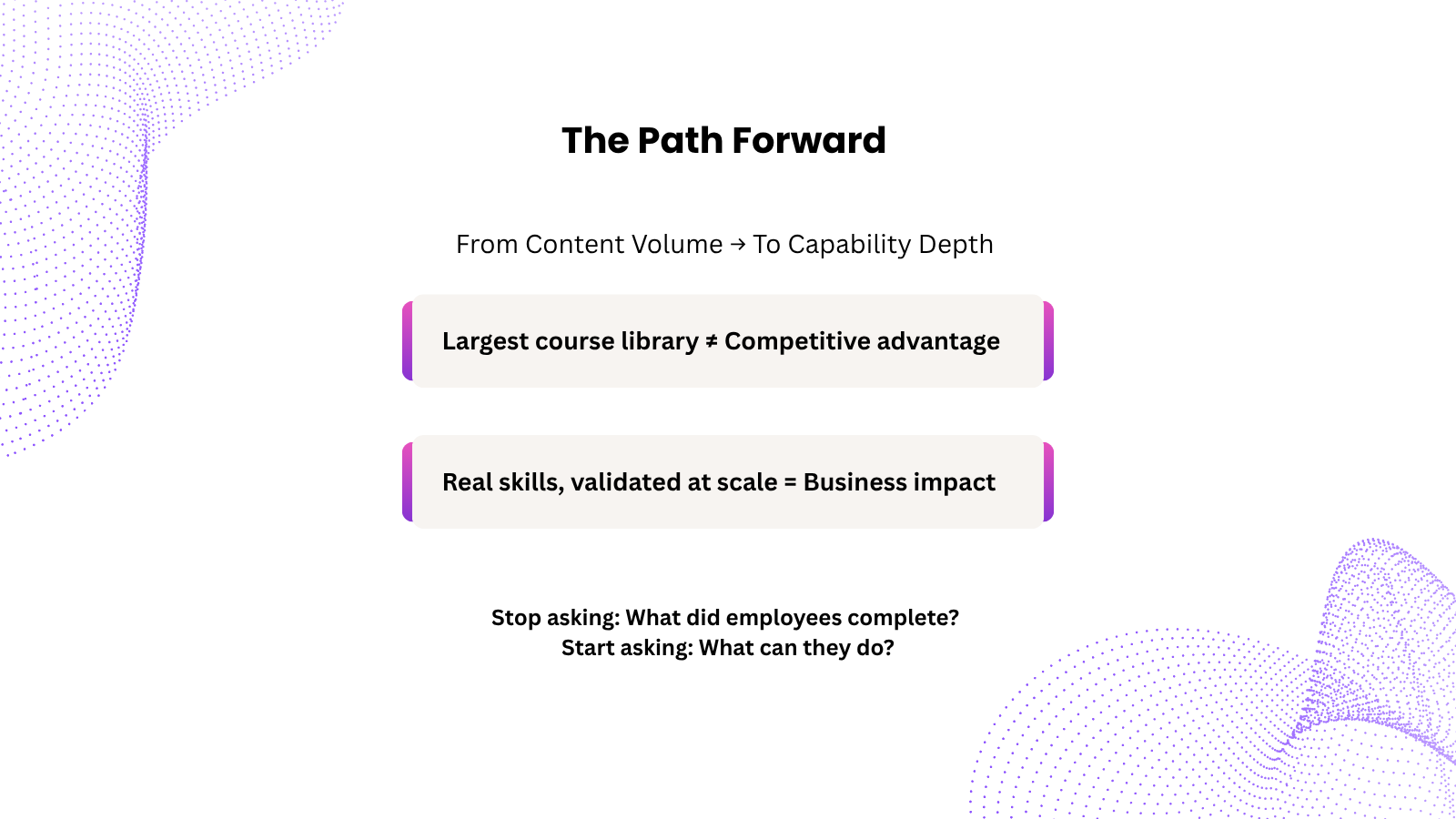
Where pedagogy and AI converge, the most potential developments in workplace learning take place. Scalable and efficient experiences can be created by directly integrating established learning science into AI systems. In the future, learning will not only be provided but also retained and implemented thanks to strategies like role-based adaptive learning pathways, improved interfaces that promote descriptive prompts, and smooth connection with current enterprise systems. 
 
The Roadmap for Smarter Learning Smart navigation is replacing larger content libraries in workplace learning. Trainers and organizations will be able to create role-specific, contextual courses in minutes with the support of the next generation of platforms, which will have adaptive learning paths, interactive simulations, multilingual access, and enhanced prompt design. A data-driven learning strategy will serve as the foundation for each stage of this evolution, guaranteeing that learning is quantifiable, tailored, and in line with actual capabilities.

The Prospects for Workplace Education

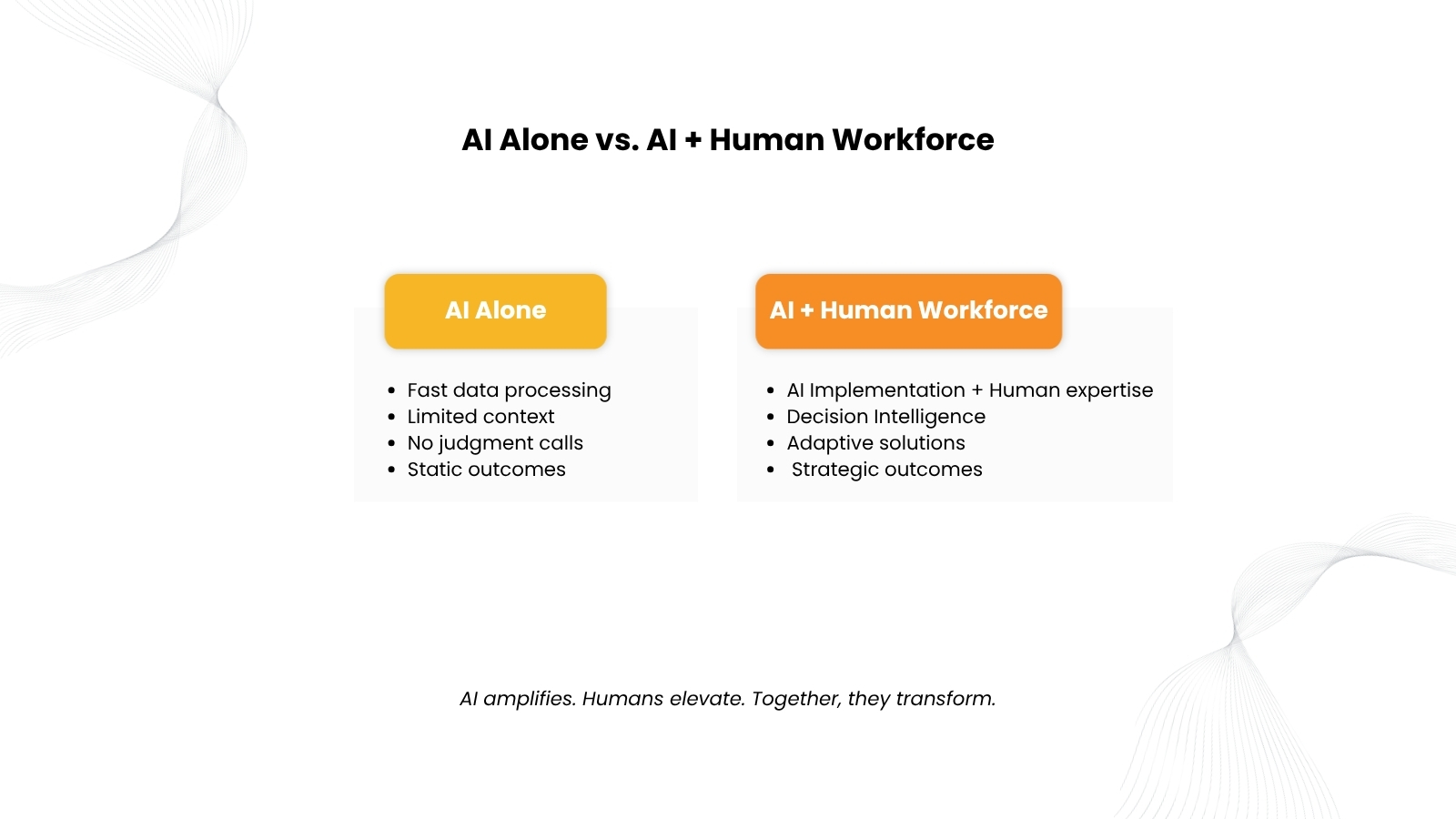
Solutions that combine AI with pedagogy will be the ones of the future. While AI alone can be quick but superficial, pedagogy alone can be rigorous but slow to scale. When Generative AI, Conversational AI, and Agentic AI collaborate to apply proven learning science at scale, that’s where the actual effect is found. This change will turn learning from static procedures into dynamic, interesting, and quantifiable learning experiences that benefit enterprises and people alike.

7 8

The Invisible Barrier to AI Success: Why Metadata Management Makes or Breaks Your AI Implementation 

The Invisible Barrier to AI Success: Why Metadata Management Makes or Breaks Your AI Implementation

The boardroom is buzzing, budgets are approved, vendors are selected, and pilots are running smoothly. For the first few weeks, everything feels like a step into the future. Leaders talk about transformation, teams finally get the resources they’ve asked for, and the organization feels ready for what’s next. 

Then, six months later, the momentum stalls. The model works, infrastructure is solid, and the team is capable, but somehow, the outcomes never match the promise. Exceptions pile up, and the AI that was supposed to speed up decisions quietly becomes another system that needs managing. 

What went wrong? It’s rarely the AI itself. The real issue lies beneath the surface, which is the absence of serious Metadata Management. Without it, even the most advanced AI Implementation is built on shaky ground. 

AI Doesn’t Fail at the Surface. It Struggles at the Foundation.

Most AI Implementation projects focus on the model, the algorithm, or the interface, but almost none prioritize the quality of the data feeding into the system and that’s where the problems begin. 

AI doesn’t think in documents. It thinks in structured, tagged, contextual data. When an AI system receives an untagged invoice with no vendor classification, no approval status, and no link to the relevant purchase order, it doesn’t know what to do with it. So, it guesses, flags it as an exception, or processes it incorrectly with complete confidence. 

Poor Metadata Management doesn’t just slow AI down, it teaches the system the wrong patterns. The more documents it processes without proper context, the more confidently wrong it becomes. 

The 3 Ways Poor Metadata Management Sabotages AI Implementation

  1. The Data Swamp

AI models are only as good as the data they’re trained on. Without Metadata Management, data becomes a disorganized, inconsistent, and unusable swamp. AI Implementation drowns in noise instead of learning from signal. 

  1. The Context Void

AI needs context to make sense of data. Without metadata to describe relationships, importance, and meaning, AI systems make decisions in a vacuum. The result? Errors, biases, and poor outcomes that erode trust. 

  1. The Scaling Wall

AI pilots often succeed in controlled environments, but 70% fail when scaling because the underlying Metadata Management can’t keep up. Without a system to organize, tag, and connect data at scale, AI Implementation hits a wall. 

The Bottom Line

Organizations that invest in Metadata Management don’t just improve their AI Implementation, but they future proof it. They ensure AI systems have the context, structure, and scalability to deliver real-world value. 

The invisible barrier to AI success isn’t the technology, it’s the lack of structure. The question is: Can your AI afford to ignore Metadata Management? 

Docxiq 2

The Hidden Costs of Unstructured Documents:Why Intelligent Document Processing (IDP) Matters More Than You Think

The Hidden Costs of Unstructured Documents: Why Intelligent Document Processing (IDP) Matters More Than You Think

One trend continued to emerge with unsettling consistency after working with firms in the fields of logistics, healthcare, and BFSI.
Despite teams investing in automation platforms, implementing new software, and digitizing their workflows, the same barrier persisted. Compliance officers were still reconstructing audit trails from the beginning, since no one had properly structured the records the first time. Analysts were still straining at fuzzy PDFs, and finance teams were still re-entering invoice data that already existed someplace else.
Most businesses pay this tax known as the Unstructured Data Tax without ever recognizing it.

Most of the companies we’ve dealt with already have document automation solutions, so that was not the issue. Without intelligence, automation only accelerates chaos, and when chaos accelerates, hidden costs do not decrease. They simply becoming more difficult to locate.

The Myth of the "Digital" Document

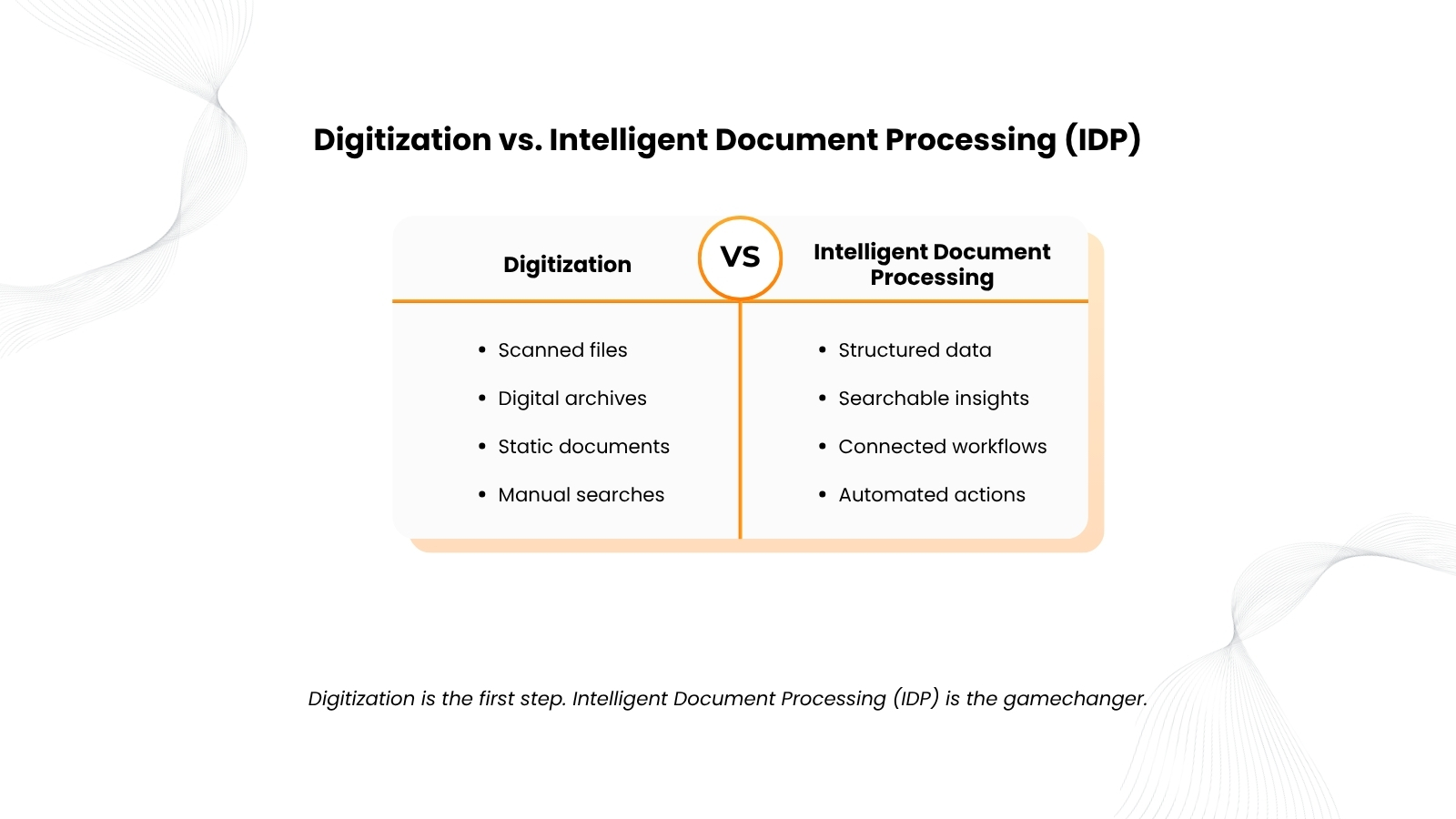
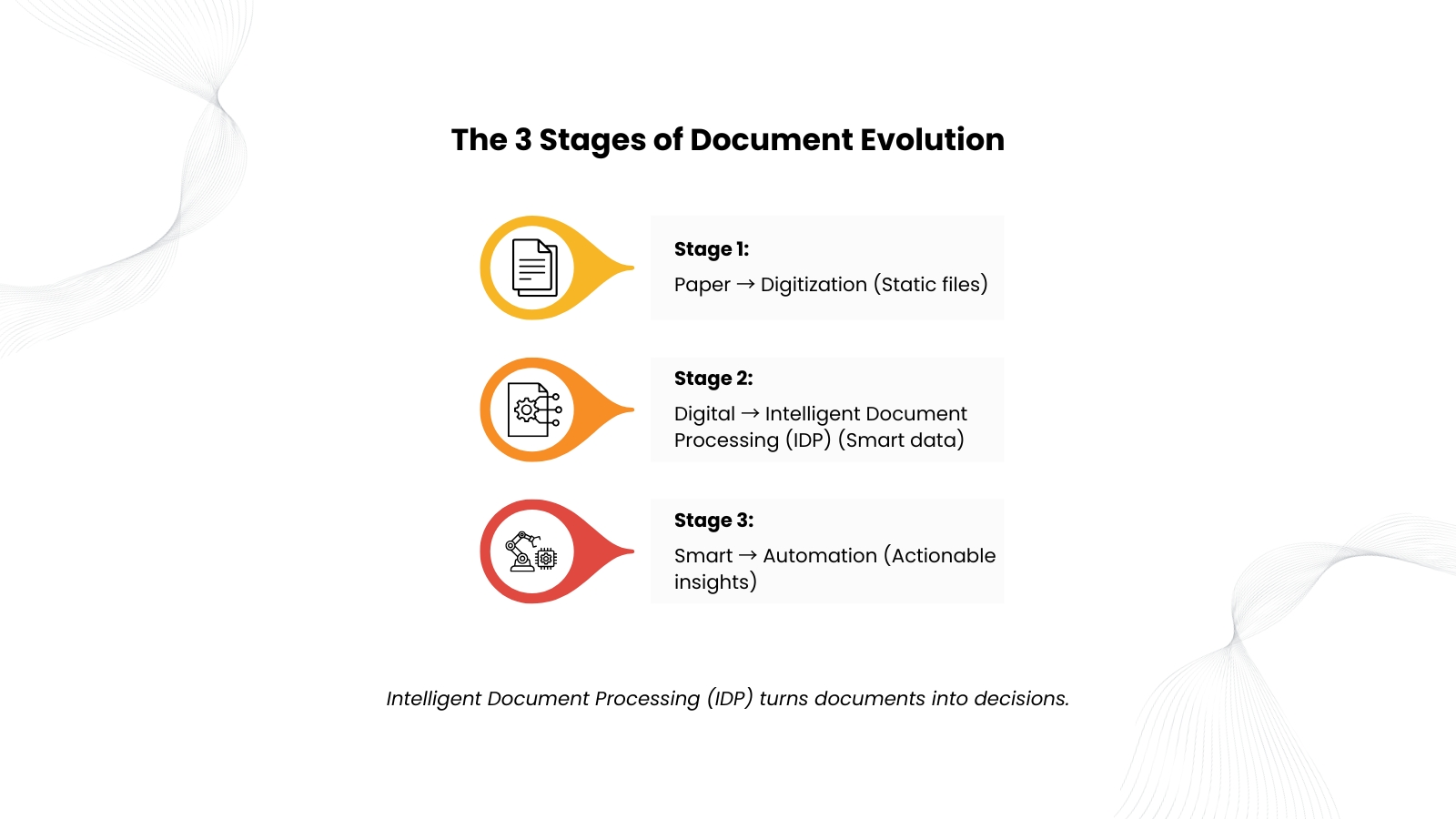
Having a PDF is not the same as having data. If a human still needs to open that file, read it, extract a number, and type it somewhere else, that document is Dark Data, which is unstructured, unindexed, and expensive. It is a 1990s paper problem wearing a digital costume.

Most organizations respond by adding headcount or deploying legacy OCR tools, but legacy tools recognize characters, not context. The moment an invoice arrives from a new vendor in a slightly different format, it becomes an exception, exceptions pile up, and the team that was supposed to benefit from Document Automation ends up managing its failures instead.

This is the Digital Plateau, where automation stalls at 60%, the remaining 40% becomes someone’s full-time job, and leadership wonders why the ROI never arrived.

The 3 Hidden Costs Nobody Puts on the Agenda

Cost 1: The Productivity Black Hole 

Employees spend up to 30% of their working day searching for information trapped inside unstructured files. Multiply that across an organization of 500 people and it stops being an inconvenience and becomes a strategic liability. Intelligent Document Processing (IDP) fixes this by making every document searchable, structured, and automatically routed to the right person the moment it arrives. 

Cost 2: The Error Multiplier 

Manual data entry carries an error rate of 1 to 3%, which sounds harmless until you trace a single wrong digit from an invoice through purchase order matching, ERP posting, and supplier reconciliation. One keystroke has now touched six systems and three teams. Document Automation driven by AI validates data against existing records before it ever reaches your systems, cutting the cascade off before it begins. 

Cost 3: The Compliance Time Bomb 

In regulated industries like BFSI, healthcare, and government, unstructured documents don’t just create friction; they create liability. When an auditor asks for every document tied to a specific vendor or transaction, “it’s somewhere in the shared drive” is not an answer. Intelligent Document Processing (IDP) builds audit trails automatically and ensures the organization is always ready, not just in the weeks before a scheduled review. 

Stop Paying the Tax and start Building Intelligence. 

The organizations winning in 2026 have stopped treating documents as administrative work and started treating them as data assets. Every invoice, every contract, every report carries intelligence inside it and leaving that intelligence unstructured is a choice that comes with a price tag, whether it appears on the balance sheet. 

Intelligent Document Processing (IDP) is not a technology upgrade, but a financial decision, and the math is straightforward. The question is no longer whether your organization can afford to implement it. The question is how much longer you can afford to keep paying the tax without it. 

DocxIQ doesn’t just process your documents, it liberates your data. 

Skillzen blog banner - 26-27

AI Is the GPS Your Learning Approach Requires 

AI Is the GPS Your Learning Approach Requires

An employee accesses a learning module, and after ten minutes, they are clicking away, bored, and perplexed. They have the desire to learn but lack proper guidance from the course. Imagine not having a GPS when traveling in a new city. You make mistakes, squander time, and ultimately give up. Nowadays, most learning feels like that. What if AI tools for learning and development could direct workers with the same clarity and accuracy as GPS? 

Lost Learners: The Issue of Dropout

Employee engagement is a problem for employee training initiatives, and because the courses are lengthy, irrelevant, and generic, completion rates are poor. Learners are unaware of their progress or how the material relates to their position, and therefore become disoriented and distracted in the absence of prompt feedback or flexibility.  
Organizations incur significant costs due to this “lost learner” issue. Critical skills are not acquired by employees, compliance deadlines are missed, and training expenditures yield a poor return on investment. Employees give up when the route is unclear, much like drivers without GPS, underscoring the necessity of a data-driven learning approach. 

Why Conventional Learning Is Inadequate

The purpose of traditional eLearning systems was not to provide guidance but were intended to convey information. 
Content becomes outdated quickly and is stagnant.  
 
Different responsibilities and learning speeds are ignored by inflexible learning routes, and completions, not real skill improvement, are used to measure progress.  
Weeks of human labour are needed for updates.  
The outcome? Learners struggle with unrelated material, lose interest, and are unable to put what they have learned into practice. In the digital age, it’s like giving someone a paper mapthough technically feasible, it is frustrating when compared to contemporary AI learning and development tools.

Introducing the GPS: How AI Improves Education

This is where conversational AI and generative AI make a big difference. 
In just a few minutes, generative AI creates individualized learning routes. The modules are customized based on employment roles, existing skills, and knowledge gaps. Instantaneous creation of compliance, onboarding, or leadership learning is possible, and it can be automatically updated when policies change.  
 
Real-time guidance is provided via conversational AI. In the middle of the lecture, learners can ask questions, obtain advice, or be prodded back on course. It functions as an on-demand personal coach.  
When combined, dynamic rerouting, adaptive checkpoints, and continuous feedback replicate the GPS experience. Students are continually aware of their current position, progress, and next steps. The result? Stronger outcomes, reduced dropout rates, and more engagement are all made possible via a data-driven learning approach.

Skillzen: The Enterprise Learning GPS

By directly integrating conversational and generative AI into workplace training, Skillzen advances this idea. 

 
Instant course creation: Skillzen creates customized, role-specific learning experiences in a matter of minutes once you upload policies, internal documents, training materials, and prompts.  
 
Conversational guidance: Students engage in genuine dialogue, posing queries and instantly receiving customized answers.  

 
Supported by science: Skillzen ensures that training goes beyond knowledge transfer to long-term application by integrating Pedagogical Frameworks of Learning with models like Spaced Repetition and Dual Coding. 
 
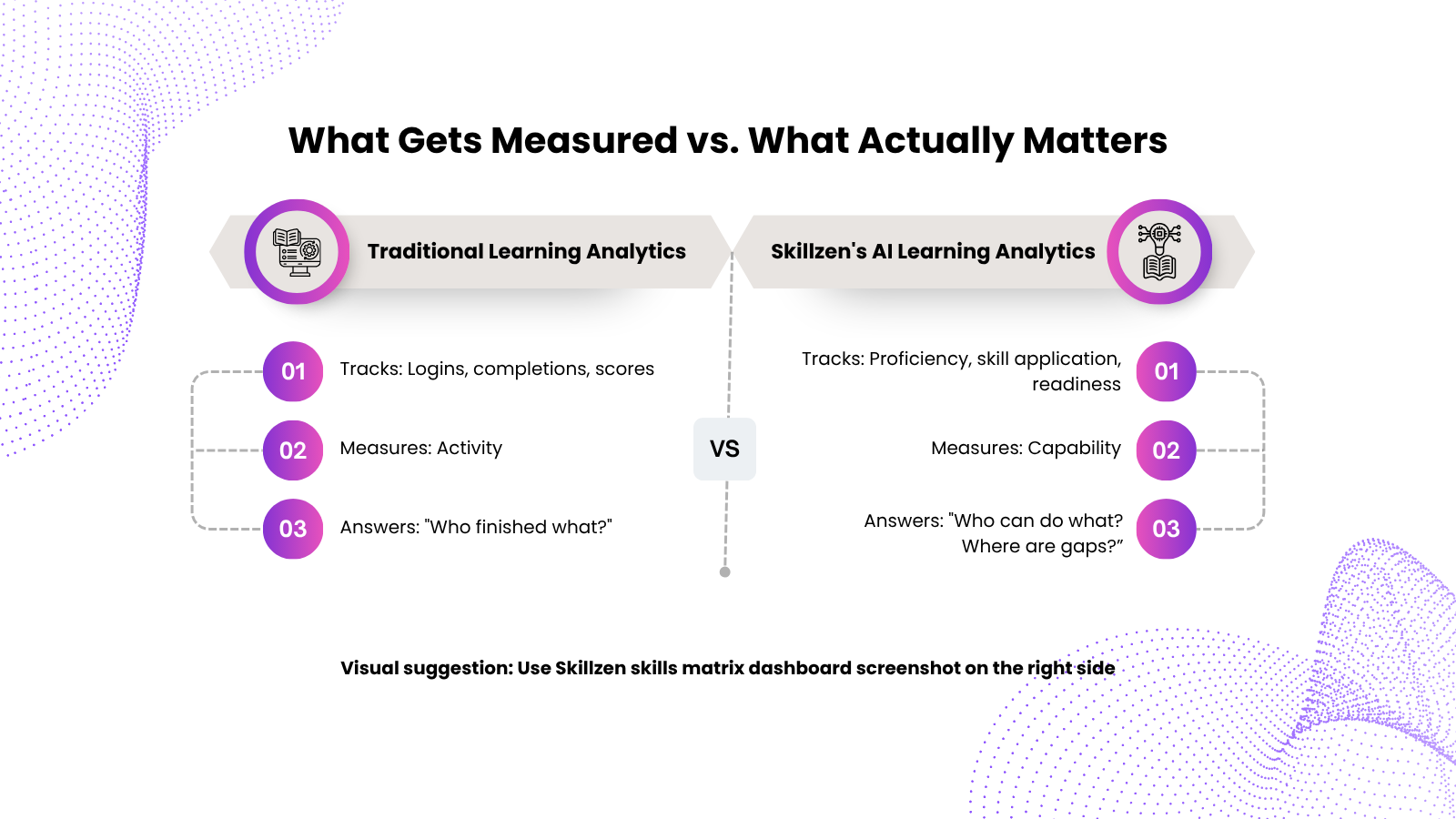
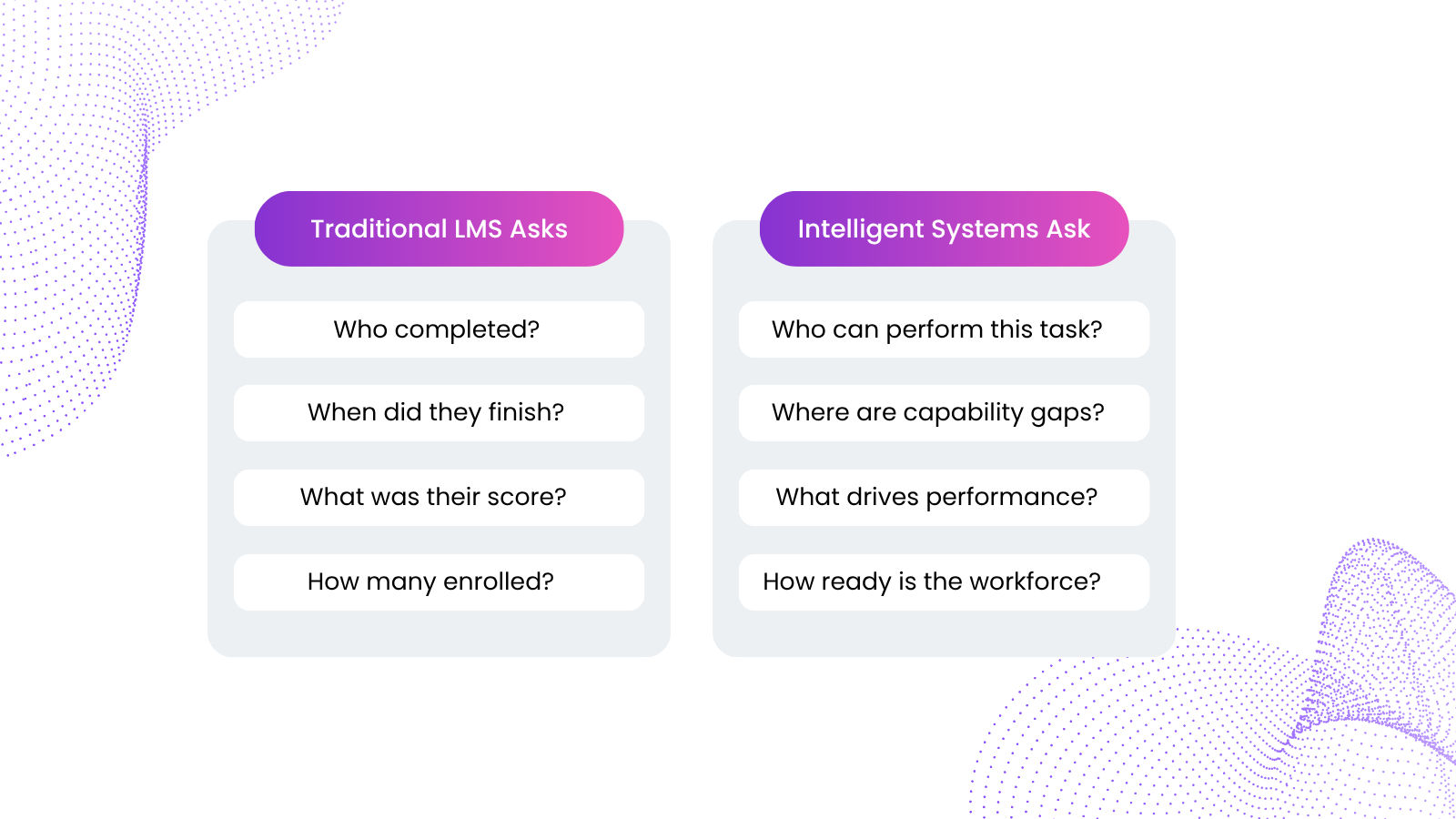
Enterprise-ready: It provides analytics that track actual capability growth rather than just completions, connects with LMS/HRMS systems, and supports many languages. 

Skillzen offers AI learning and development tools that are intended to increase engagement and have a positive commercial impact for companies seeking scalable, intelligent learning.  
 
The Product Roadmap: More intelligent navigation will be more important for enterprise learning in the future than larger libraries. In order to make training more intelligent, accessible, and effective, the roadmap will incorporate new features, new learning formats, increased language support, an enhanced UI/UX for effective prompt writing, personalized learning paths, and the creation of custom courses with stage progression using a data-driven learning approach. 
 
 
Don’t let your learners get lost. Like GPS for learning, learning becomes directed, adaptive, and efficient with the use of generative AI, conversational AI, and contemporary AI tools in learning and development. 

See how a data-driven learning approach can turn your company’s training into a customized, quantifiable, and captivating experience by scheduling a free Skillzen demo now. 

AI As the GPS Your Learning Approach Requires

By directly integrating conversational and generative AI into workplace training, Skillzen advances this idea. 

Instant course creation: Skillzen creates customized, role-specific learning experiences in a matter of minutes once you upload policies, internal documents, training materials, and prompts.  

Conversational guidance: Students engage in genuine dialogue, posing queries and instantly receiving customized answers.  

Supported by science: Skillzen ensures that training goes beyond knowledge transfer to long-term application by integrating Pedagogical Frameworks of Learning with models like Spaced Repetition and Dual Coding. 

Enterprise-ready: It provides analytics that track actual capability growth rather than just completions, connects with LMS/HRMS systems, and supports many languages. 

Skillzen offers AI learning and development tools that are intended to increase engagement and have a positive commercial impact for companies seeking scalable, intelligent learning.  

The Product Roadmap: More intelligent navigation will be more important for enterprise learning in the future than larger libraries. In order to make training more intelligent, accessible, and effective, the roadmap will incorporate new features, new learning formats, increased language support, an enhanced UI/UX for effective prompt writing, personalized learning paths, and the creation of custom courses with stage progression using a data-driven learning approach. 

Don’t let your learners get lost. Like GPS for learning, learning becomes directed, adaptive, and efficient with the use of generative AI, conversational AI, and contemporary AI tools in learning and development. 

See how a data-driven learning approach can turn your company’s training into a customized, quantifiable, and captivating experience by scheduling a free Skillzen demo now. 

AI As the GPS Your Learning Approach Requires

An employee accesses a learning module and after ten minutes starts clicking away, bored and perplexed, where they have the desire to learn but the course provides no proper guidance. It’s like traveling in a new city without GPS where you make mistakes, waste time, and eventually give up. 

Most learning today feels exactly like that, so what if AI tools for learning and development could direct workers with the same clarity and accuracy as GPS? 

The Lost Learner Problem: Why Dropout Happens

Employee engagement struggles in training initiatives because courses are lengthy, irrelevant, and generic, leading to poor completion rates where learners become disoriented and distracted when they can’t see their progress, understand how material relates to their role, or receive prompt feedback. 

This “lost learner” problem costs organizations significantly because employees fail to acquire critical skills, compliance deadlines get missed, and training expenditures yield poor ROI, where employees give up when the route stays unclear, much like drivers without GPS, highlighting the necessity of a data-driven learning approach. 

Why Conventional Learning Falls Short

Traditional eLearning systems were built to convey information rather than provide guidance, where content becomes outdated quickly and stays stagnant, inflexible learning paths ignore different roles and learning speeds, progress gets measured by completions rather than skill improvement, and updates require weeks of manual work. 

The outcome: learners struggle with unrelated material, lose interest, and can’t apply what they learned like giving someone a paper map in the digital age where it’s technically functional but frustrating compared to modern AI learning and development tools. 

How AI Transforms Learning: The GPS Solution

Conversational AI and generative AI create the difference here. 

Generative AI builds personalized learning routes in minutes where modules get customized based on job roles, existing skills, and knowledge gaps, compliance or leadership learning gets created instantly, and content updates automatically when policies change. 

Conversational AI provides real-time guidance where learners ask questions mid-lecture, get immediate advice, or receive prompts to stay on course functioning as an on-demand personal coach. 

Together, they create dynamic rerouting, adaptive checkpoints, and continuous feedback that replicate the GPS experience where students stay aware of their current position, progress, and next steps leading to stronger outcomes, reduced dropout rates, and higher engagement through a data-driven learning approach. 

Skillzen: The Enterprise Learning GPS

Skillzen advances this concept by integrating conversational and generative AI directly into workplace training. 

Instant course creation: Upload policies, internal documents, or training materials and Skillzen creates customized, role-specific learning experiences in minutes. 

Conversational guidance: Students engage in genuine dialogue, pose questions, and receive customized answers instantly. 

Science-backed design: Skillzen integrates Pedagogical Frameworks with models like Spaced Repetition and Dual Coding to ensure training moves beyond knowledge transfer into long-term application. 

Enterprise-ready infrastructure: The platform connects with LMS/HRMS systems, supports multiple languages, and provides analytics that track actual capability growth rather than just completions. 

Skillzen delivers AI learning and development tools designed to increase engagement and drive measurable commercial impact for companies seeking scalable, intelligent learning. 

The Product Roadmap: Smarter Navigation Ahead

Enterprise learning’s future prioritizes intelligent navigation over larger libraries, where the roadmap incorporates new features, expanded learning formats, increased language support, enhanced UI/UX for effective prompt writing, personalized learning paths, and custom courses with stage progression using a data-driven learning approach. 

Make Learning Directed, Adaptive, and Efficient

Like GPS for travel, generative AI, conversational AI, and modern AI tools in learning and development make learning directed, adaptive, and efficient. 

Schedule a free Skillzen demo to see how a data-driven learning approach can transform your company’s training into a personalized, measurable, and engaging experience. 

Scifi Blog banner

The Rise of the “AI Librarian”: How Metadata is the Secret to Scalable Intelligence 

The Rise of the "AI Librarian": How Metadata is the Secret to Scalable Intelligence

Every organization today is investing in AI. New automation tools get deployed, workflows get digitized, dashboards multiply, and for a while everything looks like progress. Document processing numbers go up, teams feel more “digital,” and leaders nod approvingly at the activity reports. 

Then six months pass, and something uncomfortable becomes clear. 

Employees still waste hours hunting for a single clause buried in a PDF, decisions still rely on manual checks, and managers have quietly gone back to prioritizing delivery over organization. The company is processing more documents than ever, yet it hasn’t become any smarter. 

Here’s why: most Metadata Management initiatives are built like campaigns, not systems. They generate noise, activity, and the feeling of progress, without ever building Scalable Intelligence. 

The Real Problem Is Context, Not Documents

Think about a traditional library. Thousands of books, beautifully shelved, with no catalogue, no tags, and no index. All that knowledge just sits there, locked and useless. That’s exactly how most organizations treat their documents today. 

Invoices, contracts, reports, and emails exist somewhere, but the meaning inside them is scattered. Without Metadata Management, documents become digital clutter, and clutter does not scale. 

This is where the AI Librarian enters, not as a person, but as a capability that reads every document, understands its context, and attaches invisible tags describing what it is, what it contains, and why it matters. “Who approved this? What’s the risk level? Is it compliant?”, when these questions go unanswered, automation becomes very expensive. 

The 3 Systems That Turn Activity into Scalable Intelligence

System 1: The Metadata Visibility System 

Most companies track what documents were processed, but almost none track what insights were gained. A Metadata Management visibility system changes the question entirely, from “How many invoices did we process?” to “Where are the gaps, and where do we intervene before a risk becomes a cost?” 

System 2: The Workflow Reinforcement System 

Most AI initiatives treat intelligence as a one-time event: deploy, extract, move on. In that gap, the data fades before it influences a single decision. Durable Scalable Intelligence requires the AI Librarian to live inside the workflow by tagging documents, linking records, routing to the right approver, and learning from every correction. That’s AI as the backbone of work, not a bolt-on. 

System 3: The Manager Accountability System 

No document intelligence culture survives if managers are spectators. IT owns the automation, managers own the output, and that gap is exactly where Scalable Intelligence gets lost. A managers accountability system makes intelligence-building a leadership expectation with visibility into data quality and accountability for how knowledge gets used. Real in daily decisions, not quarterly reviews.

Intelligence Is What You Build, Not What You Launch

The organizations winning in the age of AI aren’t the ones with the most tools. They’re the ones that have built the most infrastructure treating Metadata Management as a strategic asset, embedding the AI Librarian as a foundation rather than a feature, and holding leaders accountable for outcomes, not outputs. 

People don’t need more tools. They need environments that help them turn information into action. A true document intelligence culture isn’t defined by how many documents you process. It’s defined by how much smarter your organization becomes with every single one of them. 

2151887049

From Patchy to Powerful: Building a Cohesive Hybrid Cloud Strategy

Simplify IT Compliance and Regulatory Audit with COMPLYment

COMPLYment reimagines compliance management by merging advanced tracking capabilities with a sleek, intuitive interface. Our enterprise-grade solution ensures impeccable adherence to regulatory standards, significantly reducing risks and enhancing operational agility. COMPLYment provides flexibility for managing and tracking the necessary compliances as per various standards like PCI, ISO, HIPAA, SEBI, SAMA, GDPR, NIST, etc. It facilitates the simplification of the gap analysis process and required mitigation, to attain the desired compliance level for organizations. The structured approach of COMPLYment increases overall process efficiencies for the organization.

Skillmine COMPLYment - Product Brochure v3.pdf-image-005

Why COMPLYment?

  • Enhanced Visibility: Experience real-time compliance tracking across all operations, guaranteeing continuous adherence to industry standards and regulations.
  • Advanced Analytics: Effortlessly generate comprehensive, accurate compliance reports with the most telling metrics and dynamic charts.
  • Risk Management: Proactively identify, evaluate, and mitigate risks with our sophisticated risk management toolkit. Offers central repository of regulations and controls, e.g. ISO 27001, ISO 20000, PCI DSS, GDPR, SEBI, SAMA, RBI, CMMC DoD, NIST, CSF, IRDAI, VDA, NESAS
  • Streamline Your Audit: Maintain extensive, detailed audit trails, ensuring transparency and accountability throughout all compliance-related activities.


COMPLYment is engineered to transform your compliance management landscape with its sophisticated tracking and reporting capabilities. Ensure regulatory adherence and proactively mitigate risks with our state-of-the-art compliance solution.

Simplify, Streamline & Automate IT & GRC Workflow with COMPLYment!

18102

Scaling AI-Enabled Systems Without Losing Control

Experience world class security with Authenticator

Say goodbye to password fatigue and hello to seamless security with Auth. We blend top-tier security with a smooth user experience. Auth is engineered to augment your security posture by integrating advanced SSO (Single Sign-On) and MFA (Multi-Factor Authentication) capabilities. Experience unparalleled access control and compliance with our cutting-edge IDAM solution.

Auth is a Unified Authentication Platform that centralizes access management across an enterprise, simplifying security with support for OAUTH2, OpenID Connect, SAML, AD, LDAP, and various login methods including password-less and social logins. It ensures robust security through protocols for authentication, messaging, and Captcha, and offers KYC verification and API Proxy capabilities. Auth integrates multi-factor authentication and security protocols, enhancing both operational efficiency and user experience while safeguarding access to critical applications.

image

Solutions Offered

Icon

Single Sign-On (SSO) Integration:

This feature facilitates seamless access for employees to various applications using a single set of credentials, reducing the complexity of remembering multiple passwords.


Icon

Modern Authentication Protocols:

Skillmine Auth uses all the modern authentication protocols including OAuth2, OpenID Connect, SAML 2.0, AD, & LDAP with enhanced security while maintaining user convenience.

Icon

Real-Time User Synchronization:

Auth synchronizes user data across platforms in real-time, the solution ensures data integrity and reduces administrative overhead.


Icon

Multi-Factor Authentication (MFA):

A robust MFA setup, incorporating OTPs (Mobile & Email, TOTP) facial recognition, FIDO (fingerprint, IVR, face recognition) significantly enhancing security measures against unauthorized access.

Icon

KYC and API Proxy:

This lets you streamline communication by providing an interface that offers simpler options.


Icon

ABAC & RBAC Access Controls:

Organize access around predefined roles. Implement hashed passwords, blacklist compromised ones, strong policies, multi-factor auth, real-time checks, user education, and activity monitoring based on assigned roles.

Icon

Fraud Detection:

This includes robust verification, multi-factor authentication, behavior analysis, anomaly detection, device recognition, geolocation verification, continuous monitoring, and prevention of unauthorized access and identity theft.


Icon

Workflow Optimization for Onboarding, Deboarding and Permissions:

Streamlining the workflows for onboarding & deboarding (provisioning & deprovisioning) new users and managing internal permissions, significantly improving operational efficiency and user management.

Icon

Breached Password Usage Prevention:

Prevent unauthorized access: hash passwords, blacklist compromised passwords, strong policies, multi-factor authentication, real-time checks, user education, and activity monitoring.

All Users, All Apps, All Devices, Just One Authenticator! 

Banner-Image

DataV

Visualize Business Growth With DataV

DataV: Visualize and Realize the True Potential of Your Business

  • Unlock the Power of Your Data with Ease: Transform complex data into clear, actionable insights with Data V. Our platform simplifies analysis and visualization, empowering you to make informed, faster decisions with confidence.

  • Spot Trends, Drive Success: Data V uncovers hidden opportunities and areas for improvement by analyzing customer behavior, optimizing product placement, and predicting sales trends. Make data-driven decisions that boost your business performance.

  • Explore Data Like Never Before: Dive deep into your data with Data V's interactive visualizations. Reduce noise, correlate insights from multiple sources, and explore creative patterns that give you a broader and clearer view of your business landscape.

Implementation Workflow

Implementation Workflow

Research Icon

Research

Leverage domain knowledge to identify relevant data sources and extract key data points.

Design Icon

Design

Analyze data, collaborate with client, and design target dashboards.

Implement Icon

Implement

Planned implementation of solution deployment in phases.

Measure Icon

Measure

Analyze data, visualize information, record feedback, and refine with iterations.

Optimize Icon

Optimize

Optimize final dashboards and deliver solution.

Benefits to Your Business

Data Synthesis

Unlock deeper insights with tools that are easy to use and powerful in performance.

Customised Dashboards

Create dashboards that are as dynamic as your data, tailored to fit your specific needs.

Live Data Feeds

Stay updated with real-time data processing for the most current insights.

Smooth Integration

Connect effortlessly with your existing systems to build a seamless data environment.

Data V makes data analysis effortless and insightful. Turn your data into actionable insights and make smart decisions quickly!

Transform your Data with Data V - Your Key to Clear Insights!

2149160929

LOQ

Experience the LOQ Difference - Never Let a Lead Go Cold Again

2149160929

LOQ: Your Path to Smarter Sales

Introducing LOQ, the next-generation CRM tool that takes sales management to the next level by automating lead nurturing, streamlining sales data handling, and offering a highly configurable, end-to-end sales workflow. Designed with efficiency in mind, LOQ empowers your sales team to save valuable time, eliminate repetitive tasks, and focus on the most important aspect of their job – closing deals. With LOQ, you can supercharge your sales operations and enhance productivity like never before.

Revitalize your sales pipeline effortlessly with LOQ’s advanced automated follow-up assistant, ensuring that no lead is left unattended and every opportunity is maximized to its fullest potential – all without the need for manual intervention. LOQ’s intuitive features ensure that each stage of the sales process is optimized for success, from initial contact to final conversion. Experience the future of customer relationship management with LOQ, where automation meets precision, and watch your sales figures soar to new heights as your team works smarter, not harder.

Why will your Sales team love LOQ?

Turn Idle Leads into Active Opportunities
Your Automated Follow-Up Assistant

Imagine a CRM that doesn’t let valuable leads slip through the cracks. With LOQ, your sales team must no longer worry about inactive leads sitting idle. Our intelligent automation ensures consistent follow-ups, breathing new life into dormant opportunities without any manual intervention.

Effortless Automation

Say goodbye to manual tasks with LOQ’s powerful automation features. Automatically nurture leads, follow up on opportunities, and stay engaged with clients seamlessly.

Simplified Data Management

Experience the ease of managing sales data with minimal steps. LOQ’s intuitive interface makes data entry and tracking a breeze, reducing administrative workload.

Configurable End-to-End Sales Workflow

Customize your sales process to fit your unique needs. LOQ offers a fully configurable workflow that adapts to your business, ensuring every step is optimized for success.

Time-Saving Efficiency

With LOQ, your sales team can focus on selling, not admin tasks. Streamlined processes and automation free up valuable time, boosting productivity and closing more deals.

Your Path to Smarter Sales - Never Let a Lead Go Cold Again!