Last year, your L&D team made an investment in a new learning platform. Courses are being taught, workers are signing in, and the boxes for compliance are checked. However, you are unable to confidently respond when leadership inquiries about worker preparedness for the impending change.The reason is that the infrastructure you’re using isn’tappropriate for the issue you’reattempting to resolve. Three distinct categories now comprise the landscape of learning technology. Conventional LMS systems monitor compliance and manage material. AI-powered learning management systems automate the production of courses and customize their delivery. Instead of only delivering courses, LXP systems completely change the paradigm to build capability. It’s not about features to choose which one your company requires. It has to do with your goals.
The Functions of Conventional LMS Platforms (and Where They End)
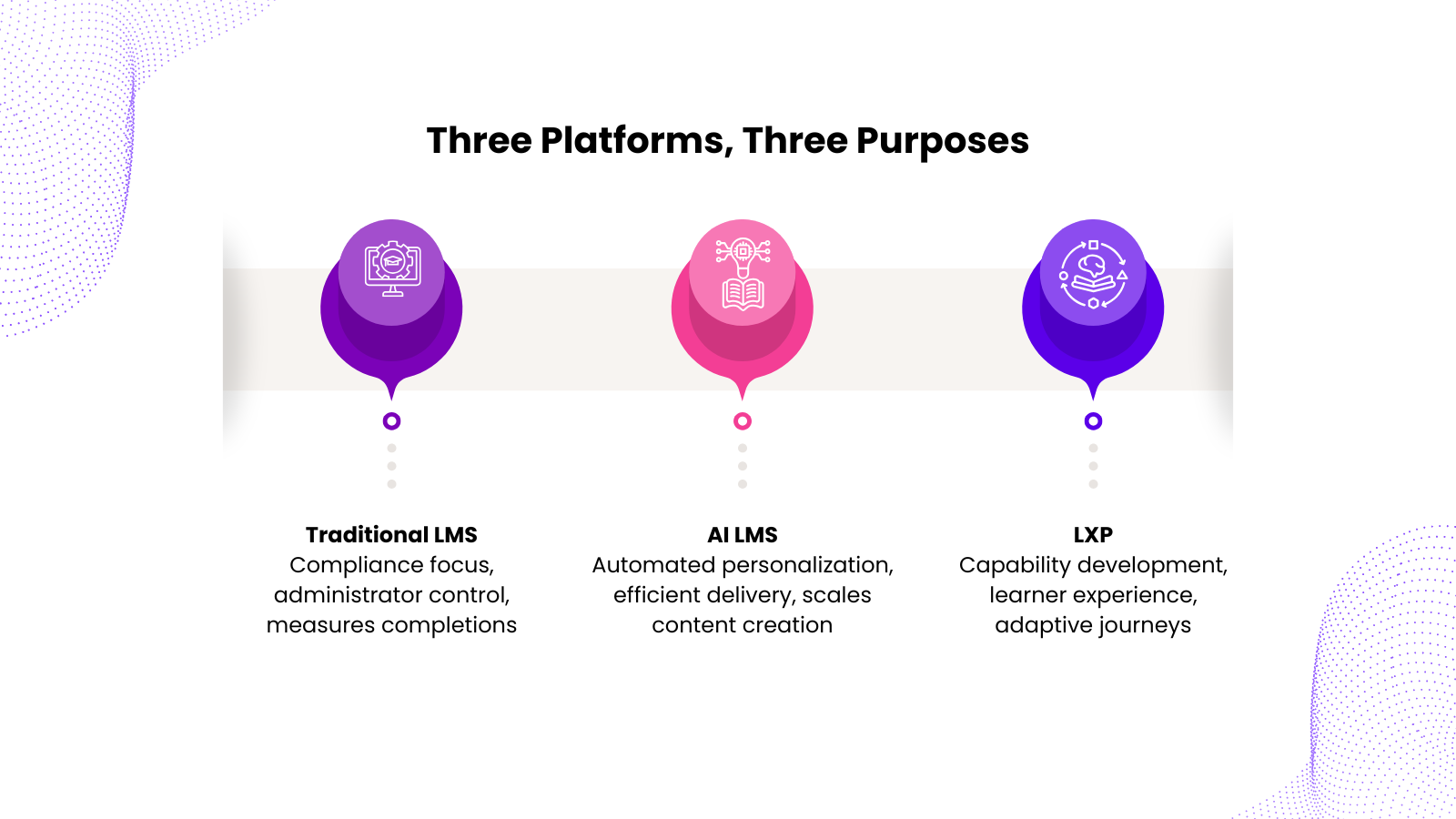
Conventional LMS systems were designed with control in mind. They create compliance reports, track completions, handle enrolments, and organize course libraries. This infrastructure is still crucial for enterprises with required programs or legal requirements. The drawback is that legacy LMS systems gauge activity rather than capability. They let you know who completed what and when they received a point. They don’t tell you who can do the job, who is prepared for the next position, or where important skill gaps are developing. Traditional systems are outdated when workforce agility is more important than completion rates. They are not learning systems; they are libraries.
How AI LMS Modified the Situation (But Not the Objective)
Artificial intelligence is used by AI LMS platforms to automate the construction of courses, customize suggestions, and lessen administrative work. When you upload a PDF, the platform creates a course in a matter of hours rather than weeks. This resolves actual issues. L&D teams accelerate, content grows more quickly, and AI LMS technologies provide real assistance for enterprises overwhelmed by backlogs in course creation. However, the learning process itself remains unresolved. The top-down reasoning still underpins most AI LMS systems. Administrators assign and create, and students consume and finish. The model did not change, but the delivery mechanism became more intelligent. Without change, intelligence only industrializes the previous method. Although you can design courses more quickly, you are still focusing on completion rather than capability.
Why the Paradigm Shift Is LXP Platforms
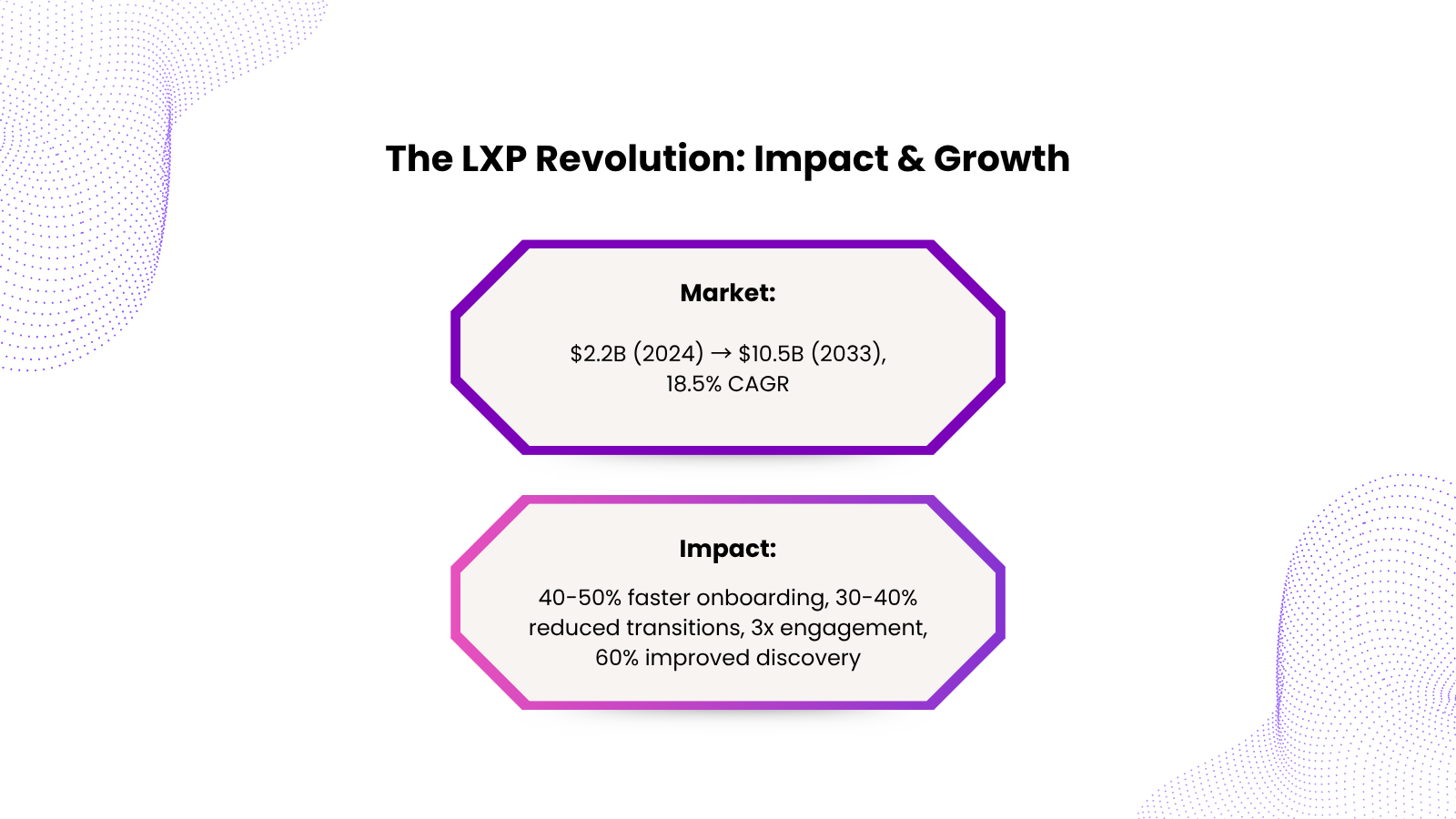
LXP systems do more than simply automate conventional models. They completely flip it. Learners pull what they need rather than administrators pushing content. They browse adaptive ecosystems rather than static catalogues. The platform validates skills rather than completes tasks. This architecture is learner-centric and built for scalability. LXP platforms track proficiency, comprehend context, and modify learning paths in real time based on demonstrated ability rather than merely activity. Businesses that use LXP platforms claim to reduce role-transition periods by 30–40% and increase recruit productivity by 40–50%. Not because learning is gamified, but rather because it is pertinent, timely, and directly related to what people need to do, they are witnessing three times higher engagement. The platform offers more than simply course recommendations. It creates capability paths based on performance signals, role, and context. Instead of using multiple-choice exams, it uses application to validate skills.
What Contemporary Businesses Really Need
If your priority is compliance, traditional LMS platforms still serve that purpose. If your bottleneck is course creation speed, AI LMS platforms solve that constraint. But if your challenge is workforce capability and transformation readiness, you need LXP platforms. The real difference lies in what outcomes you’reoptimizing for. AI LMS systems make existing processes faster. LXP platforms change what’s possible. One optimizes for efficiency. The other optimizes for impact. For enterprises navigating constant change, the question isn’t which platform has more features. It’s which infrastructure aligns with what you’re trying to build. A workforce that can execute, adapt, and perform when it matters most. That’s not a content management problem. It’s a capability development challenge.