21 2

Unlocking Training Potential: How Digital Learning Platforms and Learning Dashboards Work Together 

Unlocking Training Potential: How Digital Learning Platforms and Learning Dashboards Work Together

In today’s fast-paced business world, organizations need effective, measurable training solutions that drive real results. A Digital Learning Platform provides access to a wealth of resources, but without insights into progress and impact, its potential remains untapped. This is where the Learning Dashboard steps in. 

By integrating a Learning Dashboard with a Digital Learning Platform, organizations can unlock training potential, enhance engagement, and achieve measurable outcomes. 

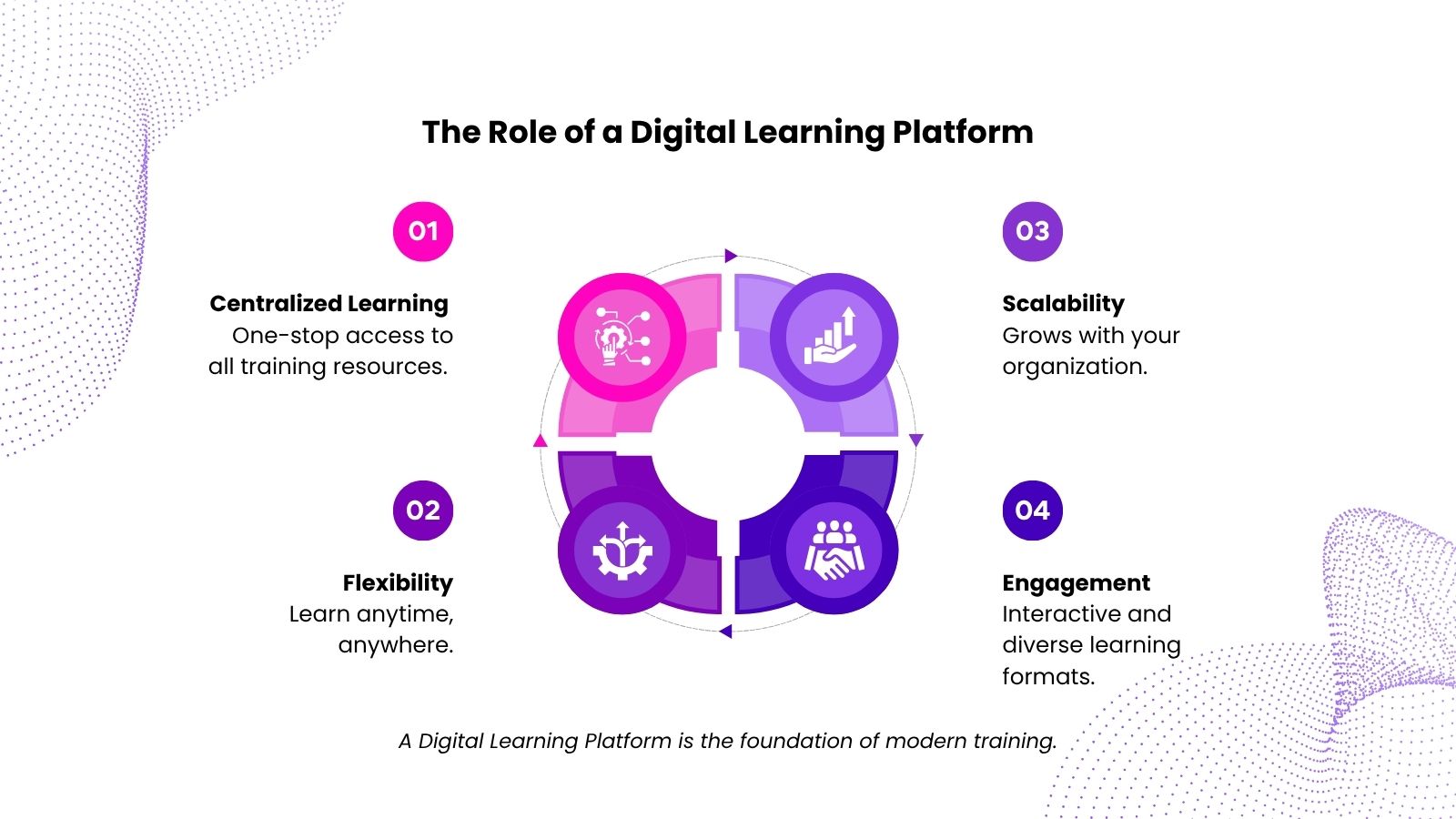
The Role of a Digital Learning Platform

A Digital Learning Platform serves as the foundation of modern training, offering: 

  • Centralized access to courses, videos, quizzes, and other resources. 
  • Flexibility for employees to learn at their own pace and convenience. 
  • Scalability to accommodate growing teams and evolving training needs. 

However, without a way to track progress, measure engagement, and assess effectiveness, even the most advanced platform can fall short of delivering real business value. 
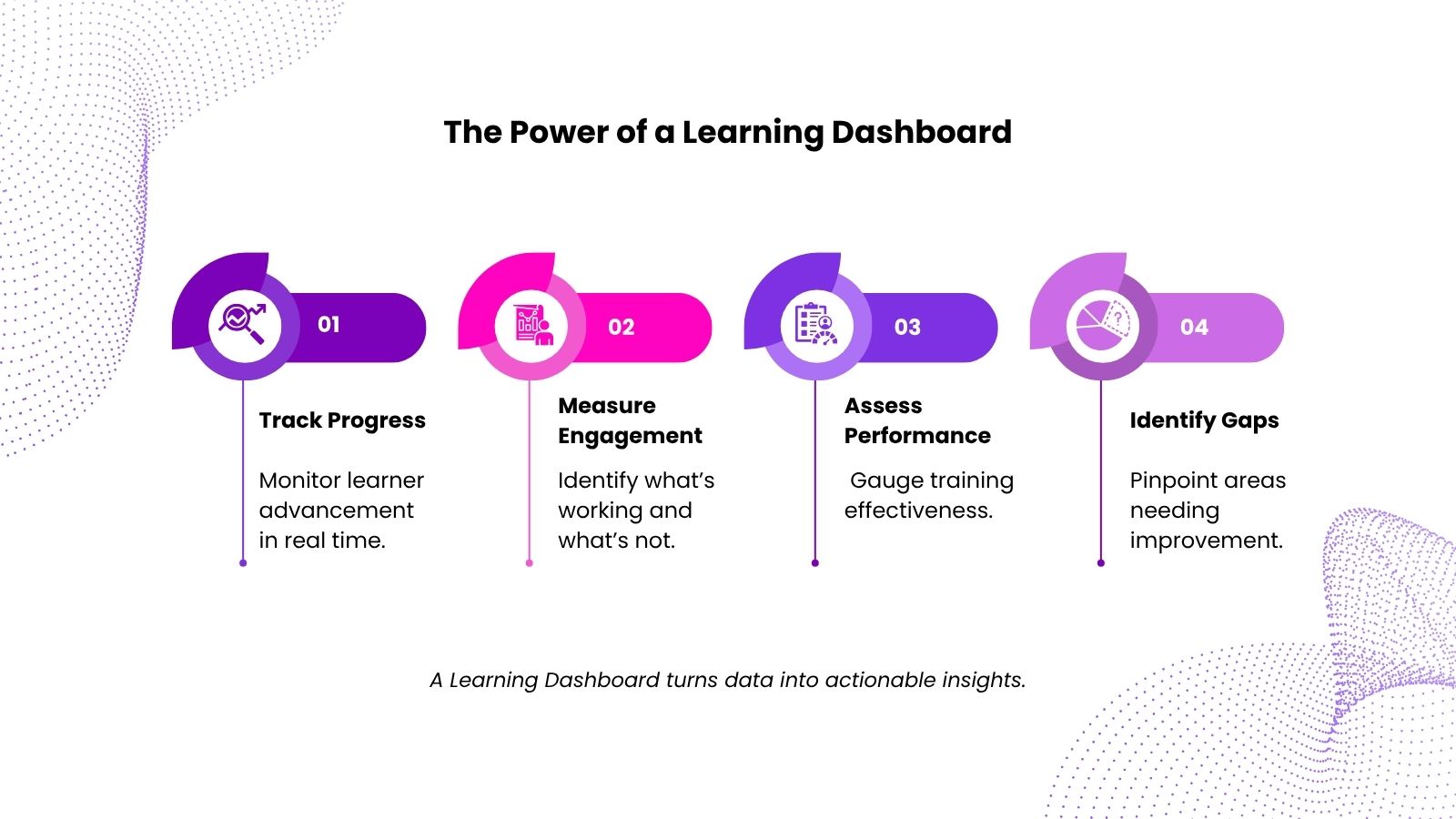
The Power of a Learning Dashboard

A Learning Dashboard acts as the command centre for your training initiatives, providing real-time insights into: 

  • Learner progress (Who is on track? Who needs additional support?) 
  • Engagement metrics (Which courses are most popular? Which are being overlooked?) 
  • Performance data (Are employees applying what they’ve learned on the job?) 
  • Skill gaps (Where are the knowledge deficiencies that need addressing?) 

When integrated with a Digital Learning Platform, a Learning Dashboard transforms raw data into actionable insights, helping organisations optimise their training programs. 
The Synergy: How They Work Together

Combining a Digital Learning Platform with a Learning Dashboard creates a powerful synergy that enhances training impact in multiple ways: 

  1. Personalized Learning Experiences

The Digital Learning Platform delivers content, while the Learning Dashboard provides insights into individual learner needs. Together, they enable: 

  • Customized learning paths based on skill gaps and performance data. 
  • Targeted recommendations for courses or resources that address specific needs. 
  1. Data-Driven Decision Making

With a Learning Dashboard, organizations can measure the effectiveness of their Digital Learning Platform and make informed decisions: 

  • Identify high-performing courses and replicate their success across other programs. 
  • Track ROI by correlating training completion with business outcomes, such as productivity or performance improvements. 
  1. Improved Engagement and Accountability

A Learning Dashboard fosters transparency and accountability by: 

  • Displaying progress so learners can see their own advancement and stay motivated. 
  • Highlighting achievements to recognize and reward employee efforts. 

This visibility keeps employees engaged and motivated, ensuring they get the most out of the Digital Learning Platform. 

Real-World Impact

A global retail chain implemented a Digital Learning Platform with an integrated Learning Dashboard to train its workforce. Within six months, they achieved: 

  • A 30% increase in course completion rates due to personalized learning paths. 
  • A 20% improvement in employee performance metrics tied to training. 
  • A 15% reduction in onboarding time for new hires, thanks to targeted skill development. 

Maximizing Your Training Impact

To fully leverage the power of this combination, organizations should: 
Integrate seamlessly to ensure data flows effortlessly between the platform and dashboard. 
Customize dashboards to display the most relevant metrics for your goals. 
Train managers and learners on how to use the dashboard effectively. 
Act on insights to continuously improve training programs. 

The Future of Training

The combination of a Digital Learning Platform and a Learning Dashboard is more than just a tool; it’s a strategic asset that can transform your training initiatives. By harnessing their synergy, organizations can: 

  • Deliver personalized, engaging learning experiences tailored to individual needs. 
  • Make data-driven decisions to optimize training and maximize impact. 
  • Drive measurable business results through improved performance and productivity. 
17 9

How Learning Analytics Transforms Skill Gaps into Business Opportunities 

How Learning Analytics Transforms Skill Gaps into Business Opportunities

Skill gaps are more than just an HR challenge. They’re a hidden obstacle to business growth. When employees lack the right skills, productivity slows, innovation stalls, and opportunities are missed. Yet, many organizations still treat skill gaps as an abstract issue, relying on outdated methods like guesswork or annual reviews to address them. 

The solution is Learning analytics. By harnessing data-driven insights, organizations can identify, measure, and close skill gaps with precision, turning a potential weakness into a strategic advantage. Here’s how learning analytics doesn’t just fix skill gaps but transforms them into opportunities for business growth. 

The Hidden Impact of Skill Gaps

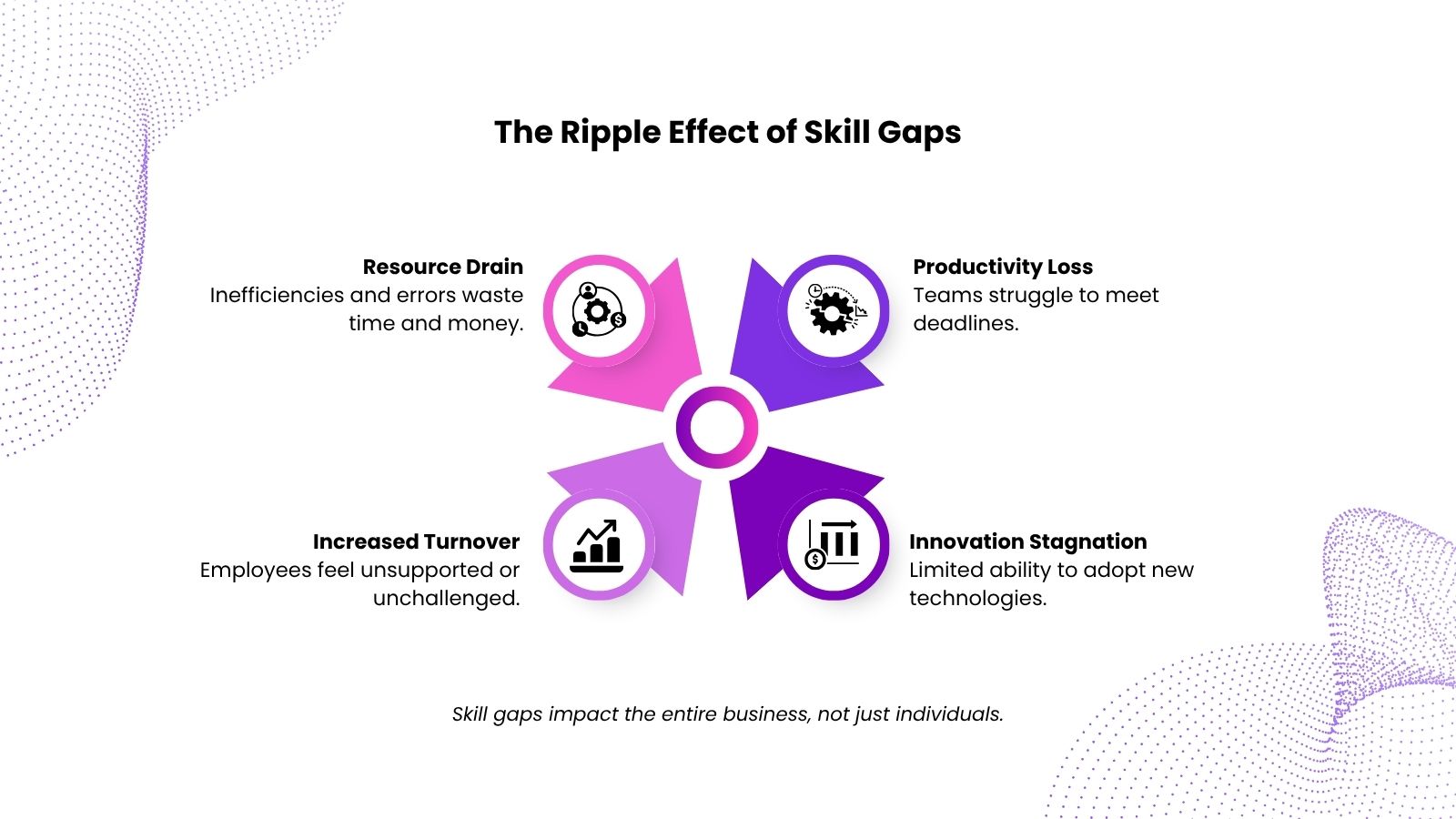
Skill gaps don’t just affect individual performance; they have a ripple effect across the entire organization. When employees lack critical skills: 

  • Teams struggle to meet goals, leading to missed deadlines. 
  • Projects get delayed, slowing down progress. 
  • Customer satisfaction drops, affecting reputation and revenue. 

Over time, these gaps can stifle innovation, increase turnover, and drain resources. Yet, many companies still address skill gaps reactively, waiting until they become glaring problems. This is where learning analytics changes the game. 

How Learning Analytics Uncovers and Addresses Skill Gaps

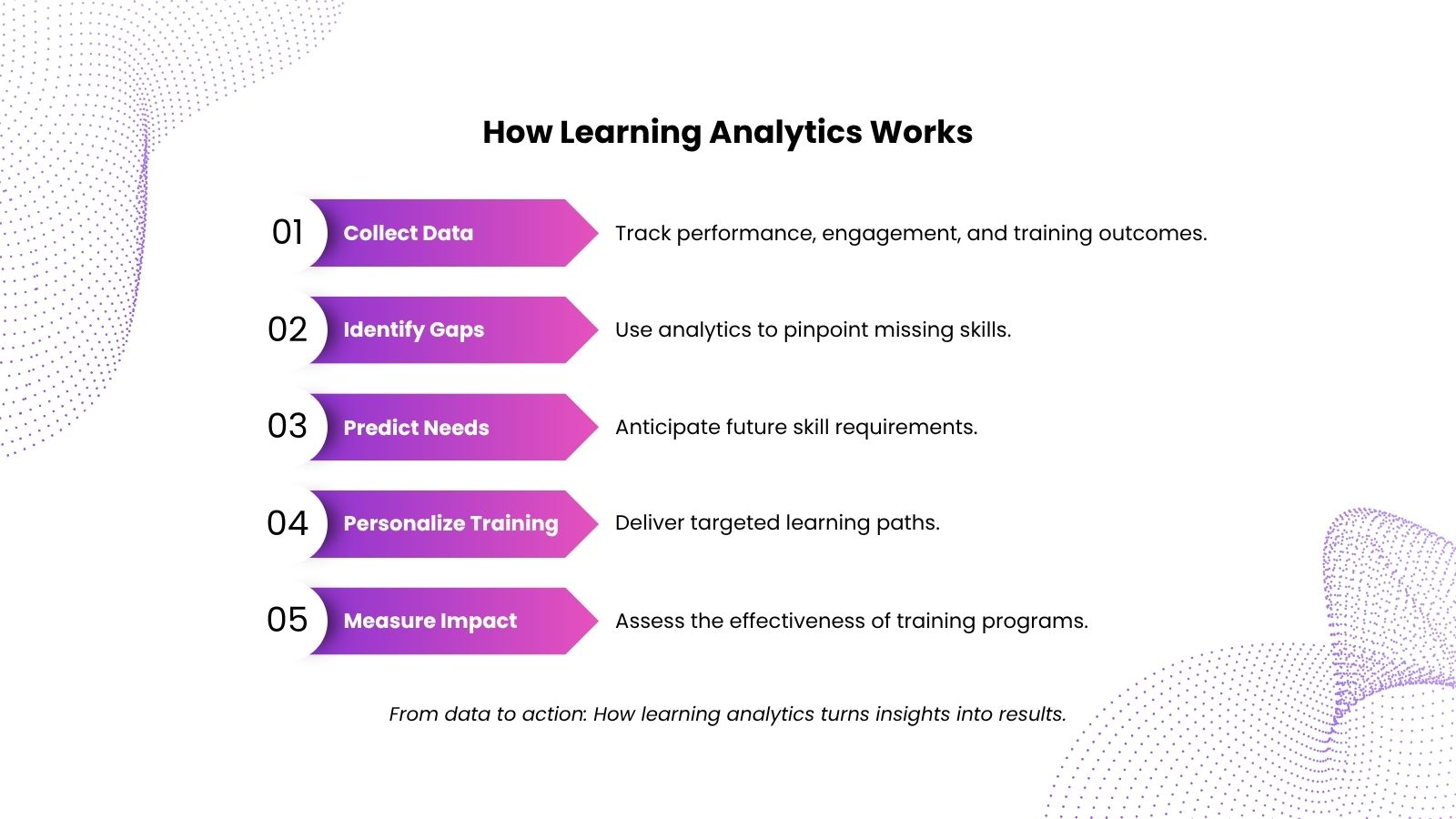
Traditional methods of identifying skill gaps, such as manager feedback or annual reviews, are slow, subjective, and often incomplete. Learning analytics, on the other hand, provides real-time, objective data to pinpoint exactly where gaps exist. 

  1. Data-Driven Skill Assessments

Learning analytics uses performance data, quiz scores, and engagement metrics to identify: 

  • Which skills are missing across teams or departments. 
  • Which employees are struggling with specific competencies. 
  • Which training programs are effective and which are not. 

This data-driven approach removes guesswork, allowing organizations to target their efforts where they’re needed most. 

  1. Predictive Insights for Future Needs

Learning analytics doesn’t just look at current skill gaps, rather, it predicts future ones. By analyzing trends in learning behavior, course completions, and performance data, organizations can: 

  • Anticipate skill gaps before they impact business operations. 
  • Align training programs with upcoming business needs. 
  1. Personalized Learning Paths

Once skill gaps are identified, learning analytics helps tailor training to individual needs. For example: 

  • An employee struggling with data analysis might receive targeted modules on Excel or SQL. 
  • A team lacking leadership skills could be enrolled in a customized leadership development program. 

This personalized approach ensures that training is relevant, efficient, and effective, closing gaps faster and with less wasted effort. 

How Addressing Skill Gaps Drives Business Growth

Fixing skill gaps isn’t just about improving individual performance; it’s about unlocking the full potential of your workforce. Here’s how learning analytics helps organizations grow by addressing skill gaps: 

  • Boosts Productivity and Efficiency: When employees have the skills they need, they work faster, smarter, and with fewer errors. 
  • Fuels Innovation: Skill gaps often hold organizations back from adopting new technologies or strategies. By proactively closing these gaps, companies can adopt new tools and develop new products or services with confidence. 
  • Improves Employee Retention and Engagement: Employees who feel supported in their growth are more engaged, loyal, and motivated. 
  • Aligns Learning with Business Goals: Learning analytics ensures that training programs are directly tied to business objectives, delivering measurable results. 

The Proof: A Real-World Example

A global manufacturing company used learning analytics to identify skill gaps in its workforce. By analyzing performance data and training outcomes, they discovered that 30% of their employees lacked critical digital skills needed for a new automation initiative. Using this insight, they: 

  • Developed targeted upskilling programs for the affected employees. 
  • Reduced onboarding time for new hires by 40%. 
  • Increased operational efficiency by 25% within six months. 

From Challenge to Opportunity

Skill gaps don’t have to be a roadblock; they can be a catalyst for growth. With learning analytics, organizations can: 
Identify gaps with precision, not guesswork. 
Predict future needs before they become problems. 
Personalize training to maximize impact. 
Align learning with business goals to drive real results. 

The organizations that thrive in the coming years won’t be the ones that ignore their skill gaps—they’ll be the ones that use learning analytics to transform them into opportunities. 

Skillzen blog banner - 26-27 4

How AI-Based LMS Makes Learning Smarter and More Efficient 

How AI-Based LMS Makes Learning Smarter and More Efficient

In today’s fast-paced workplace, traditional Learning Management Systems (LMS) often fall short. Employees expect personalized, engaging, and efficient learning experiences, while organizations need scalable, data-driven training that delivers measurable results. This is where AI-Based LMS steps in, transforming the learning experience by making it smarter, more adaptive, and deeply personalized. 

The Problem with Traditional LMS

Most traditional LMS platforms function like static digital libraries. They store courses, track completions, and generate basic reports, but they fail to engage learners or drive real behaviour change. The one-size-fits-all approach leads to disengagement, as employees either find the content too easy or too difficult. Without personalization or adaptability, the growth potential is lost. 

How AI-Based LMS Elevates Learning

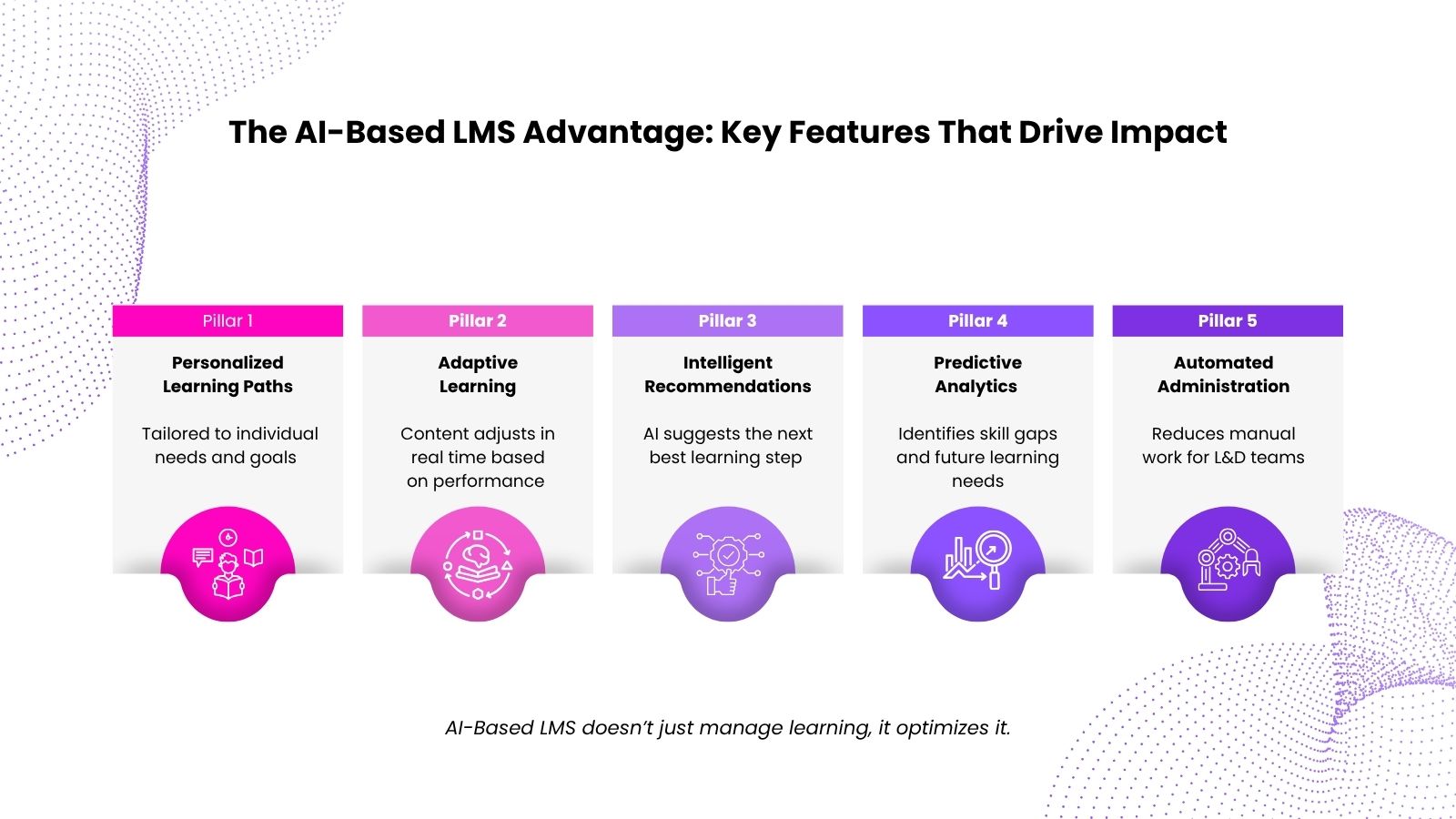
Personalized Learning Paths: Tailoring Content to Individual Needs 


In a traditional LMS, all employees receive the same training modules, regardless of their roles, skill levels, or career aspirations. This often results in disengagement, as the content may not align with their specific needs. 


An AI-Based LMS changes this by analyzing learner data such as past performance, role requirements, and skill gaps to create customized learning paths. For example, a sales representative might receive training focused on negotiation techniques, while a software developer could be directed to advanced coding modules. This ensures employees engage with relevant, challenging, and actionable content. 


Adaptive Learning: Content That Evolves with the Learner 


Traditional LMS platforms deliver content in a linear, rigid format. If a learner struggles with a concept, they’re either left behind or forced to repeat the same material, neither of which is effective for long-term retention nor engagement. 


An AI-Based LMS addresses this by continuously assessing a learner’s performance and adjusting the difficulty and pacing of the content in real time. For instance, if an employee excels in a module, the system can skip redundant content and move them to more advanced topics. Conversely, i

Intelligent Content Recommendations: Guiding Learners to What’s Next 


In a traditional LMS, employees often don’t know what to learn next, or they’re overwhelmed by too many options, leading to decision fatigue and low engagement. 

An AI-Based LMS acts like a personal learning concierge, recommending courses, articles, videos, and other resources based on the learner’s role, career goals, and past learning behaviour. For example, if a marketing employee completes a course on digital advertising, the AI might recommend advanced modules on SEO, content strategy, or data analytics. 


Predictive Analytics: Anticipating Learning Needs Before They Arise 


Traditional LMS platforms provide basic reporting, such as completion rates and quiz scores, but they don’t offer actionable insights into skill gaps, future training needs, or business impact. 

An AI-Based LMS leverages predictive analytics to analyze patterns in learning data, allowing organizations to anticipate emerging skill gaps, identify employees at risk of falling behind, and align training with future business objectives. 


Automated Administration: Freeing Up L&D Teams for Strategic Work 


Managing a traditional LMS can be time-consuming, with L&D teams spending countless hours assigning courses, tracking completions, and generating reports. 

An AI-Based LMS automates these administrative tasks, such as enrolling employees in courses, sending reminders for incomplete training, and generating customized reports on learning progress and compliance. 

The Future of Learning: AI-Based LMS as a Strategic Asset

The learning experience of the future isn’t just about delivering content, but about creating a smart, adaptive, and personalized journey for every employee. AI-Based LMS platforms make this possible by personalizing learning paths, adapting content in real time, recommending the right next steps, predicting skill gaps, and automating administrative tasks. 

The organizations that thrive in the coming years will be the ones with the smartest, most adaptive learning systems. 

9 6

5 Ways Your Corporate Training Program Can Be Enhanced by Training Companies 

5 Ways Your Corporate Training Program Can Be Enhanced by Training Companies

Organisations invest heavily in corporate training programs, yet many still grapple with poor engagement, low retention, and unclear ROI. The issue isn’t the intent, but the execution. Most training initiatives function like short-lived campaigns: a burst of activity, a flurry of completions, and then silence. Skills fade, behaviours revert, and the business impact remains elusive. 

Here’s the truth: Training companies that deliver real results don’t just provide content; they build systems. Systems that transform learning from a one-time event into a continuous, measurable, and business-driven process. The best corporate training programs focus on closing skill gaps, driving performance, and cultivating a culture of growth. 

So, how do top training companies achieve this? They focus on five key systems that turn training from a cost centre into a competitive advantage. 

The Learning Engagement Gap: Why Most Training Fails

Picture a corporate training program like a library without a catalogue. Thousands of resources like videos, slides, and quizzes piled high, but no way to find what’s relevant, track progress, or apply what’s learned. Employees log in, click through, and forget. The organisation sees activity, but not capability. 

This is the Learning Engagement Gap: the disconnect between what’s taught and what’s retained, between activity and impact. Most training companies fall short here. 

The best training companies don’t just fill the gap; they eliminate it by turning training into a system of engagement, measurement, and reinforcement. 

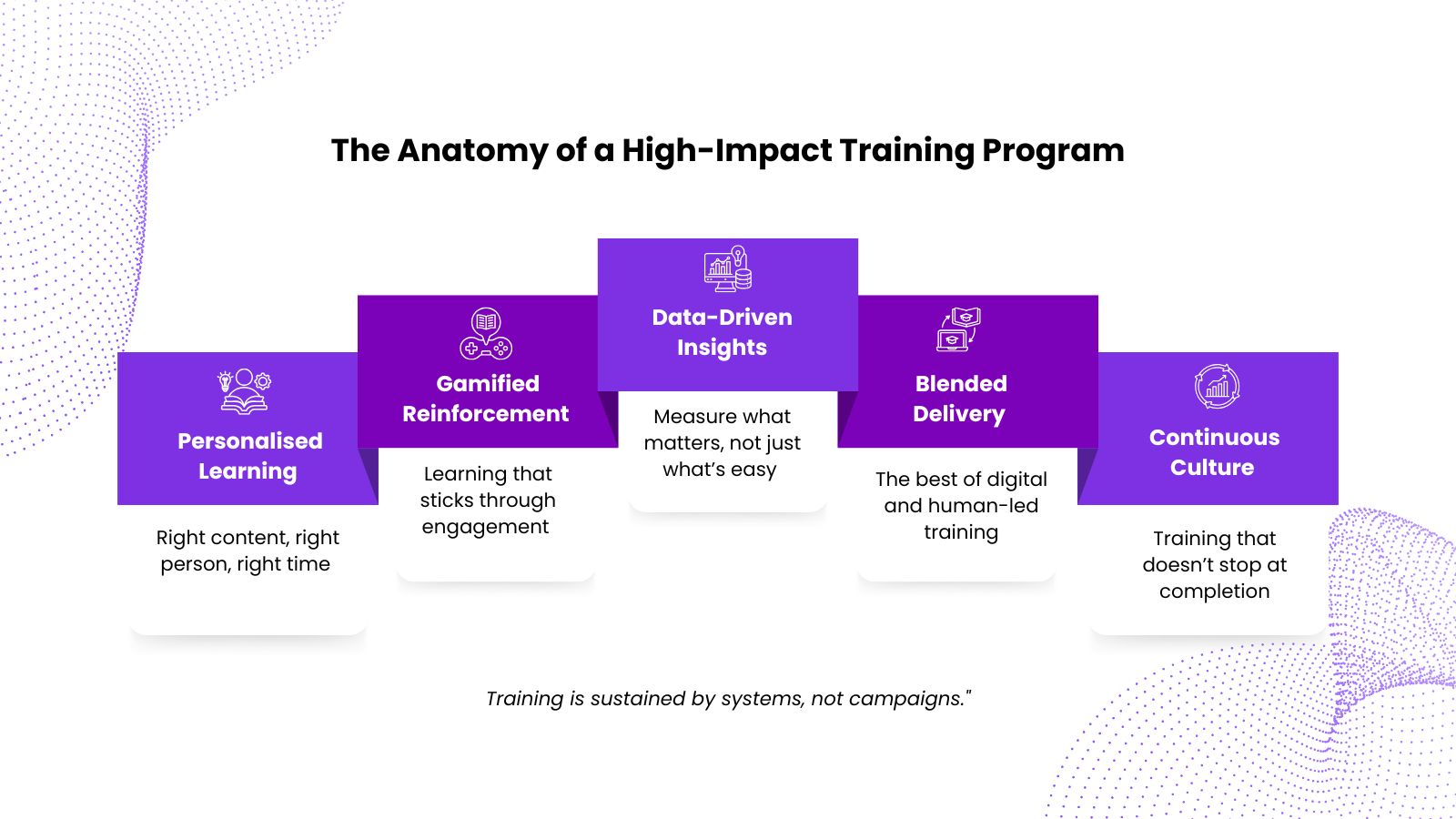
The 5 Systems That Turn Training into Results

  1. ThePersonalisedLearning Path System 

Most corporate training programs treat all learners the same, but employees have different roles, skill levels, and learning styles. A one-size-fits-all approach leads to disengagement and wasted resources. 

How Top Training Companies Fix It: 
They implement adaptive learning paths that tailor content to individual needs using AI and data analytics. This ensures employees engage with relevant, challenging, and actionable content, leading to higher completion rates and better skill retention. 


  1. The Gamified Reinforcement System

Traditional training is often dull, and boredom kills retention. Studies show employees forget 70% of what they learn within 24 hours if it’s not reinforced. 

How Top Training Companies Fix It: 
They turn learning into a game by incorporating leaderboards, badges, rewards, and microlearning. This makes training engaging, fun, and sticky, so employees retain more, apply more, and actually enjoy the process. 


  1. The Data-Driven Insights System

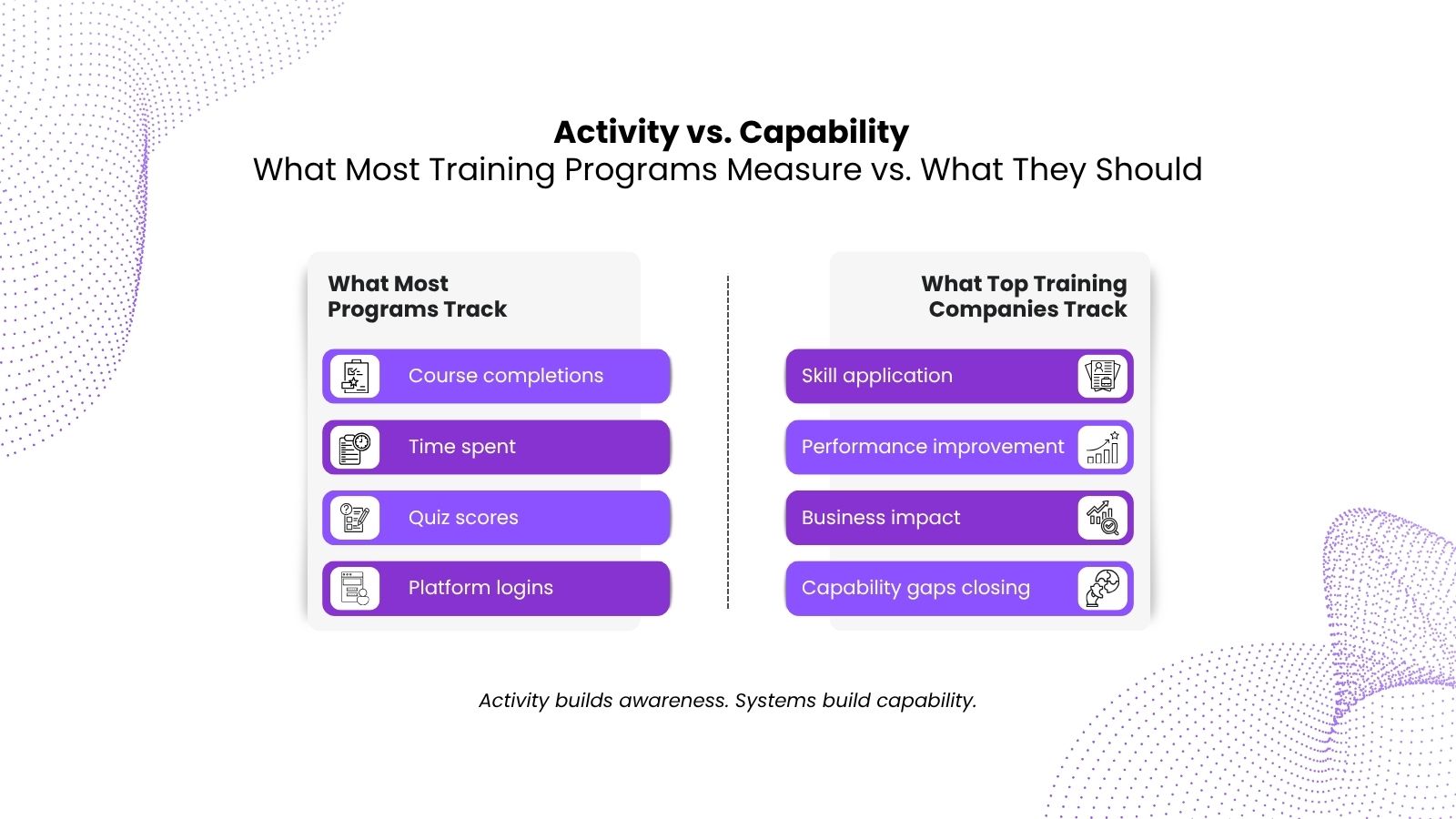
You can’t improve what you don’t measure. Yet most corporate training programs focus on vanity metrics like completion rates, time spent, and quiz scores without tying them to business outcomes. 

How Top Training Companies Fix It: 
They track what matters: 

          Skill progression 

          Behaviour change 

          Business impact 

This allows organisations to move from guessing to knowing and continuously refine their programs for maximum impact. 


  1. The Blended Delivery System

Some training companies swear by e-learning, while others insist on instructor-led sessions. The best? They blend both. 

How Top Training Companies Fix It: 
They combine digital modules for flexibility, live workshops for complex skills, and social learning for engagement. Employees get the best of both worlds: the convenience of digital and the personal touch of human interaction. 


  1. The Continuous Learning Culture System

The biggest mistake in corporate training programs? Treating training as a one-time event. Skills fade, behaviours revert, and the impact disappears. 

How Top Training Companies Fix It: 
They build a culture of continuous learning by embedding learning into daily workflows, encouraging peer-to-peer knowledge sharing, and providing ongoing coaching. This ensures training doesn’t end, but evolves, and employees keep growing. 

The Proof: A Real-World Transformation

A global tech firm struggled with low engagement and poor retention in its corporate training program. After partnering with a training company that implemented the five systems above, they saw: 

  • 40% increase in course completion rates 
  • 30% improvement in skill application 
  • 20% boost in employee productivity 

The difference? They stopped treating training as a campaign and started building it as a system. 

Training Is What You Build, Not What You Launch

The training companies that deliver real results aren’t the ones with the most content they’re the ones with the best systems. Systems that: 

  • Personalise learning to the individual 
  • Gamify reinforcement to make it stick 
  • Measure what matters, not just what’s easy 
  • Blend delivery methods for maximum impact 
  • Sustain learning as a culture, not a one-time event 
6 9

AI-Powered Scenario-Based Learning: The Future of Professional Training 

AI-Powered Scenario-Based Learning: The Future of Professional Training

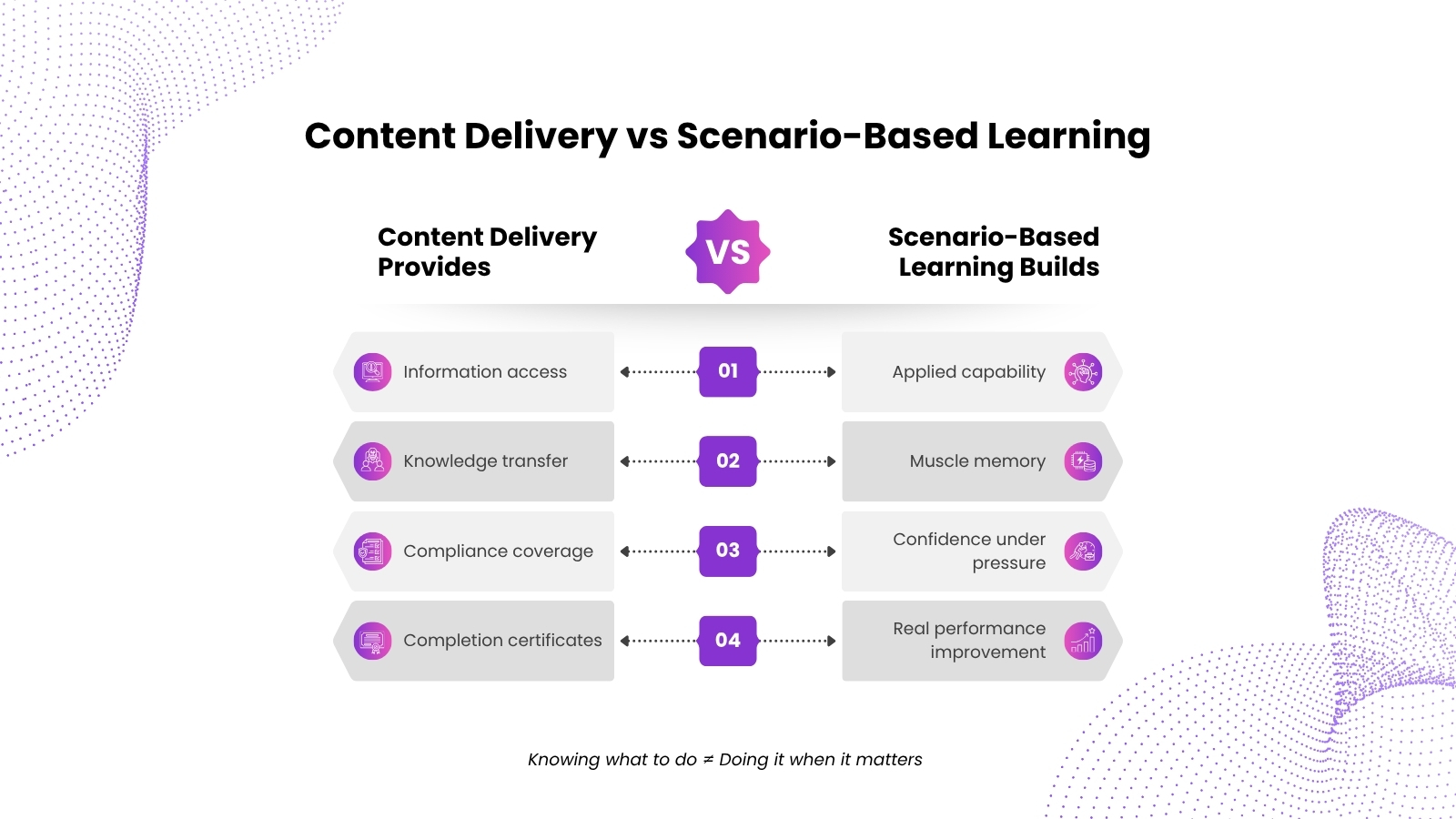
Your compliance officer just celebrated a major milestone: 98% of the workforce completed the new data privacy professional training program, managers received their certificates, and audit readiness dashboards show green across the board. So when a data breach happens two weeks later because an employee shared customer information through an unsecured channel, leadership realises that completion rates told them nothing about whether people actually understood what they should and shouldn’t do. 

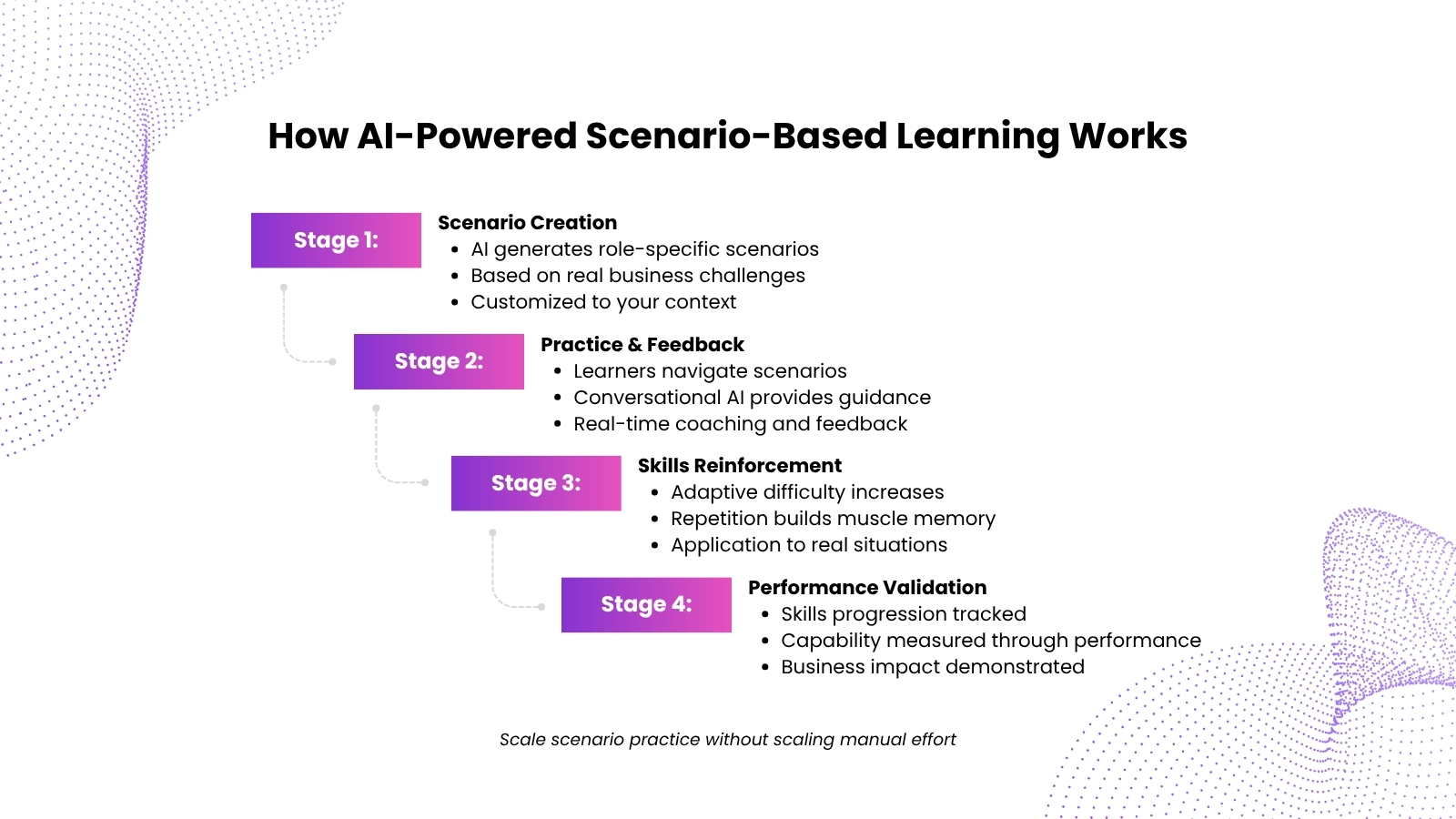
This is what happens when professional training treats learning as information transfer rather than capability building, where scenario-based learning creates the muscle memory that content delivery can never build because reading a policy and navigating a real-world judgment call are completely different challenges. 

The Completion Illusion

Organisations measure professional training success by tracking who finished modules, passed tests, and received badges, but this measures engagement with content, not whether employees can actually perform when the stakes are real. 

Think about it: a financial advisor can watch compliance training videos on regulatory requirements and still freeze during a client meeting when someone asks a question they didn’t anticipate, a project manager can complete leadership modules on conflict resolution and still struggle when their team is actually divided on approach, and a customer service representative can know company policy cold but panic when facing a genuinely upset customer because textbook knowledge doesn’t prepare you for the emotional pressure of real conflict. 

Professional training based on content assumes people learn by consuming information, but real learning happens when people must make decisions, face consequences, and adjust their approach, and without that experience, employees return to work with knowledge they’ll likely forget before they ever need to use it. 

How Real Learning Actually Happens

The organisations that build genuine capability don’t train people on what to think, but put people in situations where they have to think, decide, and live with the consequences of those decisions in a safe environment where mistakes become learning rather than disasters.


Scenario-based learning works because it forces the same neural pathways that real work demands: an employee navigates a difficult customer conversation where their responses determine whether the customer stays or leaves, a manager faces a team member who’s underperforming and has to decide what conversation to have and how to have it, a compliance officer encounters an ambiguous situation that doesn’t have a clear policy answer and has to apply principles to decide the right move.


This creates skill reinforcement not through repetition of facts but through repeated decision-making where each scenario teaches something new because context matters. The same customer objection plays out differently based on customer emotion, the same team conflict requires different approaches based on personalities, and the same compliance question changes based on business context, so employees learn that capability means adapting to reality, not following scripts. 

AI Makes Scenario-Based Learning Possible at Scale

The reason most organisations don’t use scenario-based learning is practical: creating thousands of realistic, role-specific scenarios that stay current as business changes is a massive resource drain that most L&D teams can’t support. 


AI changes that equation by generating contextual scenarios in minutes based on your actual business challenges, continuously adapting them as your industry, regulations, and strategies shift, and providing personalised coaching in the moment where the conversational AI doesn’t just tell learners the right answer but asks questions that guide them toward their own insights. 


This means professional training can finally scale with quality, where a sales team in London practices handling the same customer objections as the sales team in Singapore but with scenarios customised to their regional market. A compliance program updates automatically when regulations change rather than waiting for the next training cycle, and skills progression becomes measurable through how learners perform in increasingly complex scenarios rather than through test scores. 

The Performance Gap That Content Can't Close

Organisations measuring professional training by completion rates will keep celebrating numbers that predict nothing about actual performance, where employees will continue to struggle with judgment calls that weren’t explicitly covered in modules and managers will keep discovering capability gaps only when they surface as customer complaints or compliance issues. 


The organisations that shift from content-based training to scenario-based learning will see something different: employees who stay calm under pressure because they’ve practised difficult situations repeatedly. Teams that make better decisions because they’ve learned to adapt principles to real context, and compliance programs that actually prevent violations because people understand the why behind policies, not just the rules themselves. 


Professional training that delivers content is efficient to create and easy to measure. Scenario-based learning is harder to build, but it actually changes how people perform. Only one of these matters to your business. 

2 35

How Learning Analytics and L&D Metrics Promote Skill Development 

The Actual Predictor of Performance: Skill Reinforcement Over Course Completion Rates

In today’s fast-paced business world, the ability to track and improve staff abilities is not only advantageous, but also necessary. Learning dashboards, powered by L&D metrics and learning analytics, are changing the way businesses monitor and enhance skill advancement. But how can you use these tools to foster an environment of continual learning and demonstrable growth?

The Power of Learning Dashboards

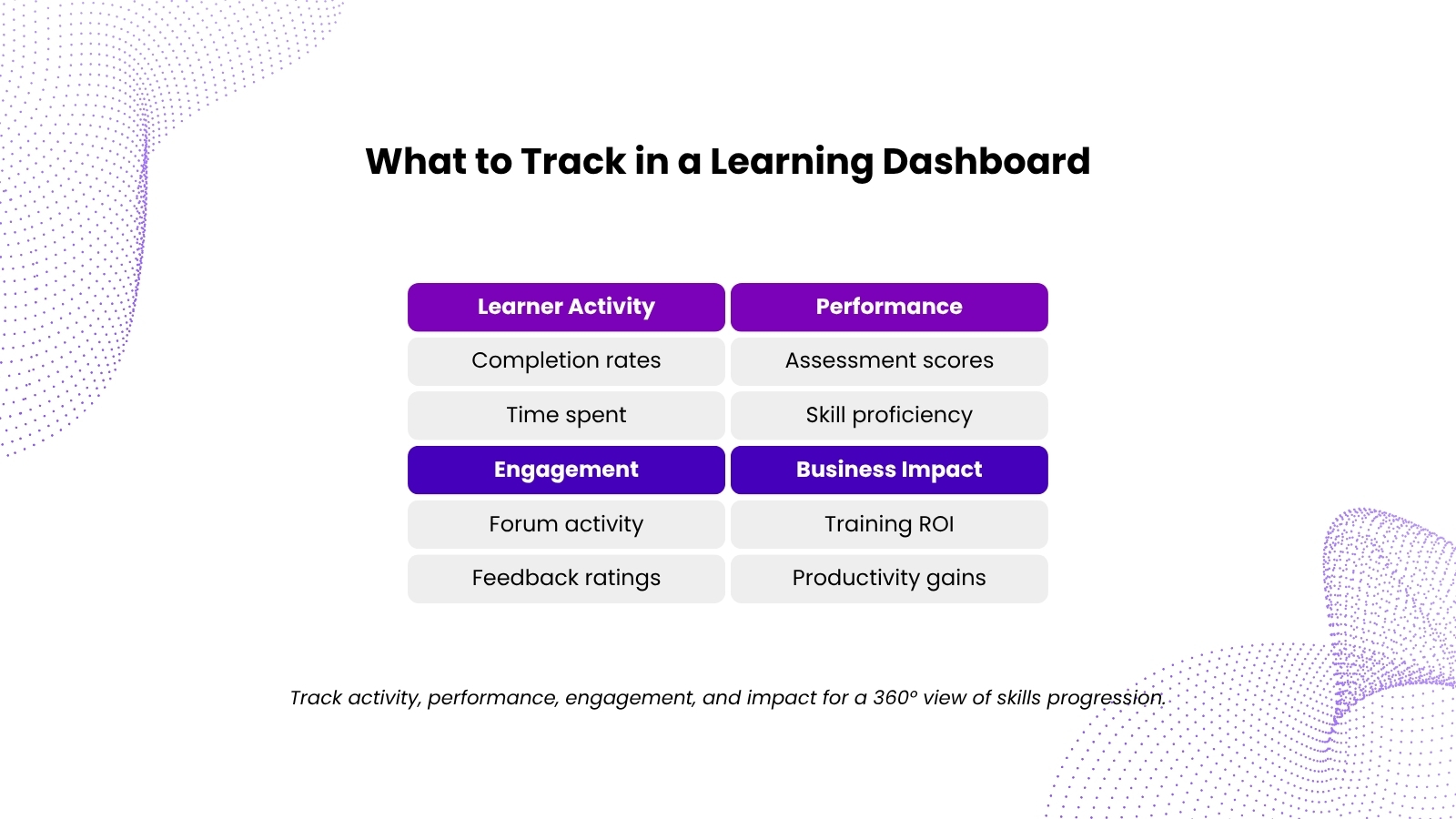
Learning dashboards show real-time, visual representations of learning activities, performance, and outcomes. They combine data from a variety of sources, such as course completion rates, assessment scores, and engagement levels, to produce actionable insights. Learning and development teams can use dashboards to: 
• Track individual and team learning progress, identifying strengths and areas for improvement. 
• Assess the impact of learning programs on corporate goals. 
• Enhance Engagement: Personalize training experiences with data-driven insights to boost motivation and participation.

Key Learning & Development Metrics to Track

To get the most out of learning dashboards, focus on five key L&D metrics: 
1. Measure course completion rates to assess employee engagement and relevancy.  
 
2. Assess information retention and application via quizzes and practical assessments.  
3. Time to Competency: Monitor employee proficiency in certain skills.  
4. Monitor learner engagement through forum conversations and resource downloads.  
5. Identify skill gaps and provide targeted assistance. 

Learning Analytics: From Data to Insight

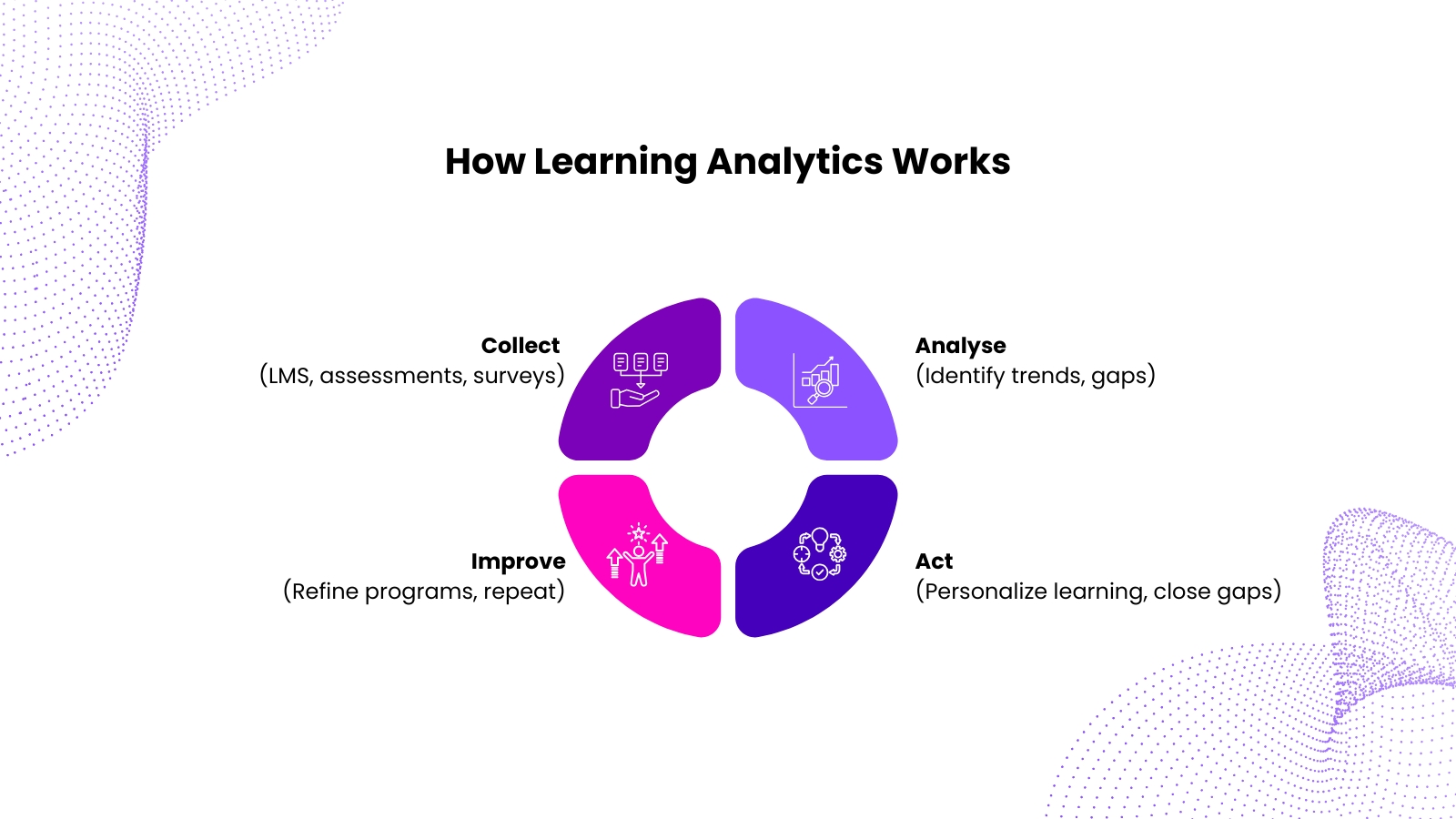
Learning analytics extends L&D metrics by utilizing advanced data analysis to identify patterns, forecast trends, and recommend actions. Here’s how it improves skill progression:  

  • Use predictive analytics to forecast future skill needs based on current learningbehavioursand business trends.  
  • Customize learning paths to meet individual needs, increasing efficiency and effectiveness. 
  • Use feedback loops to improve training programs and overcome skill gaps

Implementing Learning Dashboards in Your Organization

To effectively incorporate learning dashboards into your L&D strategy: 
1. Set clear objectives by aligning dashboard metrics with company goals and learner requirements.  
 
2. Choose the Right Tools: Choose systems with advanced analytics, user-friendly interfaces, and integration possibilities.  
3. Train Your Team: Ensure L&D professionals and supervisors understand how to analyse and apply dashboard insights.  
4. Continuously review and update dashboards to reflect changing learning priorities. 

Case Study: Using Learning Dashboards to Transform Skills Progression

A worldwide technology corporation used learning dashboards to track skill advancement throughout its staff. By focusing on L&D measures like as course completion and evaluation scores, and employing learning analytics to personalize training, they accomplished:  

  • A 20% increase in course completion rates. 
  • 15% reduction in time to competency. 
  • Improved employee engagement and retention.

Conclusion: The Future of Skills Progression

Learning dashboards, which use L&D measurements and learning analytics, are more than simply tools; they are catalysts for developing a talented, agile, and future-ready workforce. Organizations can use data to transform learning activities into measurable skill growth, resulting in individual and company success. 

32 2

The Actual Predictor of Performance: Skill Reinforcement Over Course Completion Rates

The Actual Predictor of Performance: Skill Reinforcement Over Course Completion Rates

The compliance box is selected, and leadership can be rest assured that employees have “completed their learning” as evidenced by the 92% completion rate of mandatory learning on your L&D dashboard. 
Three months later, the troubleshooting framework is unable to be applied by support teams, resulting in a surge in customer complaints. Sales cycles are extended because of erroneous rep product positioning, and the skills deficit that learning was intended to address is still costing millions.  
 
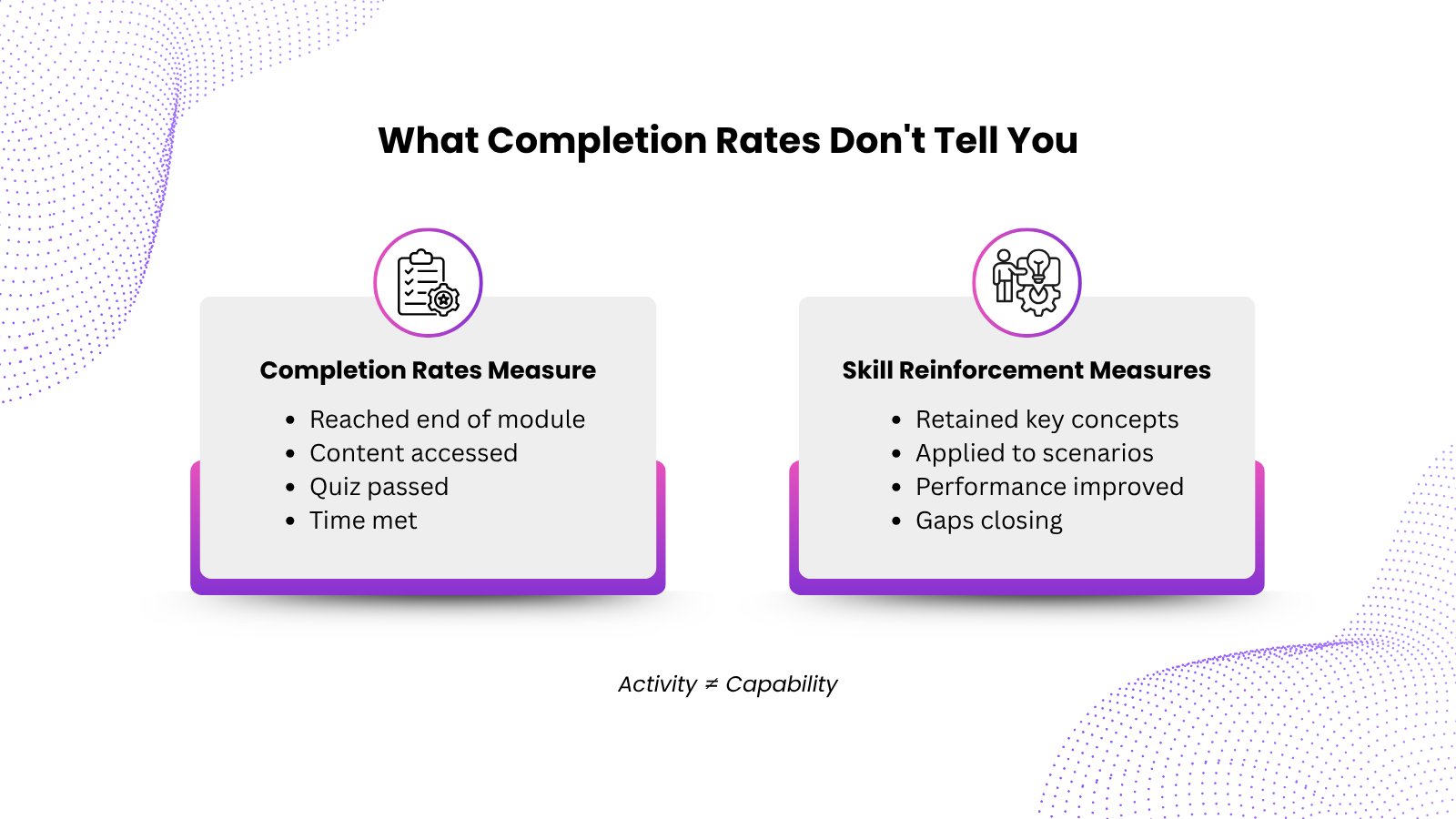
The issue is that course completion rates indicate whether an individual has completed a module; however, they do not provide any information regarding whether skill reinforcement occurred after the completion screen disappeared or whether learning was converted into capability. 

The Reasons Why Course Completion Rates Are Deceptive About Learning

Course completion rates quantify activity rather than outcome. For example, an employee who clicks through transparencies in 12 minutes is granted the same status as one who spends an hour engaged, and both are considered “trained” even though only one of them retained any valuable information.  
The completion obsession creates three problems. It optimizes for speed over retention where employees race to finish because completion is what gets measured, it hides capability gaps until performance problems surface where managers assume “they were trained,” and it produces false confidence where leadership sees high completion and assumes learning worked.  
Research indicates that 70% of information is forgotten within days and never applied in the absence of skill reinforcement. Consequently, a 92% completion rate is a poor indicator of whether your workforce has become more capable.

Skill Reinforcement: The Actual Predictor of Performance

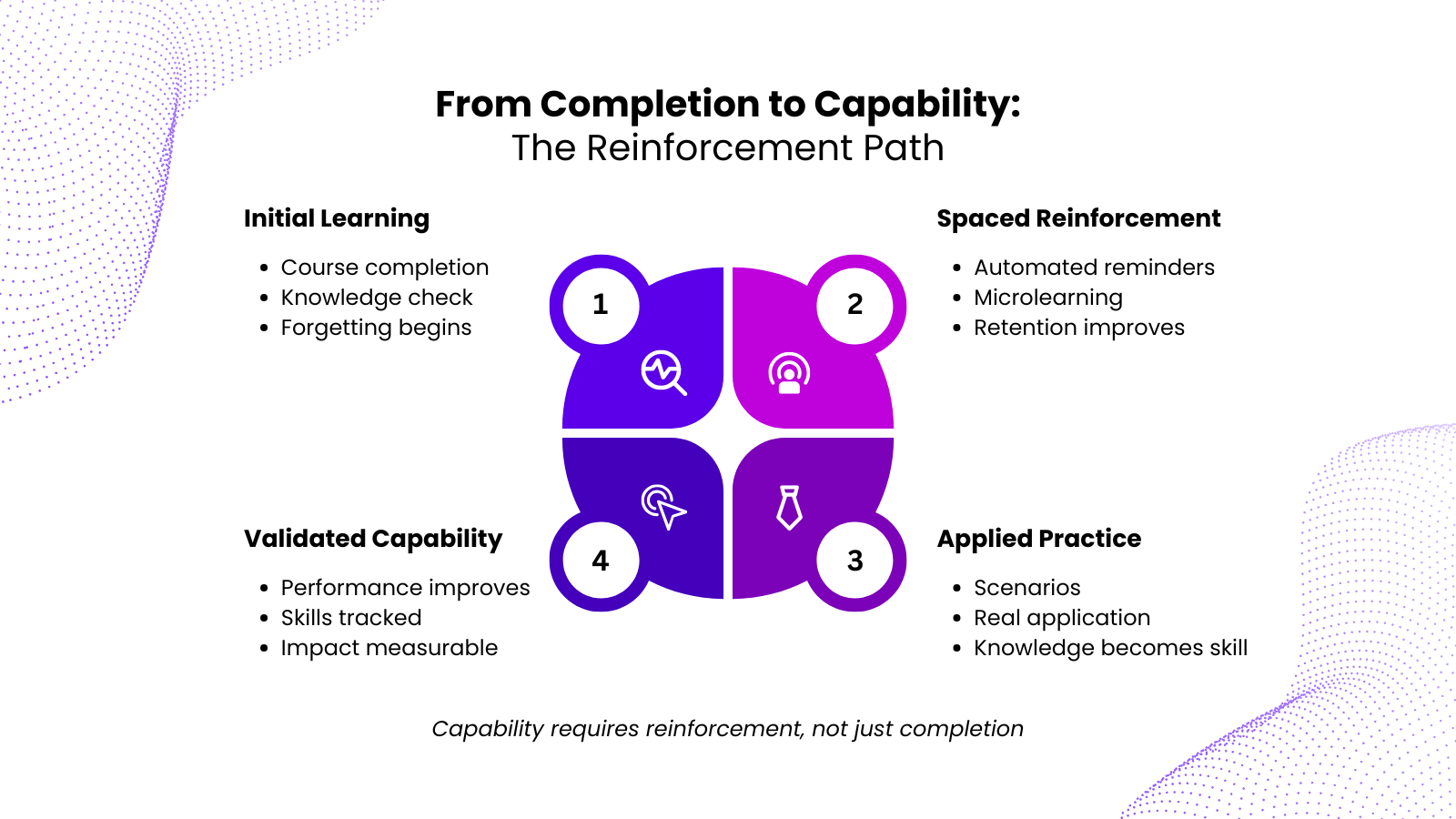
After initial learning, skill reinforcement is the process by which knowledge is practiced, applied, and strengthened over time until it becomes a capability rather than merely information that was once observed. 
Organizations that develop genuine capability emphasize reinforcement systems that utilize spaced repetition to reintroduce concepts prior to their eventual forgetfulness, microlearning to provide just-in-time refreshers prior to high-stakes tasks, and scenario-based practice to enable employees to apply their knowledge in realistic scenarios where mistakes are permissible and feedback is immediate.  
Skill reinforcement generates the repetition that learning science has demonstrated is essential for retention, the application that transforms knowledge into skill, and the learning analytics that indicate whether capability is improving rather than merely whether a course was completed. 

How Learning Analytics Discloses the Truth

Learning analytics that are designed around skill reinforcement rather than completion tracking alter the information that is visible. Rather than dashboards that display “courses completed,” users can observe which employees retain knowledge throughout reinforcement cycles, which concepts are consistently forgotten, and where skill progression is stagnating before they become a performance issue.  
Platforms that monitor more than “did they finish” are necessary for the transition from completion metrics to reinforcement metrics. You require systems that assess knowledge retention over time through periodic assessments, skill application through scenario performance, and capability development through progressive mastery.  
Managers can intervene before capability gaps become performance failures, L&D can optimize based on what works, and leadership can link learning investment to measurable skills progression when learning analytics monitor skill reinforcement.

The Metric That Really Matters

Organizations that prioritize course completion rates will continue to observe high completion rates, low retention rates, and minimal impact due to the fact that completion metrics are inaccurate. 
The individuals who transition to skill reinforcement metrics, which are supported by learning analytics that monitor retention, application, and skill progression, will be able to determine whether learning has resulted in capability, whether employees can perform at a high level when it matters, and whether learning investment has generated business results. Completion rates are incapable of demonstrating these factors.  

 
Learning occurred, as evidenced by course completion rates. Skill reinforcement indicates that learning has become stagnant. Performance is predicted exclusively by one. 

31 2

Five Systems That Transform Activity into Skills Progression: The Reasons Why Learning Culture Initiatives Fail 

Five Systems That Transform Activity into Skills Progression: The Reasons Why Learning Culture Initiatives Fail

Your CEO issued an additional all-hands email regarding the establishment of a learning culture. The budget was approved by the leadership, and the initiative was launched by L&D with motivating messaging. Three months have passed, and the completion rates appear to be satisfactory. 

Nothing has changed six months later. The capability gaps that initiated the initiative are still wide open, employees are not implementing new skills, and managers are not coaching. 

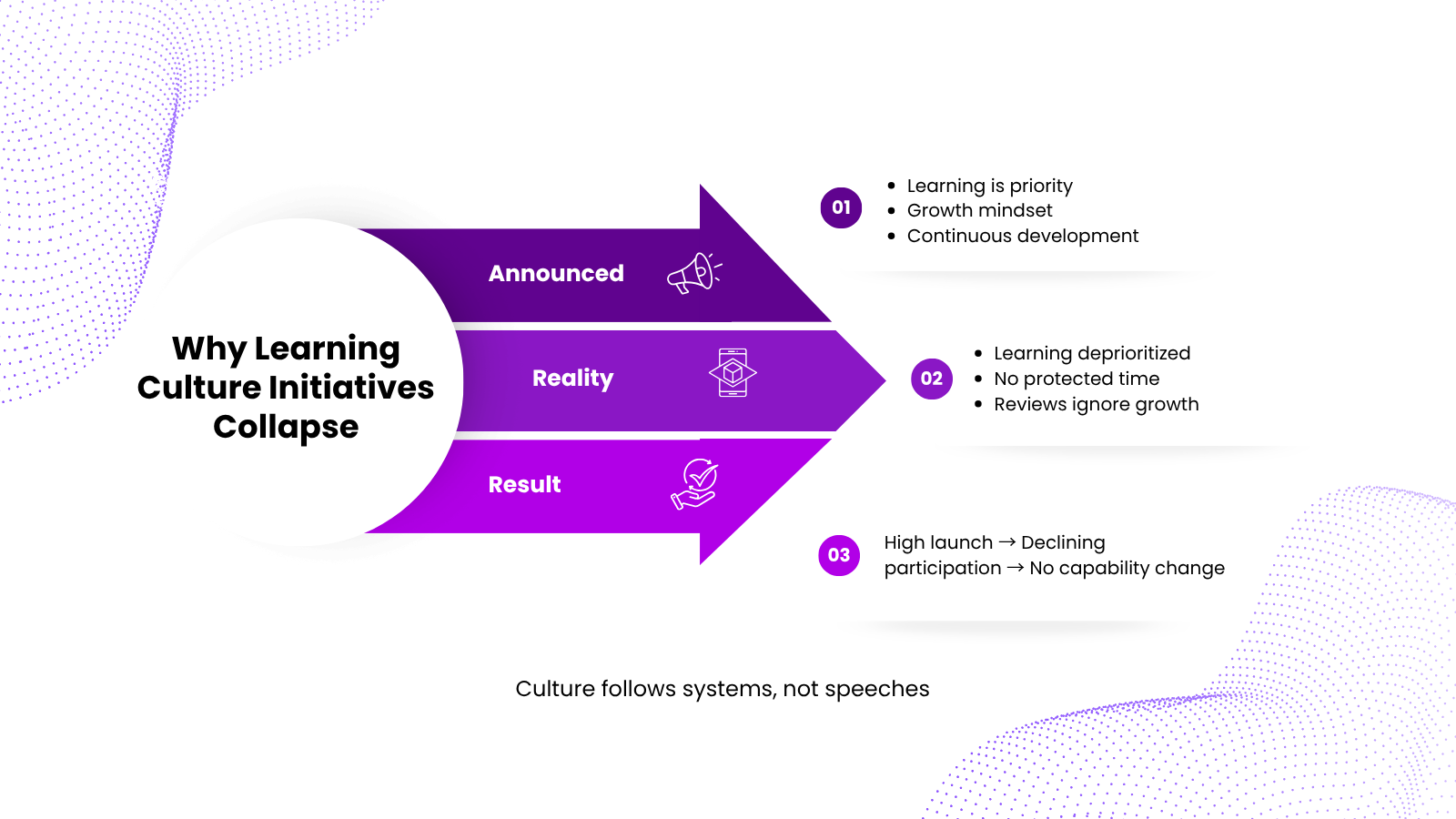
The reason for the failure of most learning culture initiatives is that they are constructed based on inspiration rather than infrastructure, considering culture as a concept that is announced rather than systematically established. 

The Reasons for the Failure of "Culture" Initiatives

A typical learning culture launch follows a predictable pattern, which includes a leadership inauguration, content library, gamification, and a period of waiting to determine whether individuals begin learning independently. 

They do not! Culture is not established through messaging; rather, it is established through systems that facilitate the development of desired behaviours. Learning culture is rendered meaningless if the infrastructure fails to facilitate the progression of skills as a natural consequence of the work process. 

The Three Failure Patterns:

Organizations declare that learning is of utmost importance; however, they do not modify their performance evaluations or priorities in response to deadlines. Consequently, employees are informed that “learning matters” while experiencing that “delivery matters more.” 


L&D monitors completions and engagement due to their ease of capture; however, these metrics do not indicate whether learning is translating into performance or whether skills are evolving. 


The same initiative is implemented in all departments as if they were all learning in the same manner; however, this is not the case, resulting in engagement fragmentation and the initiative becoming yet another “HR thing.” 


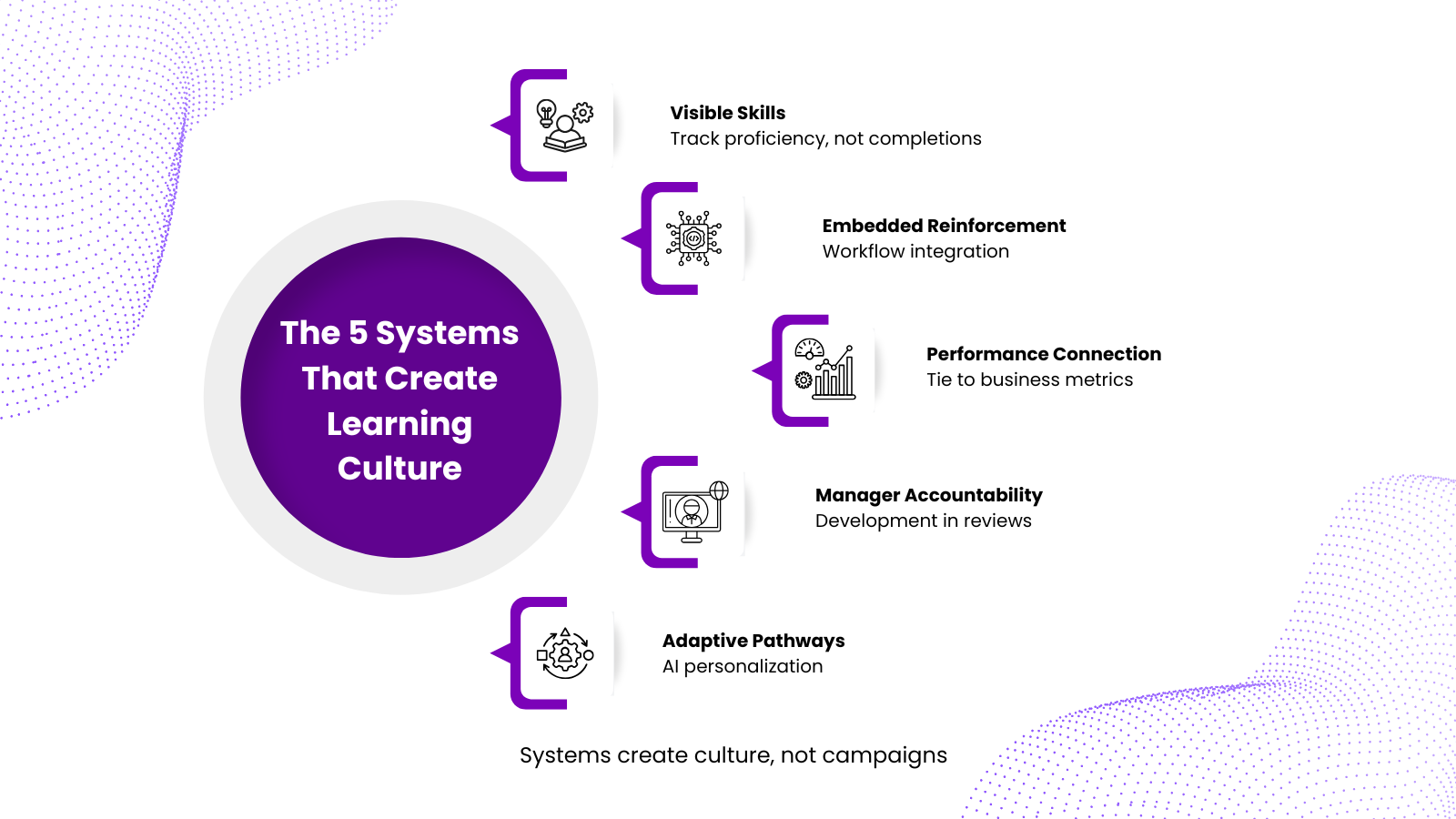
Five Systems That Truly Foster a Learning Culture

System 1: Ensure that the progression of skills is visible and measurable 


The existence of a learning culture is contingent upon the transparency of who is aware of what and where gaps are forming. Track demonstrated skills rather than courses completed, map roles to capabilities, and connect learning to validated competencies in LXP platforms. 


System 2: Integrate Skill Reinforcement into the Workflow 


One-time learning results in forgetting, as 70% of information is lost within days in the absence of skill reinforcement. Incorporate reinforcement into the workflow, prioritize microlearning before tasks, implement spaced repetition, and implement just-in-time practice. 


System 3: Connect Performance Outcomes to Learning 


Learning culture is unsuccessful when it is perceived as being disconnected from the workplace. Establish a connection between each learning path and a performance outcome that is of interest to executives. For example, align sales learning with deal velocity and technical learning with deployment speed. Learning becomes a performance lever when metrics that leadership monitors indicate that skills are improving. 


System 4: Establish Managerial Responsibility for Team Development 


When managers are not held accountable for the development of their organizations, learning culture is extinguished. Establish team development as a permanent agenda item during one-on-one meetings, incorporate it into manager evaluations, and provide managers with dashboards that illustrate the progression of team skills and the areas in which they are lacking. 


System 5: Establish Adaptive Pathways, Not Static Catalogues 


A genuine learning culture necessitates personalization, in which learning is tailored to the individual’s knowledge and the rate at which they are advancing. Modern LXP platforms offer adaptive pathways that are powered by AI, allowing advanced learners to advance while struggling learners receive assistance. This approach ensures that all learners have a learning experience that is meaningful. 

From Failing Initiatives to Functional Systems

Organizations that implement learning culture initiatives with an emphasis on inspiration will continue to observe enthusiasm diminish into compliance theatre, where completions appear satisfactory but capabilities remain stagnant. 
Managers who coach employees, employees who enhance their skills, and business outcomes that demonstrate the investment are achieved by those who transition from initiatives to systems, from activity metrics to skills progression metrics, and from immutable catalogues to adaptive pathways.  
Learning culture is not established through speeches; rather, it is established through systems that facilitate growth rather than stagnation. The appropriate infrastructure transforms intentions into quantifiable capabilities.  
That is not an initiative. This is the process by which learning is transformed into a cultural phenomenon.

30 4

AI + Instructor-Led Learning: The Compliance Training Model That Will Be Effective in 2026  

AI + Instructor-Led Learning: The Compliance Training Model That Will Be Effective in 2026

Leadership may relax knowing the company is “compliant” after your compliance team completed another round of instructor-led learning sessions with 95% attendance and completion.  

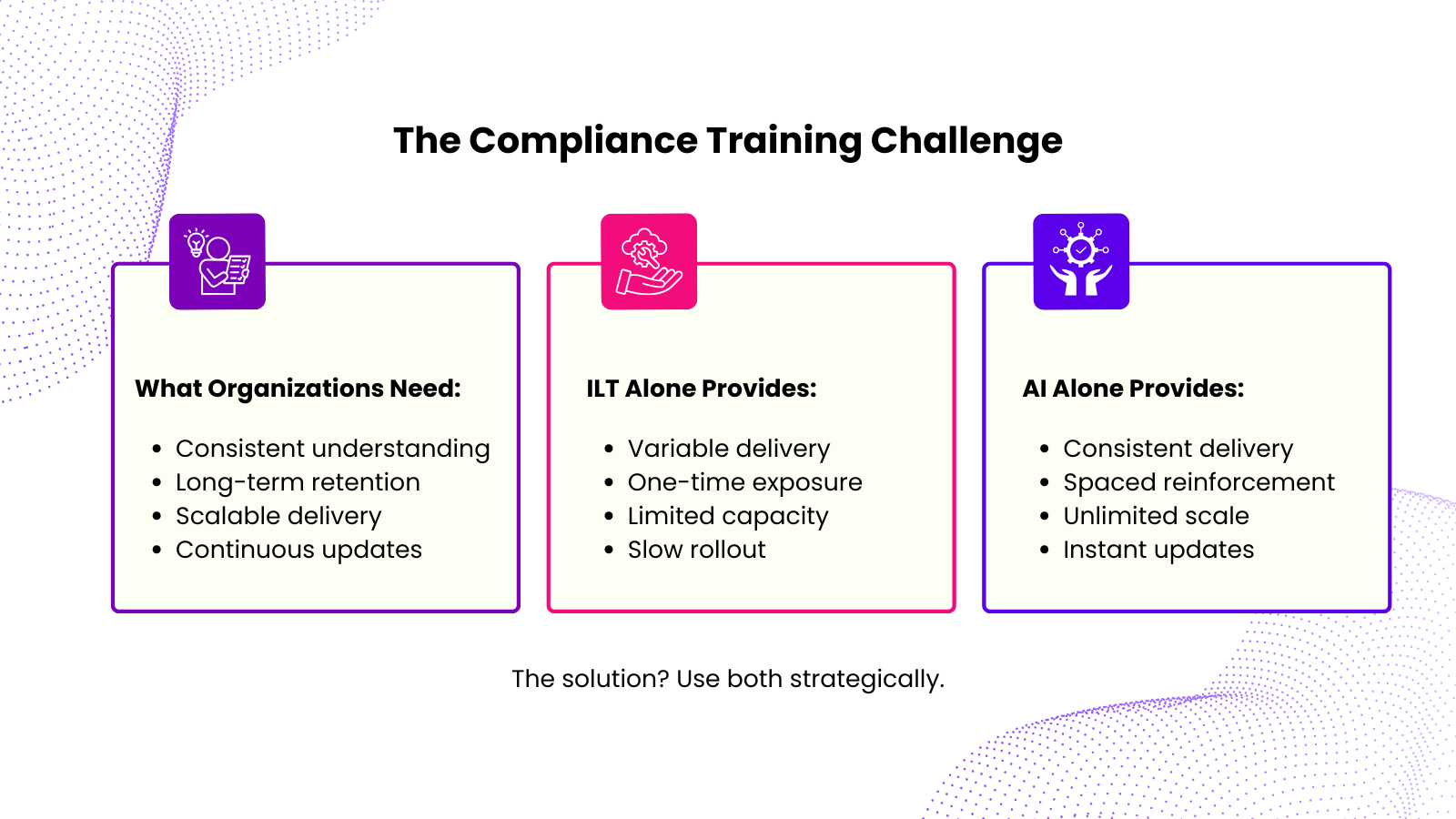
Three months later, an audit finds that staff workers cannot remember basic policies, resulting in a regulatory breach that costs millions of dollars. Instructor-led learning and AI-only solutions that value efficiency over human contact cannot solve enterprise-scale compliance training. Companies that successfully conduct compliance training in 2026 mix methods rather than choosing one.  

Why instructor-led learning fails to ensure compliance

Instructor-led classes are beneficial. Peer chats about real circumstances, skilled facilitators who handle tough issues, and accountability-fostering relationships. Ethics, harassment prevention, and crisis management are too complex for videos.  
 
Most compliance training programs merely teach once, assess personnel, and have leadership sign off. Research shows that 70% of material is forgotten within days without reinforcement, thus when audited, employees recall the training but not what they learnt. Compliance training at scale is one of the biggest issues for traditional instructor-led learning sessions.  
 
The scale issue makes it impossible for organizations with distributed workforces to gather everyone at once. Compliance training is a logistical nightmare because instructor-led sessions are scheduled across time zones, languages, and locations, putting critical updates in a training backlog for months while the organization’s operations are at danger.  
 
There is also the consistency gap, where facilitators highlight different points, one session hurries through case studies, and geographical disparities in delivery contribute to varied comprehension of universal policies. Variability creates liability when compliance depends on consistent information.

Why AI-Only Compliance Education Fails

AI-based LMS platforms solve the scalability problem by learning thousands of workers in many languages and locations, tracking completions, producing reports, and instantly updating content as requirements change. 
 
AI-only compliance training has its drawbacks because employees dealing with actual compliance issues must ask “what if” questions that algorithms cannot predict, complex ethical scenarios require human discussion rather than multiple-choice questions, and cultural nuances in harassment or discrimination require facilitators who can handle delicate conversations with context and empathy  
 
Without responsibility or human engagement, compliance training becomes a checkbox exercise that prioritizes tasks over learning. Pure digital compliance training systems also struggle with engagement, with employees clicking through lessons to finish rather than learning policies.  

Effective Model: Strategic Integration

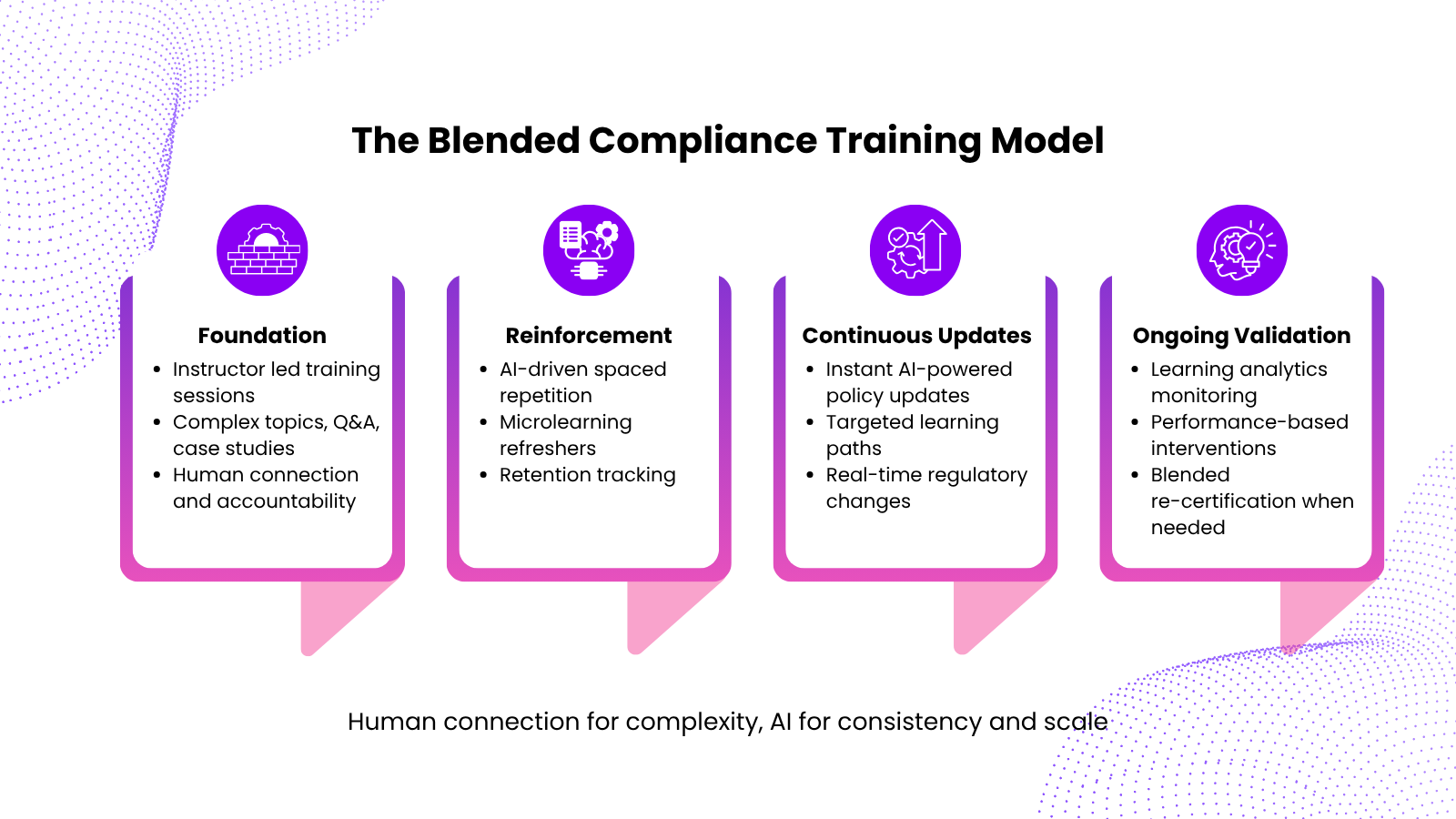
The breakthrough is using instructor-led learning sessions for foundation and complexity on topics like ethics frameworks, investigation procedures, and crisis response protocols, where nuance matters and questions vary widely and human facilitators establish baseline understanding and accountability that pure digital delivery cannot match. Each one’s strengths are employed with AI.  
 
After basic instructor-led learning sessions, AI-Based LMS platforms reinforce skills through microlearning modules that provide brief refreshers before high-risk activities, spaced repetition that keeps policies current without another classroom session, and learning analytics that determine who is retaining information and who needs intervention before compliance risks arise.  
 
AI handles rapid updates throughout the organization when rules change, allowing LXP platforms to incorporate new needs without laying off thousands of personnel. Instructor-led learning sessions can only discuss complex changes.

This in Practice

In this blended model, new hires attend instructor-led learning sessions on core policies like harassment prevention, data privacy, and ethics so facilitators can establish culture, answer questions, and create personal accountability within 48 hours. AI then reinforces skills through short scenario-based questions, policy refreshers, and progress tracking. 
 
When regulations change, AI-based LMS platforms deploy updates immediately through adaptive learning paths so affected employees receive targeted modules within hours rather than months. Complex changes that require interpretation still receive instructor-led learning, but only for those directly affected.  
 
Learning analytics show which departments have retention gaps, which topics need reinforcement, and who’s at risk before they become a compliance issue, so L&D can schedule targeted instructor-led learning sessions according to data rather than annual requirements.  
 
This creates compliance training that scales without sacrificing depth, maintains consistency without losing human connection, and allows ongoing learning without coordination issues. 

Infrastructure that allows it

This model requires technology designed for integration rather than replacement, where modern LXP platforms track who attended in-person sessions and automatically trigger reinforcement sequences based on what was covered.  
 
The system organizes instructor-led learning just when complexity requires it and handles everything else through intelligent automation. It remembers when policies were last reviewed, which employees need refreshers, and where knowledge gaps are growing.  
 
This foundation allows compliance training programs to influence people’s thinking and behaviour and reduce millions in violations. 

The Non-Choice

Still wondering whether to utilize instructor-led leaning or AI for compliance training? You’re on the wrong track. The better question is, how do we use both strategies optimally?  
 
Not selecting sides is the answer. Compliance training should respect human and technological strengths. When individuals need to discuss, argue, and acquire genuine understanding, use instructor-led learning. When they need to stay sharp, recall what matters, and keep up with changing laws, use AI.

29 3

The Development of Learning and Development Metrics: What Next-Gen Learning Platforms Assess 

The Development of Learning and Development Metrics: What Next-Gen Learning Platforms Assess

The dashboard for your learning platforms is full. Completion rates reached 92%. The average involvement time appears to be high. Enrolment in the course is now open. “Are we ready for the transformation?” asks the leadership. The answer isn’t there when you scroll through the data. 
 
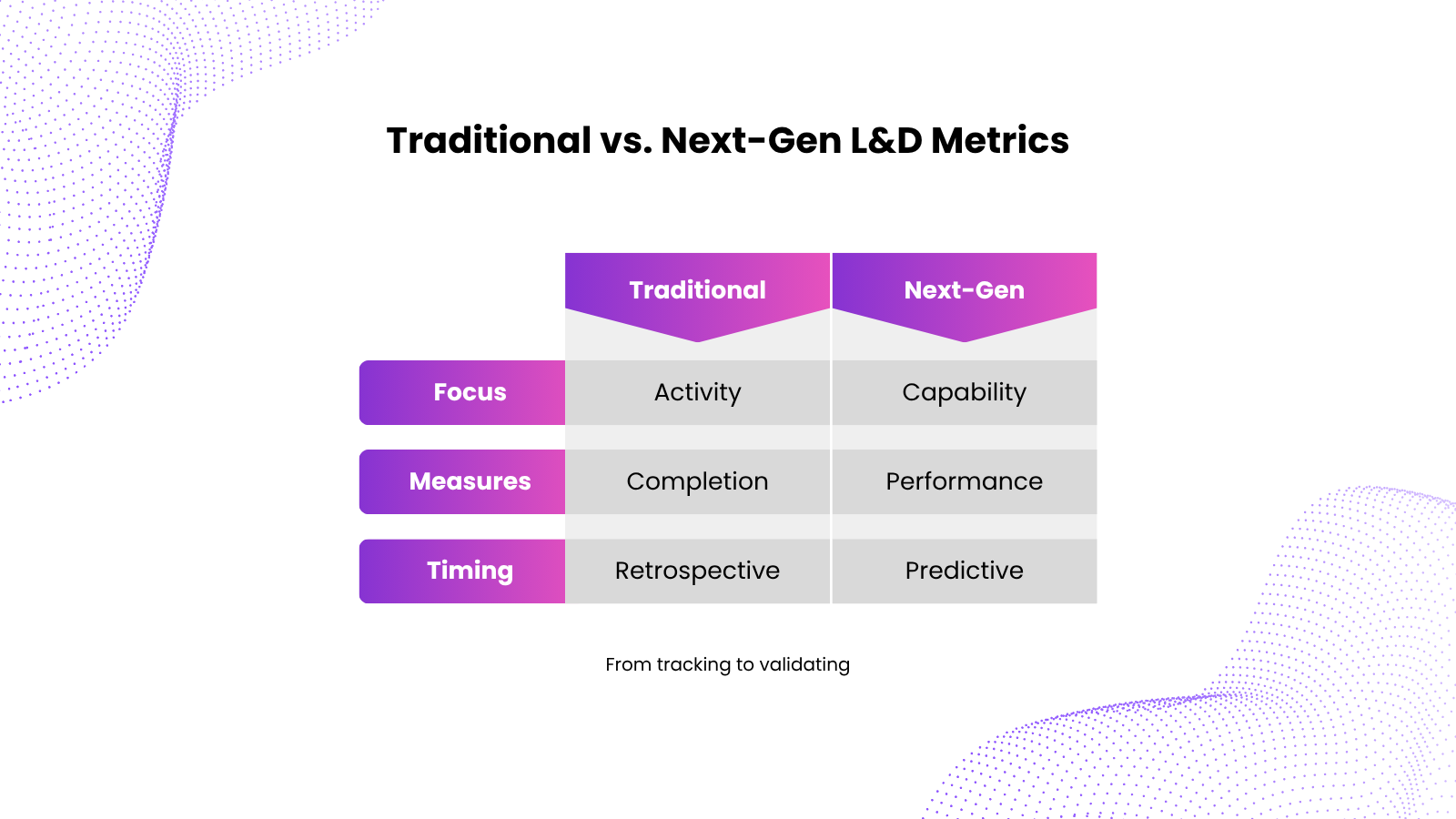
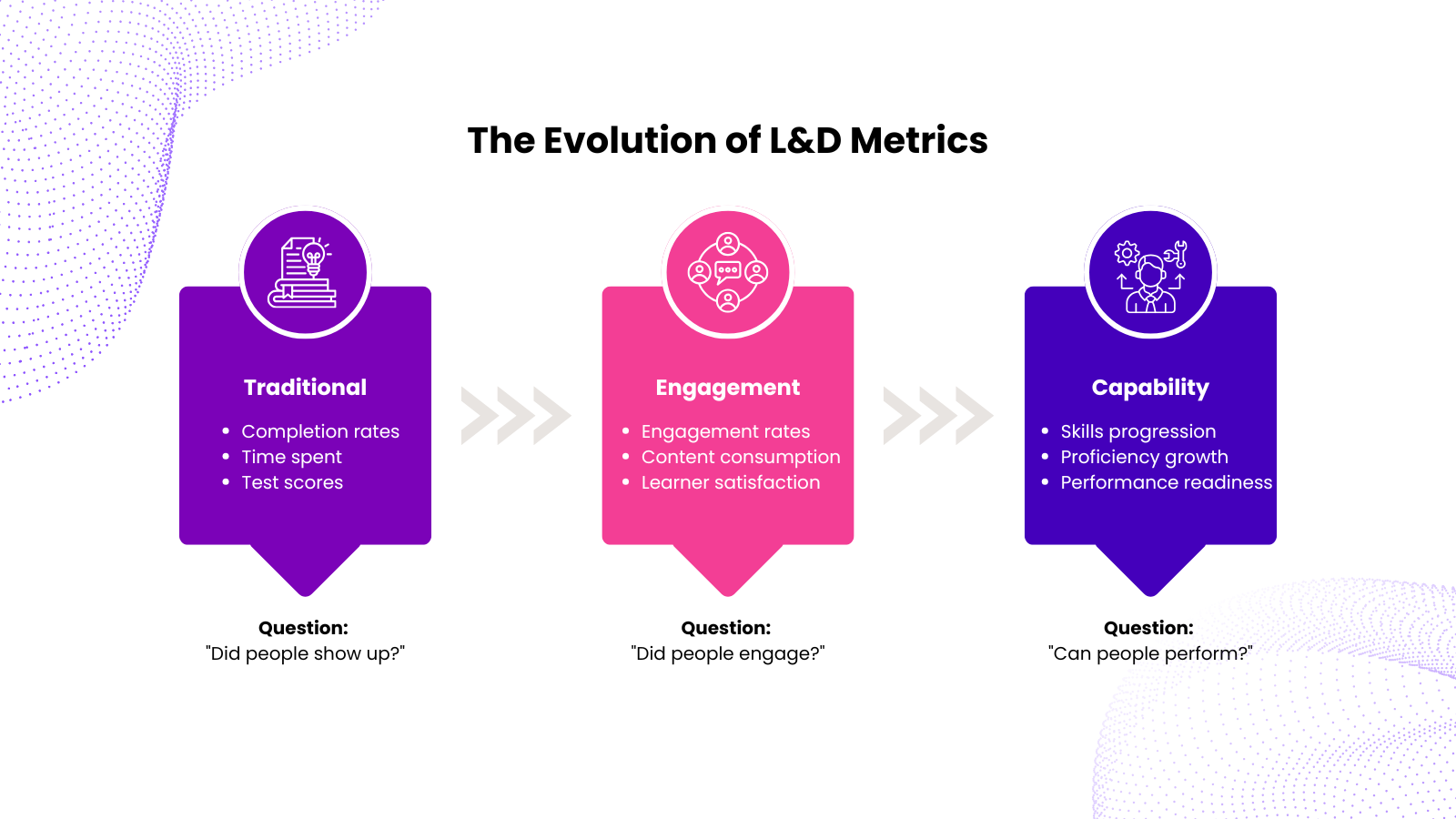
This is because conventional L&D measurements were created for a different time, because it was simple to monitor, as they measure activity. Clicks, logins, and completion. However, tracking activities doesn’t reveal whether your employees can execute, adapt, or perform when it counts most.  
 
The metrics used by next-generation learning platforms are completely different.

What Conventional L&D Metrics Really Monitor

For many years, L&D metrics concentrated on easily measurable factors, such as completion percentages, assessment scores, time spent in classes, and participation rates. In compliance-driven settings where the objective was to demonstrate that individuals attended required programs, these measures were useful.  
 
As these figures were easy to record and publish, traditional learning platforms built their dashboards around them. HR might show that it is committed to staff development, as L&D may exhibit activity. Charts showing an upward trend were visible to executives.  
 
When businesses discovered that high completion rates were unrelated to capability growth, a problem arose. Teams completed leadership development courses but were unable to take the lead. Despite completing product training, sales representatives found it difficult to interact with customers. Despite passing tests, engineers were unable to apply their knowledge to actual tasks.  
 
One topic is addressed by traditional L&D metrics, and this is Did learning occur? However, they are unable to address the important questions, which are “Can people perform? Where are gaps in capability emerging? Does education have an impact on business?”.

What Next-Generation Learning Platforms Assess Instead

The foundation of contemporary learning systems is a radically new idea that measure competence rather than conformity, monitors skill development rather than just involvement, and verifies people’s abilities rather than just what they’ve eaten. 
 
Development of Skills Over Time Next-generation learning platforms monitors learners progress from novice to competent to proficient rather than completion percentages. They track the development of skills throughout the workforce, determining who is progressing, who is stagnating, and where interventions are required before performance declines.  
 
Effectiveness of Skill Reinforcement Knowledge and capability are separated by skill reinforcement. Platforms for advanced learning monitor the transfer of knowledge from short-term to long-term memory. They determine the best intervals for reinforcement, measure retention curves, and confirm that learning continues after the test.  
 
Indicators of Performance Readiness Learning and business outcomes are linked by the most advanced L&D indicators. Can this group implement the new plan? Are these workers prepared to change roles? Which groups will be impacted by upcoming initiatives due to major capacity gaps? Real-time answers to these queries are possible with AI learning platforms that incorporate learning analytics.  
 
These AI learning systems forecast future events in addition to reporting past events. Which patterns of skill development point to future success? Where are gaps starting to appear before they become issues? Which interventions promote the quickest growth in capability? 

The Intelligence That Transforms Everything

Better measurement is only one aspect of the advancement of L&D metrics. Better results are the goal. Organizations may finally link learning investment to business effect when next-generation learning platforms assess skill development rather than completions. 
 
Infrastructure built from the ground up for capability measurement is needed for this change. As they were not designed with skills intelligence in mind, traditional learning platforms are unable to retrofit these contemporary L&D measures. Instead of developing capabilities, they were designed to manage material.  
 
Instead of asking, “Did people finish the course?”, AI learning platforms ask, “Can people perform the task?”. What is measured, how it is measured, and what is made feasible are all altered by that question.  
 
Predictive capability modelling, automated skill gap detection, adaptive skill reinforcement scheduling, and real-time workforce readiness indicators are just a few of the L&D metrics made available by the intelligence built into these platforms. These aren’t small advancements over conventional measurement. They represent a basic rethinking of what learning platforms ought to monitor.  
 
The development of L&D measures isn’t a nice-to-have improvement for companies who take workforce capability seriously. The infrastructure is what distinguishes learning impact from learning activity. In addition to measuring differently, next-generation learning platforms measure what really counts.