Data has always been abundant in learning and development, but insight has always been lacking. Dashboards are filled with completion rates, attendance records, and assessment results, yet judgment is frequently used. This gap between data and action is growing intolerable as firms deal with quicker skill transitions and more stringent performance standards. Here, AI and automation are transforming how L&D decisions are madenot by increasing the number of reports, but by radically altering the process of generating insight.
From Activity Reporting to Impact Understanding
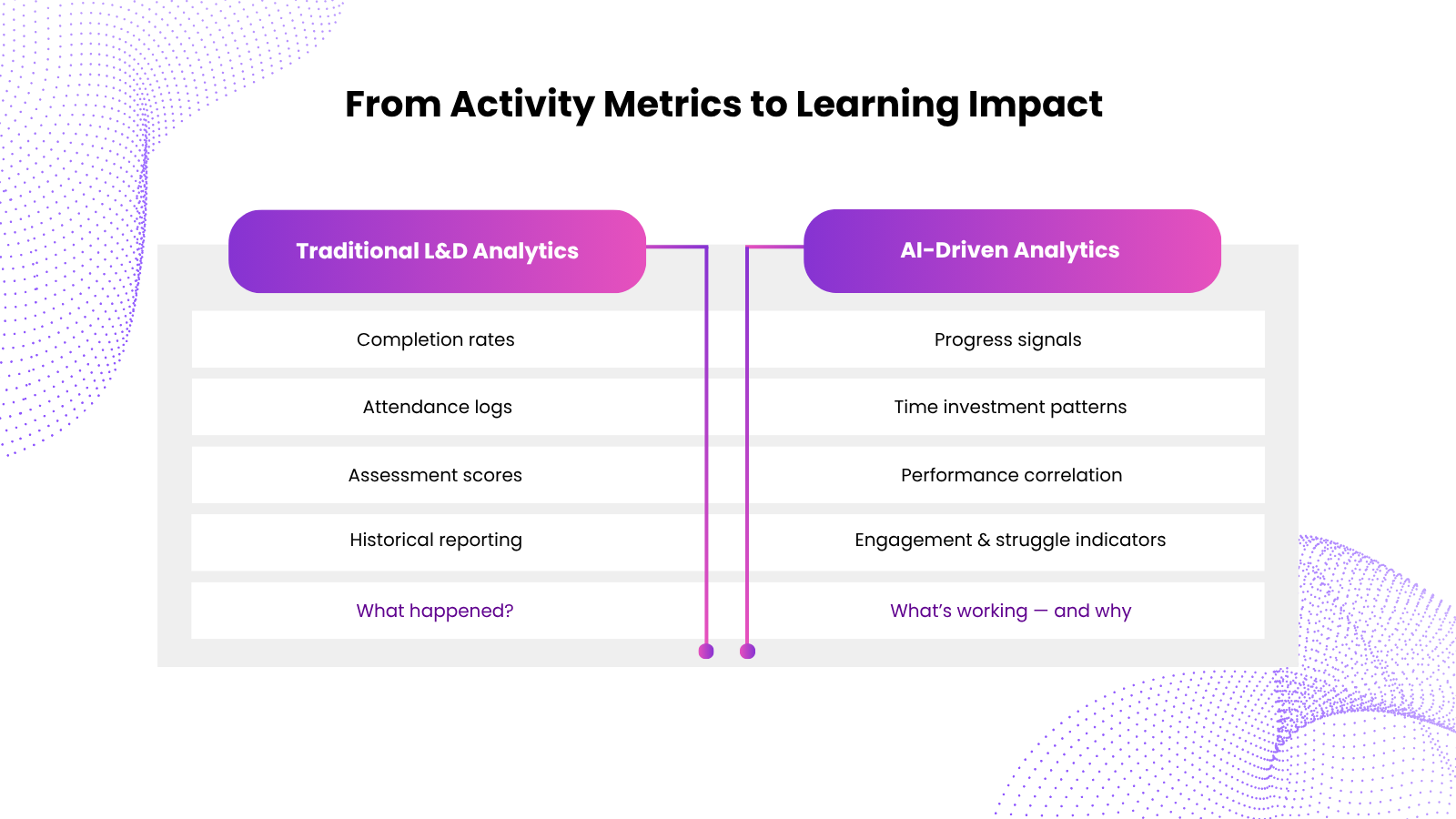
Conventional L&D analytics concentrate on Who finished a course? How much time did it take? What was their score? These indicators are helpful for tracking operations, but they don’t provide much information regarding application, readiness, or actual capability growth. The emphasis is shifted from action to impact via AI-driven analytics. Granular learning behaviours are tracked by contemporary platforms like Skillzen, which provide a far more comprehensive view of how learning occurs throughout the company. This includes thorough progress tracking that shows learners where they are in their journey in real time and identifies individuals who have accelerated or stagnated. Time investment analysis aids L&D in understanding how employees allocate their learning hours among skills and modules in addition to completion. Performance correlation shows which learning strategies produce the best results by linking assessment results with time spent. Engagement patterns show where drop-offs happen, which formats are popular, and when students are most engaged. Struggle indicators identifyideas or modules where workers requireassistance before their performance suffers. This analytical depth turns unprocessed data into useful intelligence through AI in L&D.
Automation as a Multiplier for Decisions
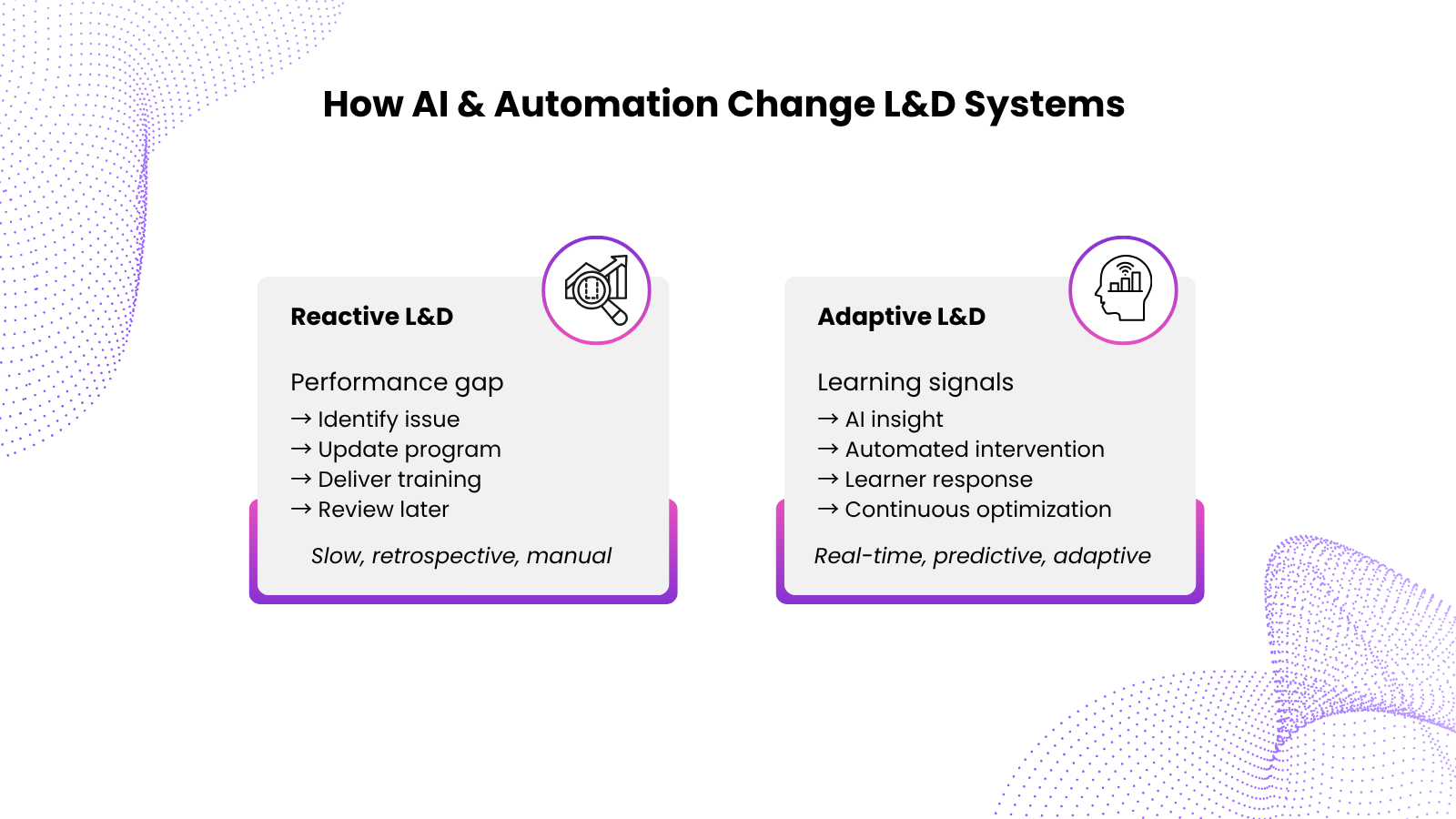
Administrative efficiency is only one aspect of automation in L&D. Program scheduling, reminders, and enrolment management are useful, but cognitive support is where the real transformation occurs. Learning paths can be dynamically modified using AI and automation in response to student behaviour, engagement signals, and new skill gaps. When students struggle or become disengaged, interventions may be initiated automatically. Without human supervision, feedback loops run endlessly. Crucially, human expertise cannot be replaced by machines. By reducing cognitive load, it frees up L&D leaders to concentrate on strategy rather than coordination.
Converting Signals into Strategic Knowledge
The capacity of AI-driven analytics to link learning data with business context is one of its most potent contributions. It is possible to analyse learning behaviours, performance results, role evolution, and skill demand collectively rather than separately. L&D teams can confidently respond to strategic questions because to this integrated picture. Which skills are improving and which are stagnating? Where is the measurable impact of learning investment? As corporate priorities change, how should programs change? Learning transitions from a support role to a strategic partner in line with organizational goals when AI is integrated into L&D.
Systems: From Reactive to Adaptive
L&D systems react slowly in the absence of intelligence. Programs are changed on a regular basis, needs are determined after performance gaps emerge, and insights frequently come too late to affect results. Automation and AI make L&D systems more adaptable. They continuously learn from interaction and outcome data, optimize learning journeys, improve suggestions, and change with the workforce. Instead of reacting after change, learning systems start to react at its speed.
A New Role for L&D Leaders
The job of L&D leaders is changing in tandem with the development of AI-driven analytics. They are now more valuable in interpreting insight, forming strategy, and directing organizational competence than in managing content or programs. AI makes everything clear. Scale is provided via automation, and direction is provided by leadership. When combined, they make it possible to make better decisions, not because people give up, but rather because they have more knowledge.
Stronger Impact, Wiser Decisions
The goal of L&D transformation is not to substitute algorithms for human judgment. It involves using technology that can recognize trends, foresee requirements, and take large-scale action to supplement human decision-making. AI in L&D and intelligent automation are becoming crucial to making learning responsive, quantifiable, and in line with business objectives as firms manage continuous change. The product is an L&D function that is clever by design in addition to being efficient.