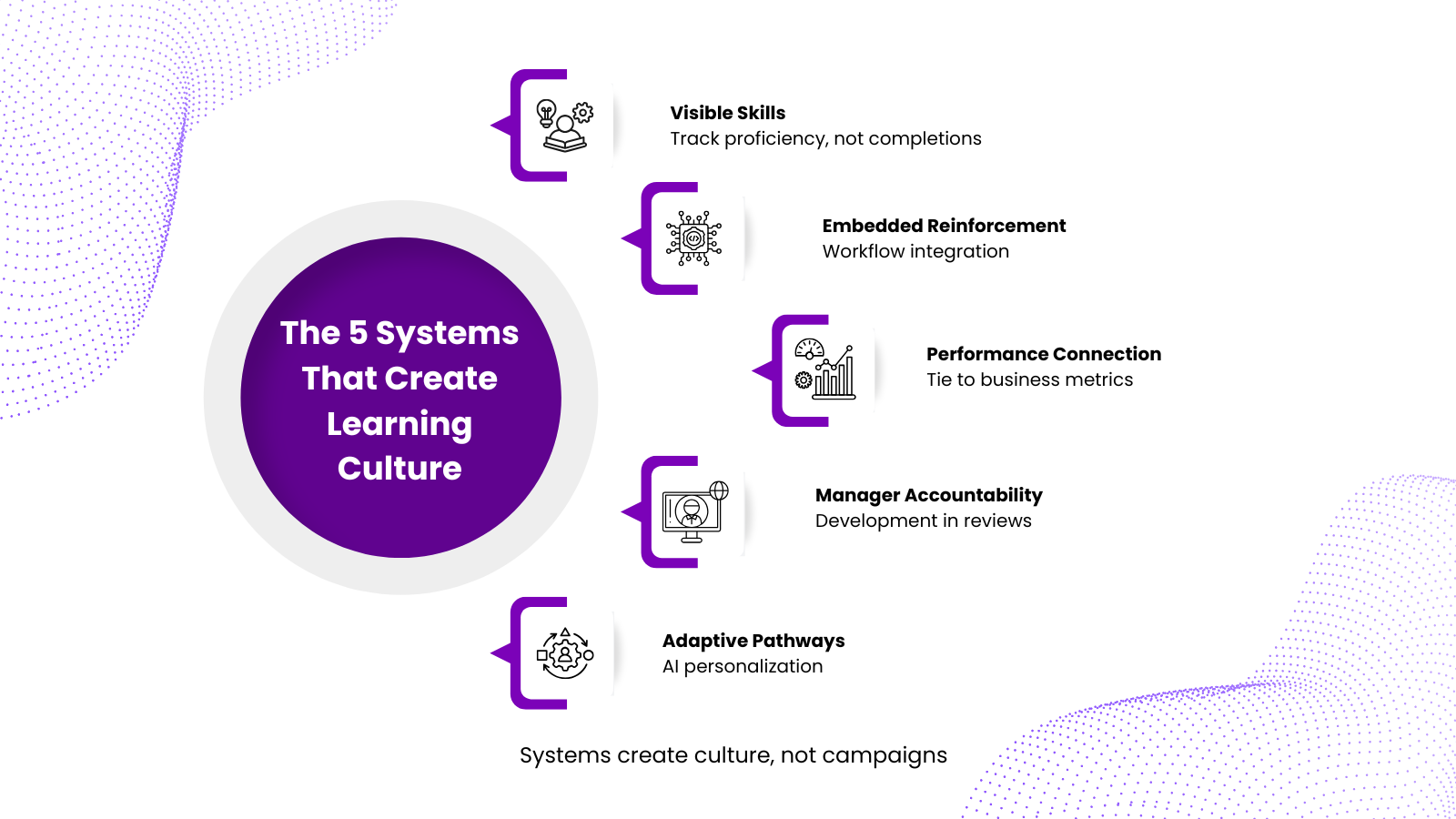
System 1: Ensure that the progression of skills is visible and measurable
The existence of a learning culture is contingent upon the transparency of who is aware of what and where gaps are forming. Track demonstrated skills rather than courses completed, map roles to capabilities, and connect learning to validated competencies in LXP platforms.
System 2: Integrate Skill Reinforcement into the Workflow
One-time learning results in forgetting, as 70% of information is lost within days in the absence of skill reinforcement. Incorporate reinforcement into the workflow, prioritize microlearning before tasks, implement spaced repetition, and implement just-in-time practice.
System 3: Connect Performance Outcomes to Learning
Learning culture is unsuccessful when it is perceived as being disconnected from the workplace. Establish a connection between each learning path and a performance outcome that is of interest to executives. For example, align sales learning with deal velocity and technical learning with deployment speed. Learning becomes a performance lever when metrics that leadership monitors indicate that skills are improving.
System 4: Establish Managerial Responsibility for Team Development
When managers are not held accountable for the development of their organizations, learning culture is extinguished. Establish team development as a permanent agenda item during one-on-one meetings, incorporate it into manager evaluations, and provide managers with dashboards that illustrate the progression of team skills and the areas in which they are lacking.
System 5: Establish Adaptive Pathways, Not Static Catalogues
A genuine learning culture necessitates personalization, in which learning is tailored to the individual’s knowledge and the rate at which they are advancing. Modern LXP platforms offer adaptive pathways that are powered by AI, allowing advanced learners to advance while struggling learners receive assistance. This approach ensures that all learners have a learning experience that is meaningful.