There is a ton of data on your learning analytics dashboard. measures for engagement, time spent, assessment results, and completion rates. “Are we ready for the digital transformation?”, questions the leadership. You look over charts, but you can’t find the solution.The issue is that learning analytics reveals what transpired. It doesn’tindicate what people are capable of, where important skill gaps are developing, or who is prepared for the next phase. The majority of platforms gauge activity rather than aptitude. They do not bridge skill gaps, but they do monitor learning. Skillzen was constructed in a new way.
What Conventional Learning Analytics Really Measures
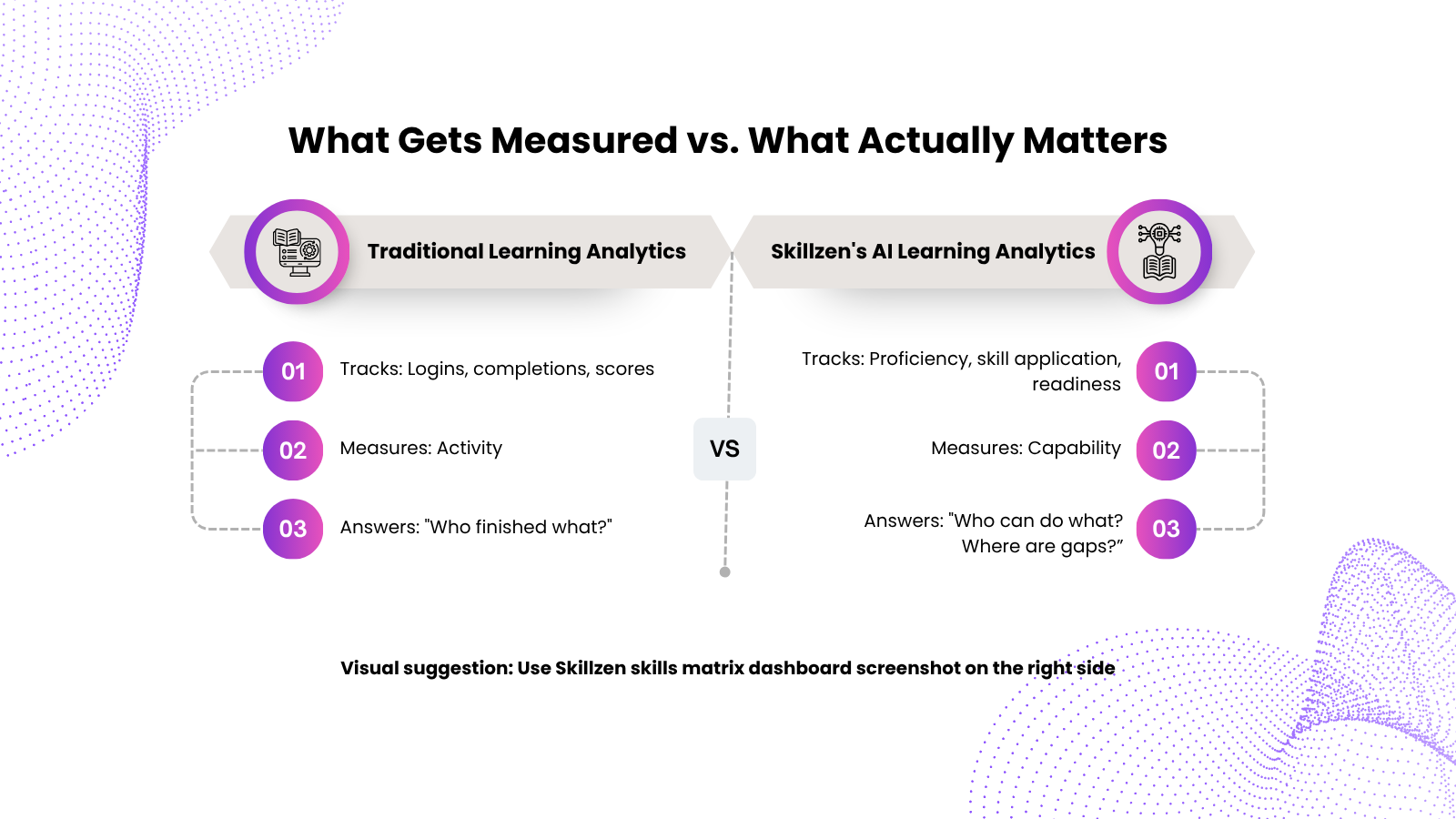
Conventional learning analytics systems are quite good at monitoring behaviour. They display your average time on task, quiz scores, module completions, and login frequency. This information is important for reporting and compliance. However, activity indicators are insufficient when your company needs to know whether engineers are prepared for the cloud migration or if the sales team can implement the new go-to-market plan. Since learning analytics was created to quantify consumption rather than abilities, it is unable to address capability problems on its own. The outcome? Despite investing in workforce learning analytics and producing eye-catching dashboards, organizations are still unable to detect skill gaps in the workforce before they have an adverse effect on performance. They are aware that individuals are learning. They are unsure of people’s performance abilities. A misleading sensation of progress is produced by this discrepancy between measurement and mastery. While crucial capabilities are still underdeveloped, L&D teams celebrate strong completion rates. While employees struggle with practical implementation, executives approve spending based on engagement numbers. The disconnect is structural rather than deliberate. Simply put, traditional learning analytics was created to validate people’s consumption rather than their abilities.
How Skillzen Fills Skill Gaps Rather Than Just Monitors Them
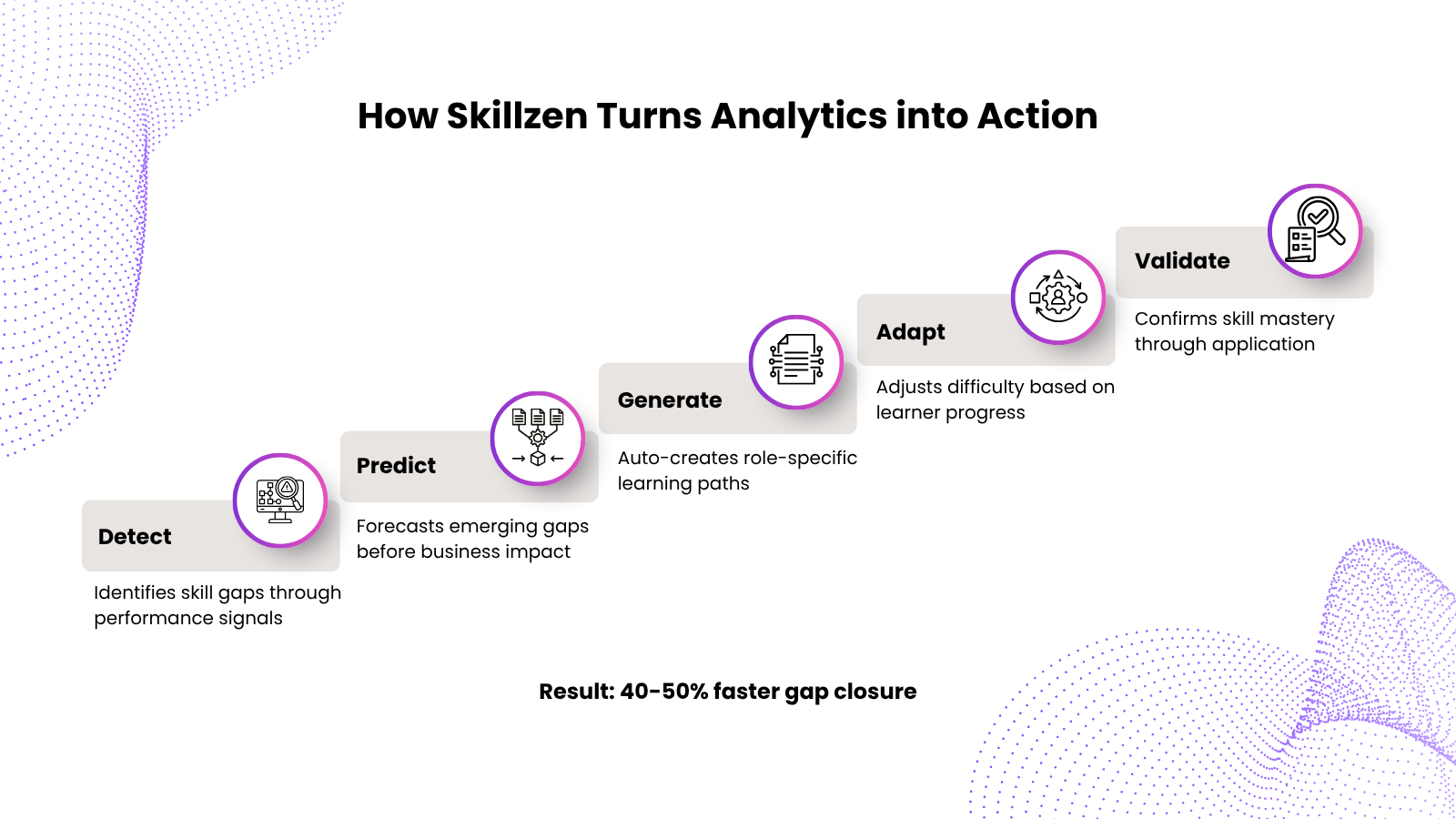
Skillzen does more than just find skill gaps. The platform employs AI learning analytics to identify the reasons for gaps, forecast the locations of future ones, and automatically modify learning to bridge them. The technology does more than simply highlight new skill gaps for L&D to manually fill when it finds them through performance signals. To transfer knowledge from short-term to long-term memory, it creates role-specific learning paths, modifies content difficulty in real time, and employs skill reinforcement strategies. This is the point at which Skillzen’s strategy deviates from conventional platforms. Skillzenacts rather than giving you a report on organizational skill shortages and letting you create courses by yourself. Adaptive learning journeys are created based on each learner’s demonstrated competency and are continuously modified in response to their performance. Personalization is just one aspect of the intelligence. Every interaction within the company is continuously analysed by Skillzen’s AI learning analytics, which finds trends in the development of abilities, common areas of difficulty for learners, and the interventions that lead to the quickest mastery. With every student, every course, and every skill certified, this combined intelligence makes the platform smarter. Skillzendoesn’t wait for L&D to step in, and organizations that adopt it report reducing skill gaps 40–50% faster. The AI learning analytics engine finds gaps, creates relevant information, and distributes it precisely when students need it. Role changes that used to take months now happen in a matter of weeks. New hires are 40–50% more productive. Prior to workforce readiness surpassing company needs, critical capabilities become stronger.
The System That Converts Knowledge into Capability
Learning analytics was never intended to be the final goal. It is the beginning. What really matters is whether you produce reports or capabilities after identifying skill gaps. You are visible on traditional platforms. You may act using Skillzen, as it develops skills, whereas others display dashboards. AI learning analytics does more than just measure; it also makes predictions, adjusts, and fills in gaps on its own. Workforce skill gaps are more than just statistics to monitor for businesses undergoing fast change. These are hazards to capabilities that call for quick, wise action. Skillzen offers the infrastructure to act before it becomes a business issue, as well as the intelligence to see what’s coming. More than ever, the difference counts. Organizations cannot afford platforms that merely notify issues as change picks up speed and capabilities deteriorate more quickly. They require systems to address them. They require learning analytics that not only guides but also propels decisions, transforming insights into observable capabilities and data into action. This is the distinction between learning analytics that transforms and learning analytics that informs.