Your compliance officer just celebrated a major milestone: 98% of the workforce completed the new data privacy professional training program, managers received their certificates, and audit readiness dashboards show green across the board. So when a data breach happens two weeks later because an employee shared customer information through an unsecured channel, leadership realises that completion rates told them nothing about whether people actually understood what they should and shouldn’t do.
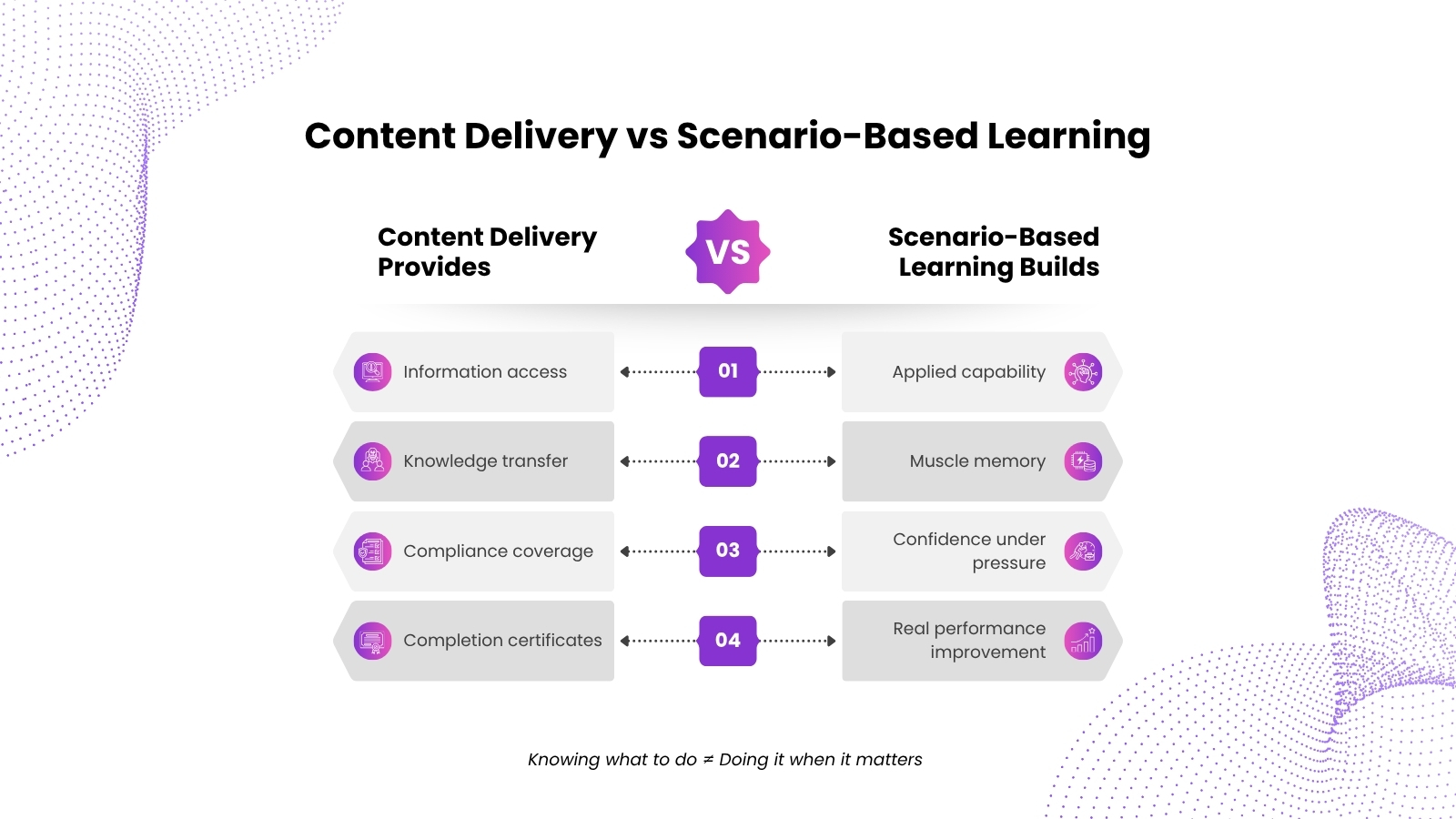
This is what happens when professional training treats learning as information transfer rather than capability building, where scenario-based learning creates the muscle memory that content delivery can never build because reading a policy and navigating a real-world judgment call are completely different challenges.
The Completion Illusion
Organisations measure professional training success by tracking who finished modules, passed tests, and received badges, but this measures engagement with content, not whether employees can actually perform when the stakes are real.
Think about it: a financial advisor can watch compliance training videos on regulatory requirements and still freeze during a client meeting when someone asks a question they didn’t anticipate, a project manager can complete leadership modules on conflict resolution and still struggle when their team is actually divided on approach, and a customer service representative can know company policy cold but panic when facing a genuinely upset customer because textbook knowledge doesn’t prepare you for the emotional pressure of real conflict.
Professional training based on content assumes people learn by consuming information, but real learning happens when people must make decisions, face consequences, and adjust their approach, and without that experience, employees return to work with knowledge they’ll likely forget before they ever need to use it.
How Real Learning Actually Happens
The organisations that build genuine capability don’t train people on what to think, but put people in situations where they have to think, decide, and live with the consequences of those decisions in a safe environment where mistakes become learning rather than disasters.
Scenario-based learning works because it forces the same neural pathways that real work demands: an employee navigates a difficult customer conversation where their responses determine whether the customer stays or leaves, a manager faces a team member who’s underperforming and has to decide what conversation to have and how to have it, a compliance officer encounters an ambiguous situation that doesn’t have a clear policy answer and has to apply principles to decide the right move.
This creates skill reinforcement not through repetition of facts but through repeated decision-making where each scenario teaches something new because context matters. The same customer objection plays out differently based on customer emotion, the same team conflict requires different approaches based on personalities, and the same compliance question changes based on business context, so employees learn that capability means adapting to reality, not following scripts.
AI Makes Scenario-Based Learning Possible at Scale
The reason most organisations don’t use scenario-based learning is practical: creating thousands of realistic, role-specific scenarios that stay current as business changes is a massive resource drain that most L&D teams can’t support.
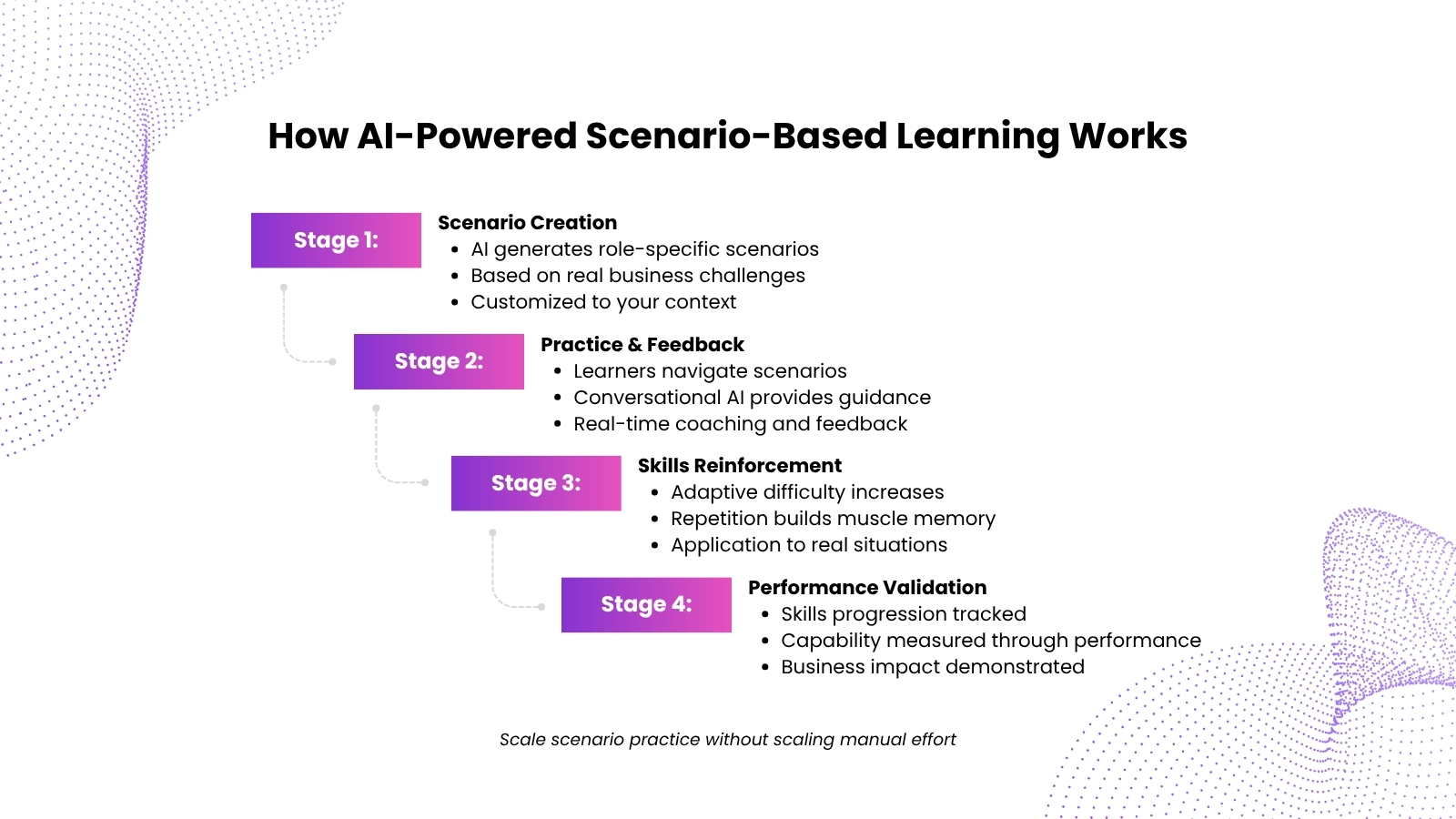
AI changes that equation by generating contextual scenarios in minutes based on your actual business challenges, continuously adapting them as your industry, regulations, and strategies shift, and providing personalised coaching in the moment where the conversational AI doesn’t just tell learners the right answer but asks questions that guide them toward their own insights.
This means professional training can finally scale with quality, where a sales team in London practices handling the same customer objections as the sales team in Singapore but with scenarios customised to their regional market. A compliance program updates automatically when regulations change rather than waiting for the next training cycle, and skills progression becomes measurable through how learners perform in increasingly complex scenarios rather than through test scores.
The Performance Gap That Content Can't Close
Organisations measuring professional training by completion rates will keep celebrating numbers that predict nothing about actual performance, where employees will continue to struggle with judgment calls that weren’t explicitly covered in modules and managers will keep discovering capability gaps only when they surface as customer complaints or compliance issues.
The organisations that shift from content-based training to scenario-based learning will see something different: employees who stay calm under pressure because they’ve practised difficult situations repeatedly. Teams that make better decisions because they’ve learned to adapt principles to real context, and compliance programs that actually prevent violations because people understand the why behind policies, not just the rules themselves.
Professional training that delivers content is efficient to create and easy to measure. Scenario-based learning is harder to build, but it actually changes how people perform. Only one of these matters to your business.