We are reaching a turning moment in enterprise learning. Learning management systems promised control, consistency, and scale for many years. They provided structure, but not flexibility. Today, businesses are facing a harsh reality which is, that learning systems built for content management cannot keep up with capability development as jobs change more quickly than curricula and abilities deteriorate more quickly than they can be taught. This is where the transition from a conventional LMS to an AI-native platform starts, not as a feature enhancement, but rather as a fundamental rethinking of how learning functions within the company.
Managing Education to Facilitating Performance
Conventional LMS systems were designed to address operational queries such as who finished what? At what score and when? These methods are effective for systematic training, onboarding, and compliance, but modern Enterprise solutions demand learning that adapts to individuals, contexts, and real work. Courses are not the beginning of an AI-powered platform. It starts with the learner, their role, their goals, and the problems they are trying to solve. Learning is no longer an event to be scheduled but a continuous process embedded into daily work.
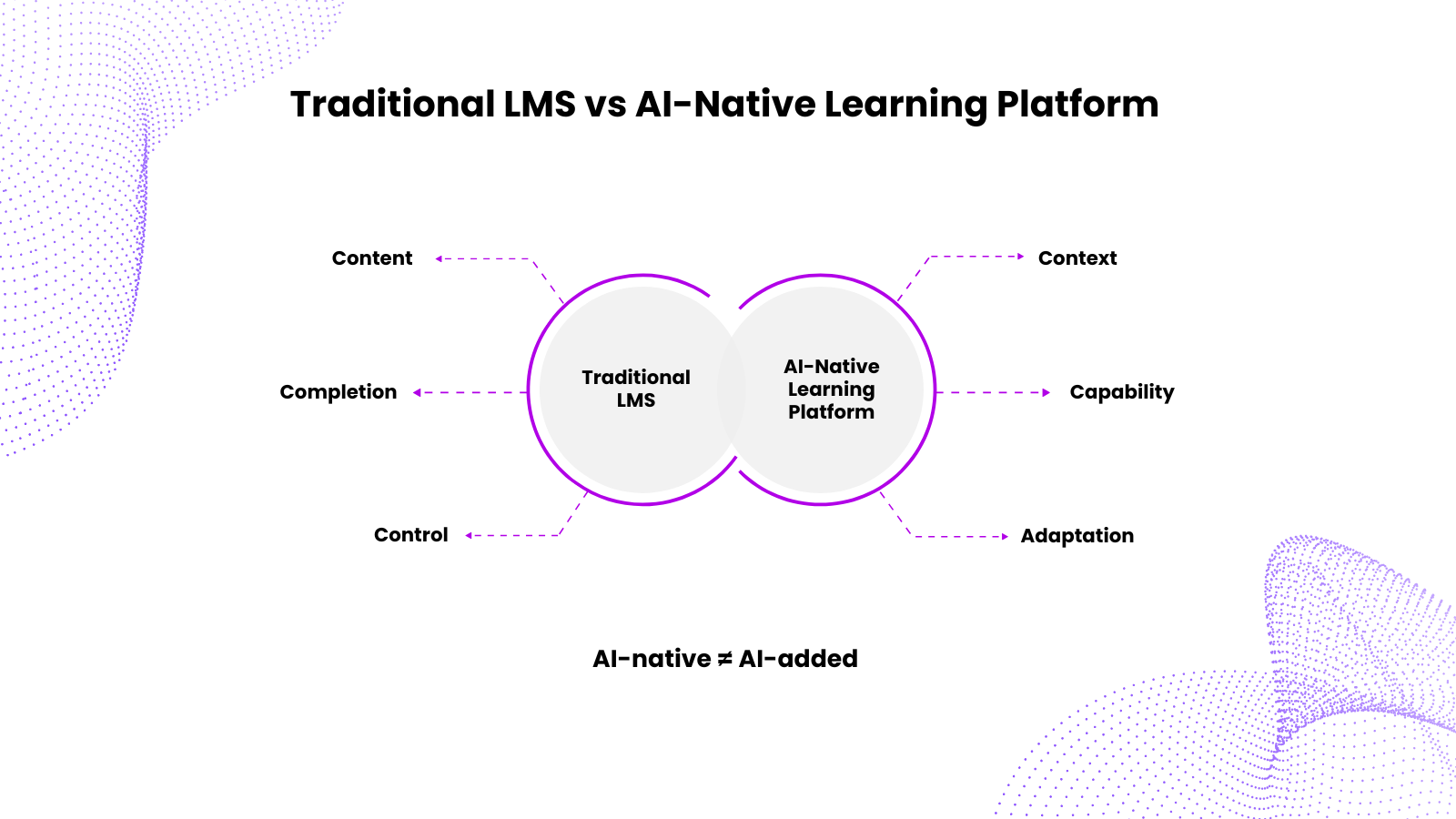
AI-Added Is Not AI-Native
Many platforms today claim intelligence because they’ve added recommendations or chatbots on top of legacy architectures, but an AI native platform is designed with intelligence at its core. AI is the operating system, not just a layer.
This distinction is important. Data from learner behaviour, performance signals, and feedback loops is always flowing in AI-native systems. As the learner gains knowledge, so does the platform. This makes it possible for enterprise solutions to transition from static paths to real-time, adaptive learning experiences. An AI-powered platform anticipates demands, finds gaps, and dynamically modifies learning methodologies in addition to responding to inputs.
Learning with a Contextual Understanding
Learning rarely occurs in isolation in real-world organizations. It takes place in the face of uncertainty, pressure, and shifting priorities, because they view learning as being disconnected from context, traditional LMS platforms struggle in this area. Situational learning is understood by an AI-native platform. It detects whether a student is experimenting, having difficulty, using, or becoming proficient in a skill. This makes learning a performance enabler rather than a distraction by enabling micro-interventions, reflecting prompts, and just-in-time support. This contextual intelligence is essential for contemporary enterprise solutions. It guarantees that learning is in line with company objectives rather than just learning metrics.
From Capability Systems to Content Libraries
The shift away from content fixation is one of the most significant changes brought about by AI-native platforms. Although content is still important, it is no longer the focus. An AI-powered platform emphasizes capabilities, such as what people can accomplish, rather than what they have eaten. Through practice, feedback, and interaction, skills are deduced, confirmed, and strengthened. The platform gradually creates a dynamic skills graph that is specific to each function and learner. Enterprise solutions can assess learning effects in terms that are important, such as preparedness, confidence, and performance on the job, thanks to this capability-first approach.
Enterprise Learning's Future Will Be Adaptive by Design
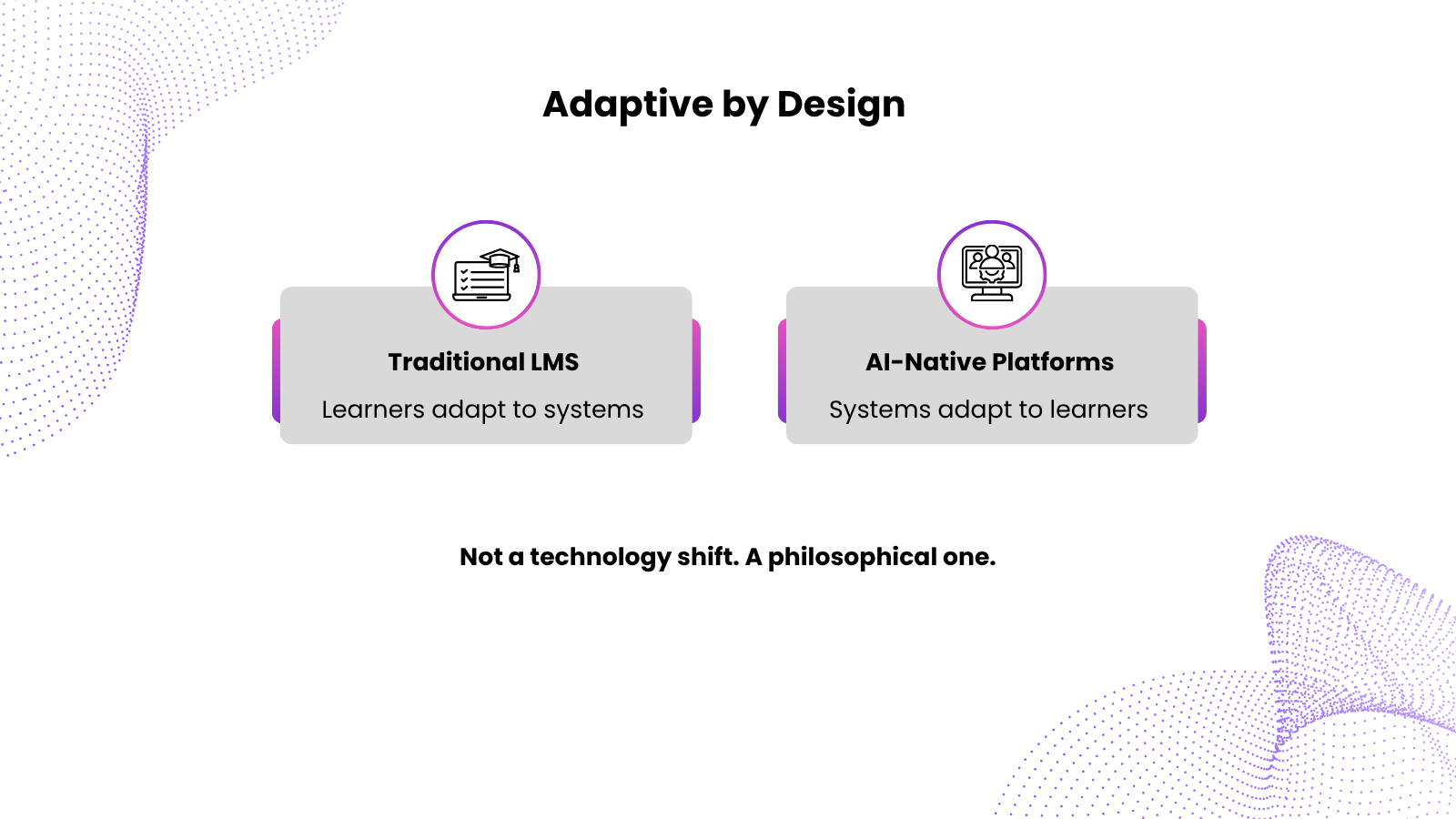
Learning systems must change from being passive repositories to becoming cognitive partners as AI transforms the workplace. Human judgment and instructional design are not replaced by an AI-native platform. By managing complexity at scale, it magnifies them. An AI-powered platform’s true potential is in its capacity to bridge intent and execution, coordinating personal development with corporate objectives. This is a need, not a luxury, for businesses managing ongoing change. In the end, there is no technological difference. It is philosophical. Conventional LMS solutions require students to adjust to the system. In the coming years, enterprise learning will be redefined by AI-native platforms that adjust the system to the learner.