The Hidden Costs of Unstructured Documents: Why Intelligent Document Processing (IDP) Matters More Than You Think

One trend continued to emerge with unsettling consistency after working with firms in the fields of logistics, healthcare, and BFSI.
Despite teams investing in automation platforms, implementing new software, and digitizing their workflows, the same barrier persisted. Compliance officers were still reconstructing audit trails from the beginning, since no one had properly structured the records the first time. Analysts were still straining at fuzzy PDFs, and finance teams were still re-entering invoice data that already existed someplace else.
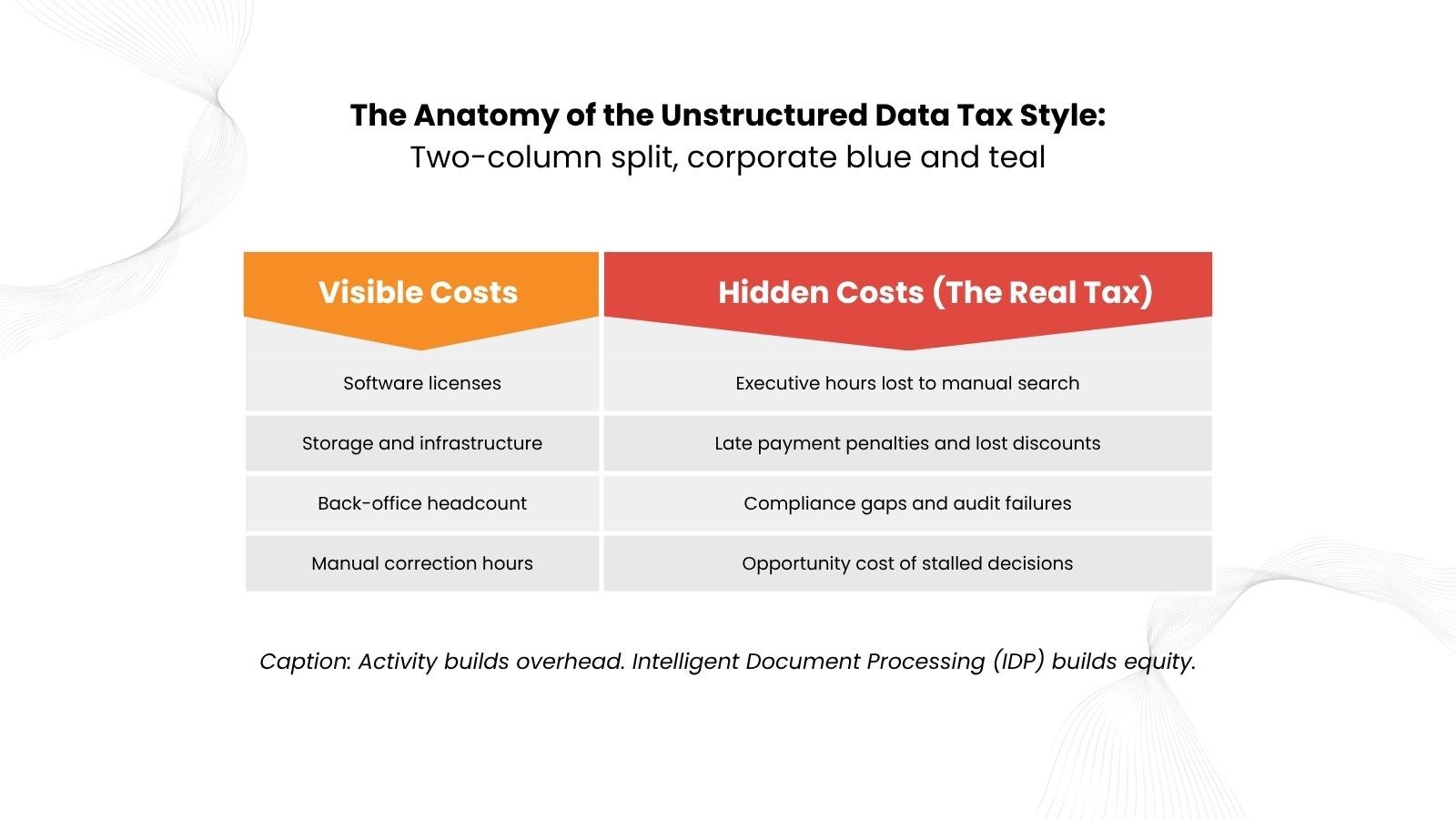
Most businesses pay this tax known as the Unstructured Data Tax without ever recognizing it.

Most of the companies we’ve dealt with already have document automation solutions, so that was not the issue. Without intelligence, automation only accelerates chaos, and when chaos accelerates, hidden costs do not decrease. They simply becoming more difficult to locate.

The Myth of the "Digital" Document

Having a PDF is not the same as having data. If a human still needs to open that file, read it, extract a number, and type it somewhere else, that document is Dark Data, which is unstructured, unindexed, and expensive. It is a 1990s paper problem wearing a digital costume.

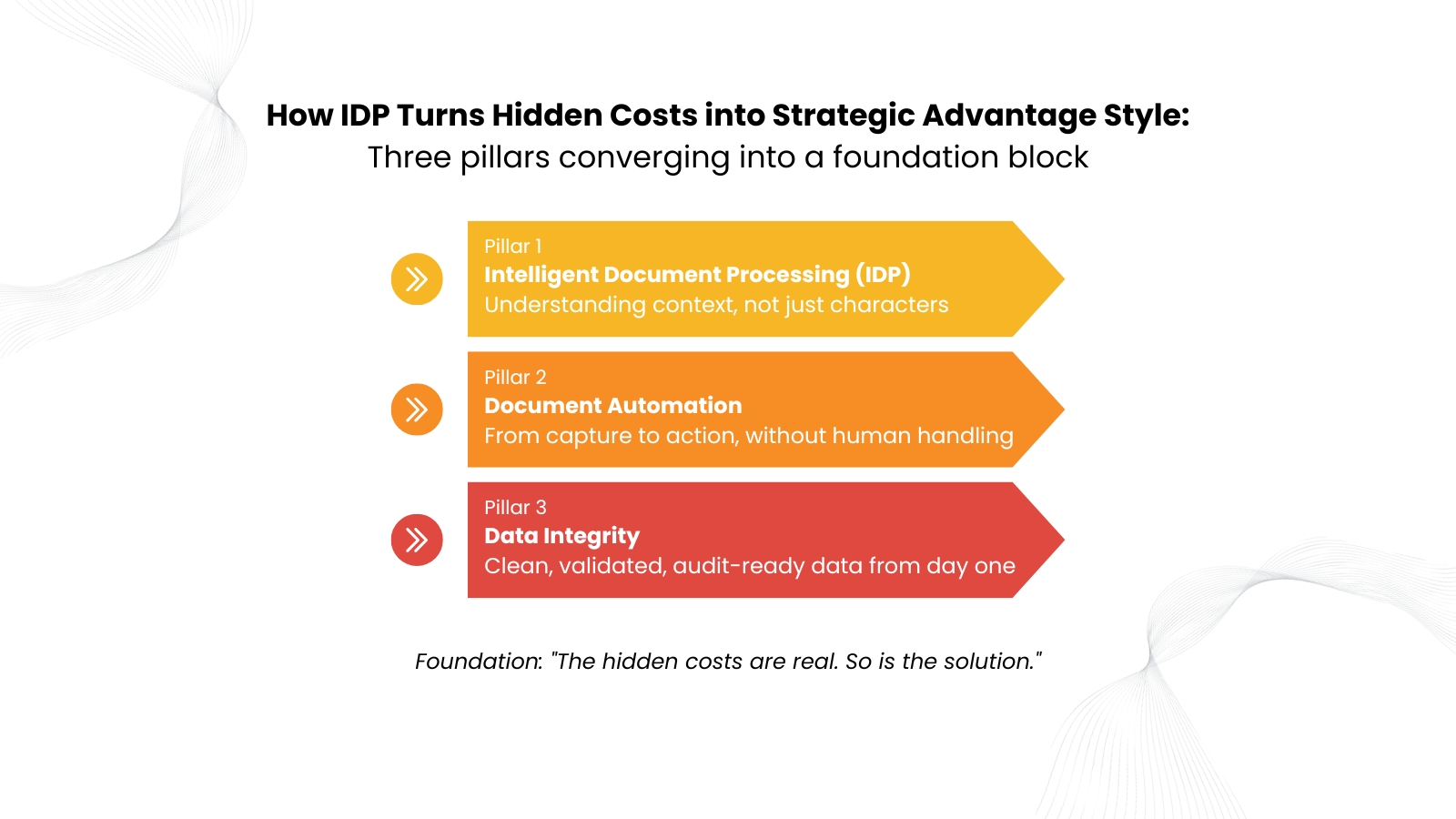
Most organizations respond by adding headcount or deploying legacy OCR tools, but legacy tools recognize characters, not context. The moment an invoice arrives from a new vendor in a slightly different format, it becomes an exception, exceptions pile up, and the team that was supposed to benefit from Document Automation ends up managing its failures instead.

This is the Digital Plateau, where automation stalls at 60%, the remaining 40% becomes someone’s full-time job, and leadership wonders why the ROI never arrived.


The 3 Hidden Costs Nobody Puts on the Agenda

Cost 1: The Productivity Black Hole 

Employees spend up to 30% of their working day searching for information trapped inside unstructured files. Multiply that across an organization of 500 people and it stops being an inconvenience and becomes a strategic liability. Intelligent Document Processing (IDP) fixes this by making every document searchable, structured, and automatically routed to the right person the moment it arrives. 

Cost 2: The Error Multiplier 

Manual data entry carries an error rate of 1 to 3%, which sounds harmless until you trace a single wrong digit from an invoice through purchase order matching, ERP posting, and supplier reconciliation. One keystroke has now touched six systems and three teams. Document Automation driven by AI validates data against existing records before it ever reaches your systems, cutting the cascade off before it begins. 

Cost 3: The Compliance Time Bomb 

In regulated industries like BFSI, healthcare, and government, unstructured documents don’t just create friction; they create liability. When an auditor asks for every document tied to a specific vendor or transaction, “it’s somewhere in the shared drive” is not an answer. Intelligent Document Processing (IDP) builds audit trails automatically and ensures the organization is always ready, not just in the weeks before a scheduled review. 

Stop Paying the Tax and start Building Intelligence. 

The organizations winning in 2026 have stopped treating documents as administrative work and started treating them as data assets. Every invoice, every contract, every report carries intelligence inside it and leaving that intelligence unstructured is a choice that comes with a price tag, whether it appears on the balance sheet. 

Intelligent Document Processing (IDP) is not a technology upgrade, but a financial decision, and the math is straightforward. The question is no longer whether your organization can afford to implement it. The question is how much longer you can afford to keep paying the tax without it. 

DocxIQ doesn’t just process your documents, it liberates your data. 

Shopping Basket