AI now comprehends how you learn rather than merely providing you with facts. Learning platforms have always prioritized delivery, including material uploads, module pushes, and completion metrics. Delivery, however, is not learning. When technology comprehends the learner as well as the instruction, it truly makes a breakthrough. The nexus of artificial intelligence and cognitive science, where technology adjusts to human cognition rather than the other way around, holds the key to the future of education.
Learning Theories: The Science of Human Learning
Understanding human learning is a prerequisite for developing intelligent systems. It’s not conjecture. It is the result of decades of studying psychology condensed into useful frameworks. Behaviourism: Reinforcement’s Power Measurable results, feedback and corrections, and repeated practice all contribute to learning. These ideas apply into sophisticated tests and analytics that pinpoint areas in which learners require reinforcement in AI-powered and adaptable learning environments. When you struggle, the system recognizes it and automatically gives you focused practice. Cognitivism: Comprehending Mental Functions Cognitivism is concerned with the processing, storing, and retrieval of information. AI systems based on these ideas do more than just score; they understand why errors happen. Did the learners lack basic knowledge? Was the subject matter too complicated? As a result, each learner receives the appropriate challenge at the appropriate time thanks to an adaptive learning pathway that reorganizes the experience in real time. Constructivism: Using Experience to Build Knowledge We develop comprehension through context rather than by absorbing data. This notion is being used by AI systems to map prior knowledge and modify lectures to make connections with what learners already know. Each learner’s route becomes distinct due to their performance, experience, and advancement.
Adaptive, Multilingual, and Multimodal Education: Unrestricted Customization
Everything comes together at this point. Based on learner’s data, true adaptive learning continuously modifies content, tempo, and difficulty. However, intelligence is insufficient on its own. Additionally, inclusivity is important.
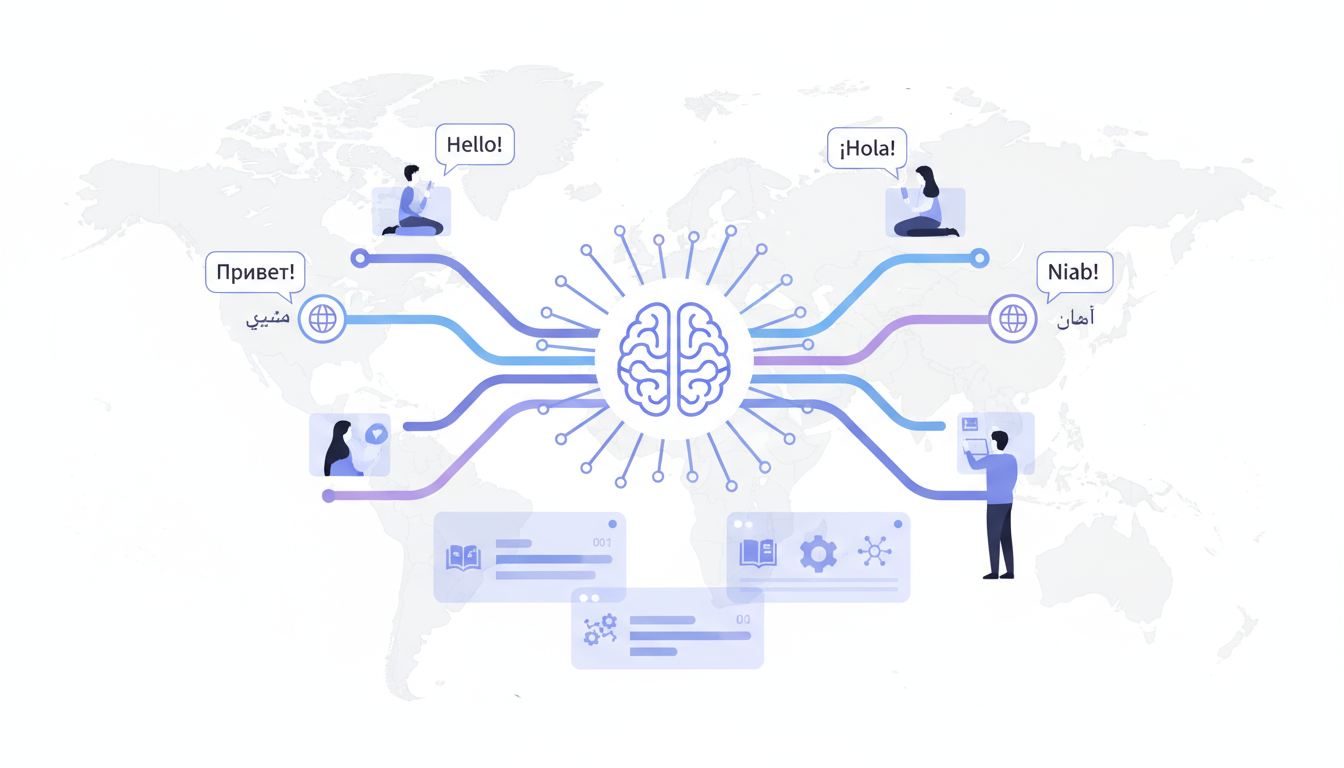
If employees are unable to receive learning in the language or format of their choice, a multinational corporation cannot effectively train its employees. Learning multiple languages guarantees that subtlety and context are maintained rather than lost in translation. The way that humans learn best through sight, hearing, interaction, and experience is respected by multimodal design. This method creates a tailored and inclusive learning environment when combined with adaptive learning intelligence. What is the takeaway? AI turns static, one-size-fits-all courses into dynamic systems that adapt to each learner’s journey across all platforms, languages, and locations.
The Integration: How AI Links Experience and Science
These theories are not used separately by intelligent systems; rather, they are integrated into a single adaptive ecosystem. They know how to organize your experience (instructional design), why you learn (learning theory), and what approaches are most effective for you (delivery mode). Machine learning models analyse patterns continuously: Which order is most effective for learners who are like you? When do people reach a plateau? Which interventions aid in their advancement? Over time, the system becomes wiser and more human because of the data generated by each contact. This is what we refer to as an AI Learning Intelligence System: a real-time knowledge creation, adaptation, and optimization system rather than merely a content platform. It is very personal in helping each learner while being independent in controlling learning objectives.
Skillzen: A Place Where Intelligence and Pedagogy Collide
Our adaptive learning intelligence integrates technology and pedagogy while respecting human learning. from role-based learning created by AI to analytics that pinpoint skill shortages.
By design, our platform is bilingual, multimodal, and adaptive, providing uniform learning experiences across roles, locations, and devices. It guarantees that each learner receives what they require, when they require it, and in the most effective way possible.