Picture a typical training day: a packed conference room, a slide deck, and employees who leave energised, only to find that a few weeks later, almost nothing has changed on the job. It’s a pattern businesses know all too well. Without reinforcement, most newly learned material fades within days. This phenomenon is known as the forgetting curve.
Forward-thinking training companies have decided that this is no longer acceptable. Instead of treating training as an event, they treat it as a journey that is built on practice, personalisation, and proof of impact. The result? Professional training that genuinely sticks and changes how people work.
Where Conventional Training Falls Short
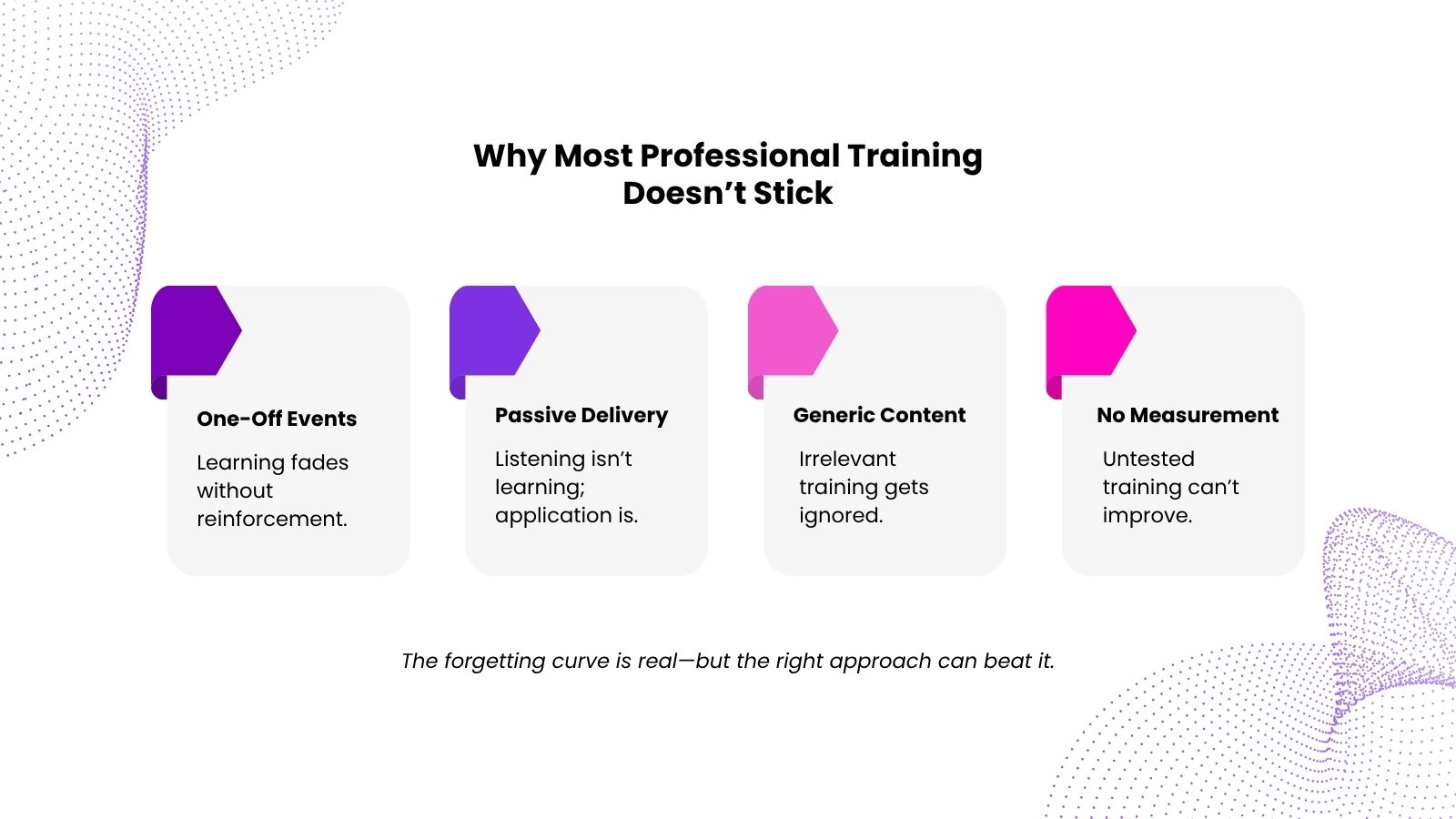
If you want training that lasts, start by understanding why so much of it evaporates:
❌Event thinking – One workshop, no follow-up, and the learning quietly disappears. ❌Lecture overload – Employees hear plenty but rarely get to practise. ❌Cookie-cutter content – Programs built for “everyone” fit no one in particular. ❌Blind spots – With no measurement, organisations can’t tell success from failure.
The most effective training companies have rebuilt their approach around fixing each of these gaps.
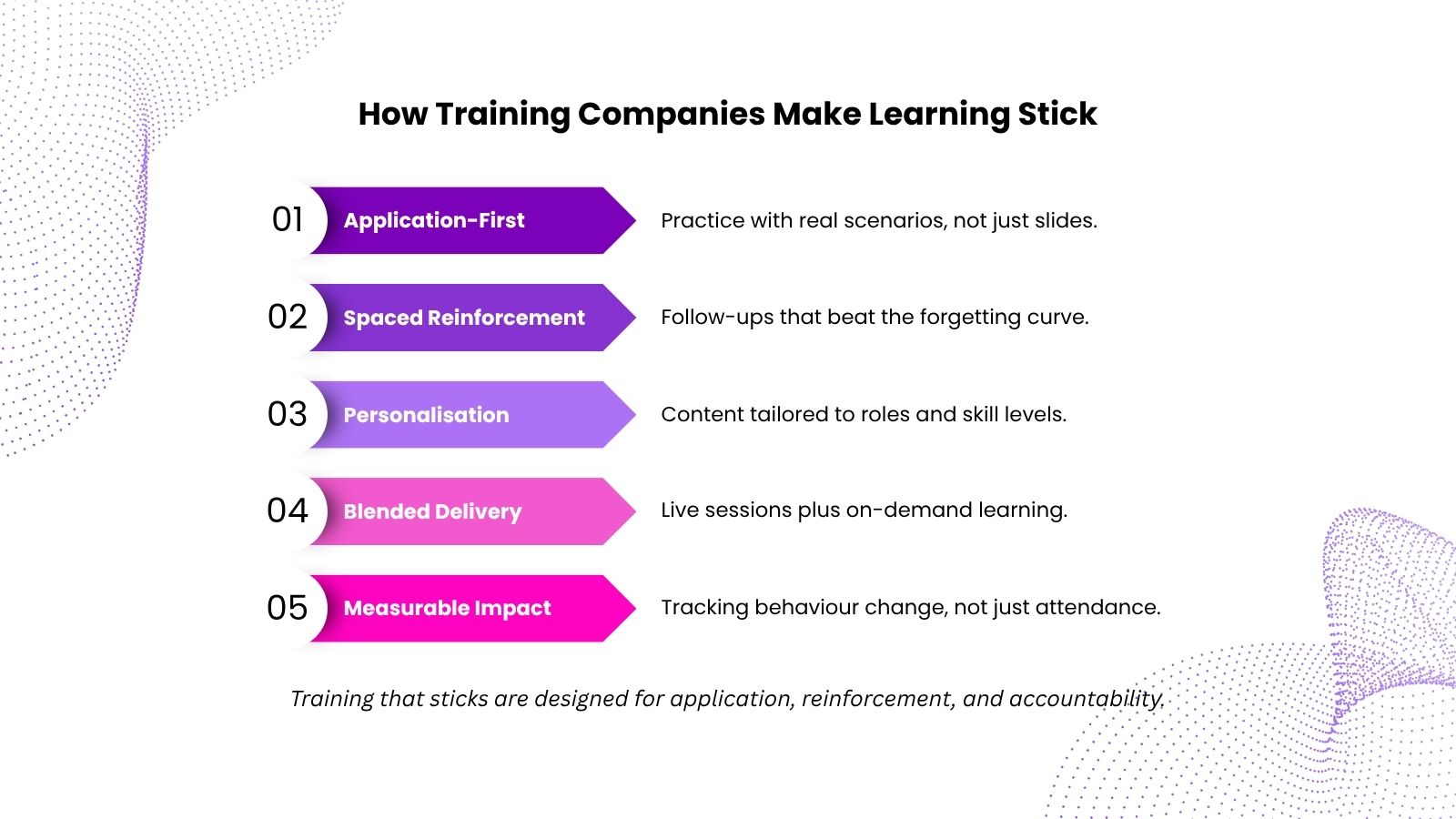
The Modern Approach: What Effective Training Companies Do Differently
Practice Over Presentations
Top training companies flip the traditional model on its head. Rather than spending the day on slides, they put learners to work on:
Scenarios modelled on the company’s own challenges, not textbook cases.
Role-plays and simulations that recreate the pressure of real situations.
Hands-on projects where new skills are used from day one.
Example: Rather than sitting through a negotiation theory session, a sales team runs through live buyer simulations and then gets coached on exactly what to improve.
Reinforcement That Beats the Forgetting Curve
One session can’t win the memory battle alone, so modern professional training is delivered over time. Training companies build in:
Short follow-up modules spaced across weeks, not crammed into one day.
Quick quizzes and challenges that resurface knowledge just as it starts to fade.
Workplace nudges that prompt employees to use new skills in live situations.
One Size Fits None: Personalised Paths
Learners disengage when content doesn’t apply to them. That’s why skilled training companies begin with a skills assessment and build from there:
Difficulty calibrated to each learner’s current level.
Pathways mapped to specific roles, goals, and career ambitions.
Flexible pacing so fast movers accelerate, and others get the support they need.
Example: A first-time manager works through essentials like delegation and feedback, while a senior leader tackles strategy and executive coaching.
The Blend of Human and Digital
The strongest professional training programs refuse to choose between live and digital. They use both deliberately:
In-person workshops for discussion, rehearsal, and connection.
Digital platforms carrying pre-work, resources, and post-session follow-ups.
Peer communities that keep conversations and learning alive long after the program closes.
Proving It Worked
Finally, results-driven training companies look far beyond attendance rates. They track:
Retention – Do assessments weeks later show the knowledge held?
Behaviour – Are people visibly working differently?
Business outcomes – Are productivity, quality, sales, or satisfaction improving?
How Addressing Skill Gaps Drives Business Growth
Fixing skill gaps isn’t just about improving individual performance; it’s about unlocking the full potential of your workforce. Here’s how learning analytics helps organizations grow by addressing skill gaps:
Boosts Productivity and Efficiency: When employees have the skills they need, they work faster, smarter, and with fewer errors.
Fuels Innovation: Skill gaps often hold organizations back from adopting new technologies or strategies. By proactively closing these gaps, companies can adopt new tools and develop new products or services with confidence.
Improves Employee Retention and Engagement: Employees who feel supported in their growth are more engaged, loyal, and motivated.
Aligns Learning with Business Goals: Learning analytics ensures that training programs are directly tied to business objectives, delivering measurable results.
The Proof: A Real-World Example
A global manufacturing company used learning analytics to identify skill gaps in its workforce. By analyzing performance data and training outcomes, they discovered that 30% of their employees lacked critical digital skills needed for a new automation initiative. Using this insight, they:
Developed targeted upskilling programs for the affected employees.
Reduced onboarding time for new hires by 40%.
Increased operational efficiency by 25% within six months.
From Challenge to Opportunity
Skill gaps don’t have to be a roadblock; they can be a catalyst for growth. With learning analytics, organizations can: ✅Identify gaps with precision, not guesswork. ✅Predict future needs before they become problems. ✅Personalize training to maximize impact. ✅Align learning with business goals to drive real results.
The organizations that thrive in the coming years won’t be the ones that ignore their skill gaps—they’ll be the ones that use learning analytics to transform them into opportunities.