Five Systems That Transform Activity into Skills Progression: The Reasons Why Learning Culture Initiatives Fail

Your CEO issued an additional all-hands email regarding the establishment of a learning culture. The budget was approved by the leadership, and the initiative was launched by L&D with motivating messaging. Three months have passed, and the completion rates appear to be satisfactory. 

Nothing has changed six months later. The capability gaps that initiated the initiative are still wide open, employees are not implementing new skills, and managers are not coaching. 

The reason for the failure of most learning culture initiatives is that they are constructed based on inspiration rather than infrastructure, considering culture as a concept that is announced rather than systematically established. 

The Reasons for the Failure of "Culture" Initiatives

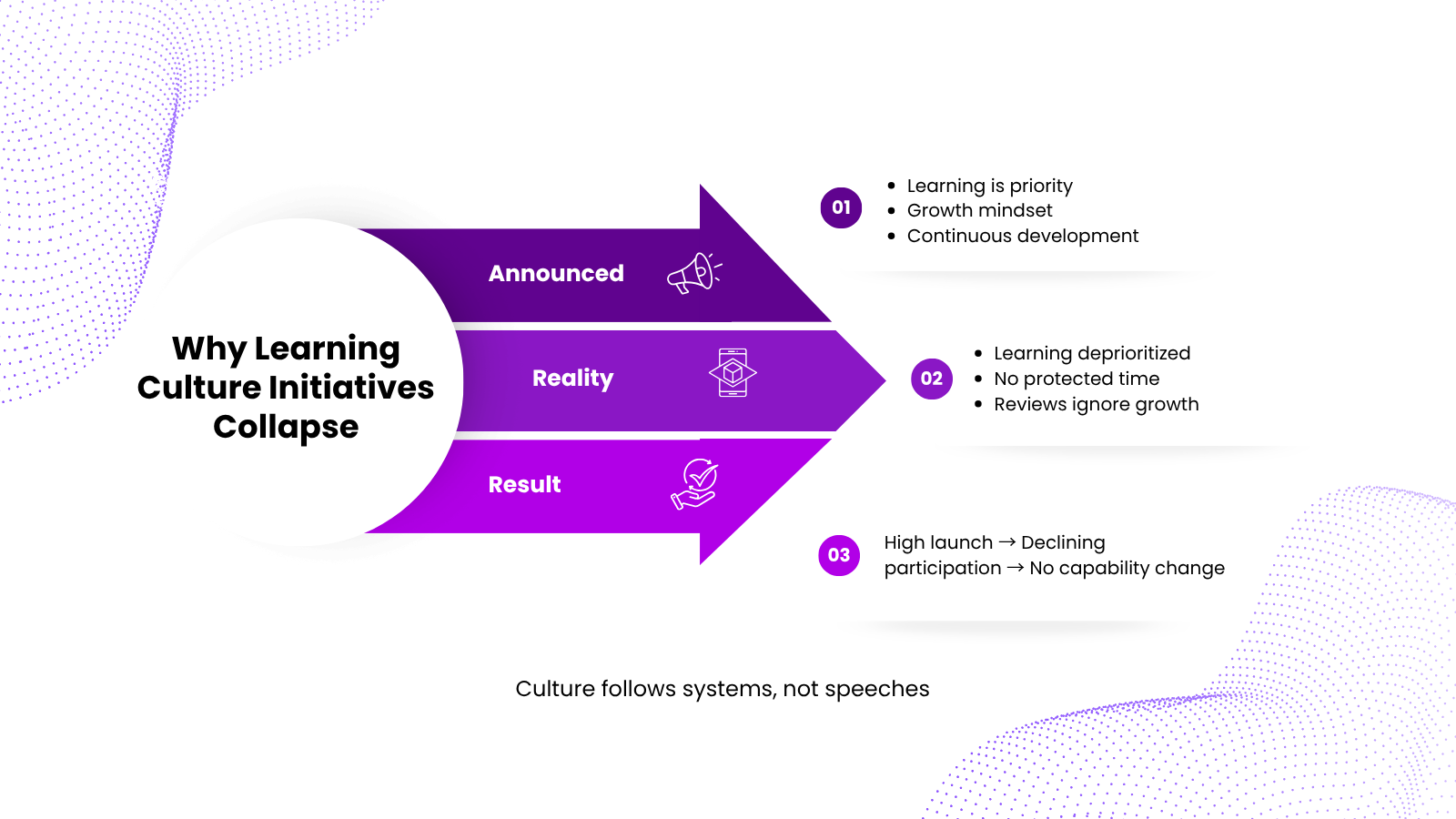
A typical learning culture launch follows a predictable pattern, which includes a leadership inauguration, content library, gamification, and a period of waiting to determine whether individuals begin learning independently. 

They do not! Culture is not established through messaging; rather, it is established through systems that facilitate the development of desired behaviours. Learning culture is rendered meaningless if the infrastructure fails to facilitate the progression of skills as a natural consequence of the work process. 

The Three Failure Patterns:

Organizations declare that learning is of utmost importance; however, they do not modify their performance evaluations or priorities in response to deadlines. Consequently, employees are informed that “learning matters” while experiencing that “delivery matters more.” 


L&D monitors completions and engagement due to their ease of capture; however, these metrics do not indicate whether learning is translating into performance or whether skills are evolving. 


The same initiative is implemented in all departments as if they were all learning in the same manner; however, this is not the case, resulting in engagement fragmentation and the initiative becoming yet another “HR thing.” 


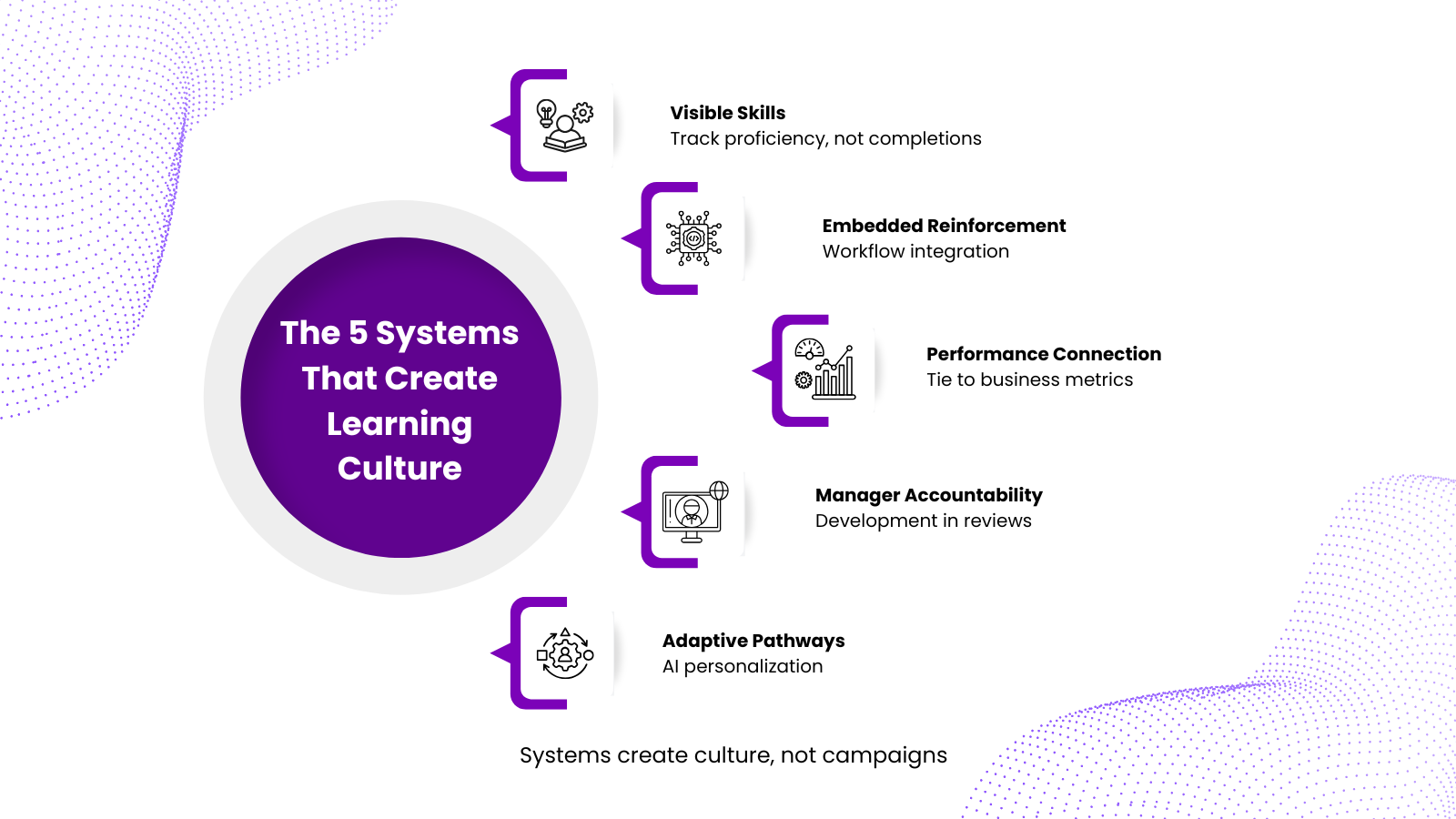
Five Systems That Truly Foster a Learning Culture

System 1: Ensure that the progression of skills is visible and measurable 


The existence of a learning culture is contingent upon the transparency of who is aware of what and where gaps are forming. Track demonstrated skills rather than courses completed, map roles to capabilities, and connect learning to validated competencies in LXP platforms. 


System 2: Integrate Skill Reinforcement into the Workflow 


One-time learning results in forgetting, as 70% of information is lost within days in the absence of skill reinforcement. Incorporate reinforcement into the workflow, prioritize microlearning before tasks, implement spaced repetition, and implement just-in-time practice. 


System 3: Connect Performance Outcomes to Learning 


Learning culture is unsuccessful when it is perceived as being disconnected from the workplace. Establish a connection between each learning path and a performance outcome that is of interest to executives. For example, align sales learning with deal velocity and technical learning with deployment speed. Learning becomes a performance lever when metrics that leadership monitors indicate that skills are improving. 


System 4: Establish Managerial Responsibility for Team Development 


When managers are not held accountable for the development of their organizations, learning culture is extinguished. Establish team development as a permanent agenda item during one-on-one meetings, incorporate it into manager evaluations, and provide managers with dashboards that illustrate the progression of team skills and the areas in which they are lacking. 


System 5: Establish Adaptive Pathways, Not Static Catalogues 


A genuine learning culture necessitates personalization, in which learning is tailored to the individual’s knowledge and the rate at which they are advancing. Modern LXP platforms offer adaptive pathways that are powered by AI, allowing advanced learners to advance while struggling learners receive assistance. This approach ensures that all learners have a learning experience that is meaningful. 

From Failing Initiatives to Functional Systems

Organizations that implement learning culture initiatives with an emphasis on inspiration will continue to observe enthusiasm diminish into compliance theatre, where completions appear satisfactory but capabilities remain stagnant. 
Managers who coach employees, employees who enhance their skills, and business outcomes that demonstrate the investment are achieved by those who transition from initiatives to systems, from activity metrics to skills progression metrics, and from immutable catalogues to adaptive pathways.  
Learning culture is not established through speeches; rather, it is established through systems that facilitate growth rather than stagnation. The appropriate infrastructure transforms intentions into quantifiable capabilities.  
That is not an initiative. This is the process by which learning is transformed into a cultural phenomenon.

Shopping Basket