
Home » The Pedagogical Framework for Adaptive AI Education
The Pedagogical Framework for Adaptive AI Education
The Pedagogical Framework for Adaptive AI Education
Instead of truly transforming learners, corporations have spent decades investing in learning technologies designed to deliver knowledge. However, consuming alone does not result in true learning. It is brought about by application, experience, and cognition.
Every pupil is not taught by a great instructor in the same way. To ensure that every student can comprehend, apply, and develop, they observe how each learner thinks, modify their strategies, reinforce concepts when necessary, and reconfigure their approach. They adapt their instruction in real time to ensure that genuine learning occurs because they have an innate sense of who needs more time, who needs a challenge, and who needs a different explanation.
This function is now mirrored by AI, which serves as a highly customized instructor for each student. However, AI in learning and development adapts continuously and individually, using the same pedagogical theories of learning that guide effective teaching, but delivering them with far greater precision, consistency, and scalability than a human teacher overseeing a room full of diverse abilities.
The pedagogical theories of learning that enable intelligent learning are broken down in an organized manner below, along with how AI enhances each one.
Layer 1: Learning Theories: Knowing How People Learn
Learning Through Experience: The Influence of Action
Kolb’s experiential learning cycle serves as a reminder that knowledge develops in four stages: exploration, conceptualization, reflection, and experience. Managing actual projects is how you learn project management, not by reading about it.
These days, AI in learning and development makes large-scale experiential learning possible by:
- Labs online
- Situation-based difficulties
- Branching simulations that adjust to the choices made by learners
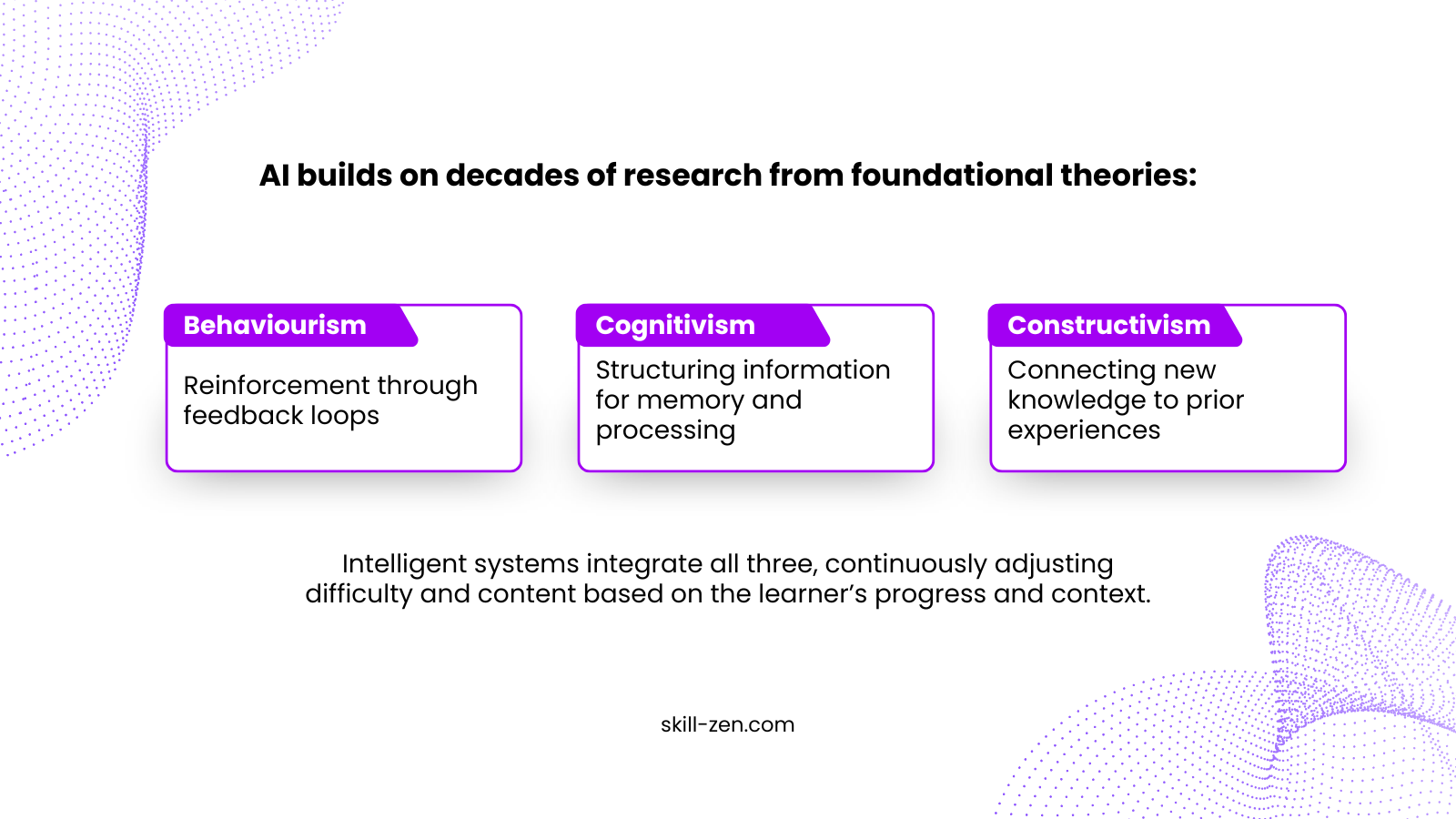
Constructivism, Cognitivism, and Behaviourism: The Three Main Frameworks
By strengthening learning, organizing knowledge, and expanding on prior knowledge, AI combines constructivism, behaviourism, and cognitivism.
For instance, a system that provides additional practice when you’re having trouble, goes over fundamental concepts again when necessary, and unlocks more difficult tasks when you’re ready.
Layer 2: The Architecture of Learning through Instructional Design Models
Creating experiences that are in line with human cognition comes next after we have a better understanding of how learning takes place. Instructional design models are crucial in this situation.
Systematic and Continuous Improvement or ADDIE
The foundation of instructional design has long been ADDIE (Analysis, Design, Development, Implementation, Evaluation). By transforming Evaluation into a real-time feedback engine, AI in learning and development revolutionizes ADDIE. AI continuously evaluates learning efficacy and instantaneously modifies content rather than waiting for post-training assessments.
Climbing the Cognitive Ladder with Bloom’s Taxonomy
AI matches learning challenges to a learner’s cognitive level using Bloom’s Taxonomy.
An example would be an instructor who, once you’ve learned the fundamentals, gives you more difficult, analytical problems or goes over the principles again when you find it difficult to apply a concept.
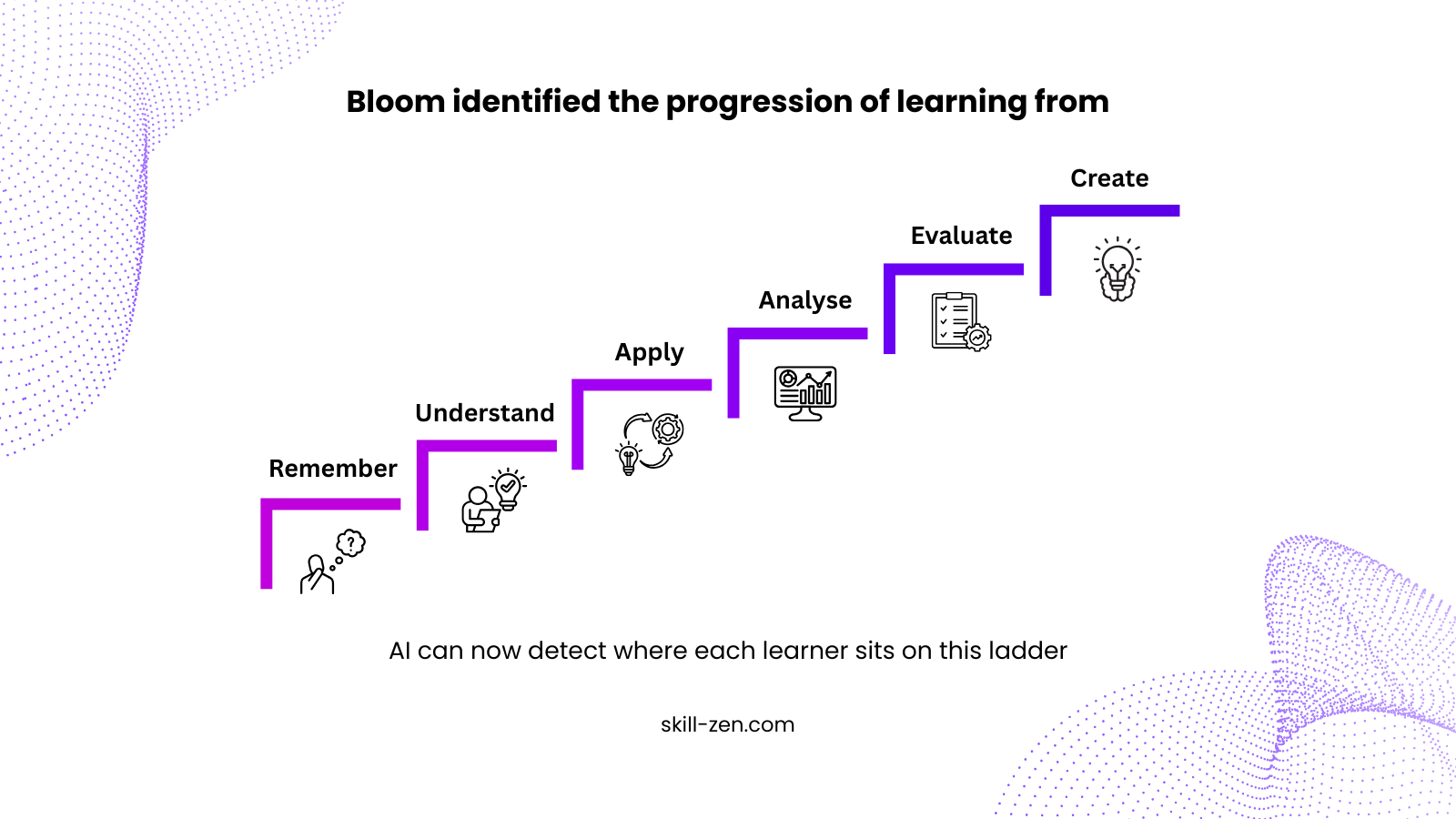
This respects pedagogical theories of learning while avoiding boredom and overwhelm.
Gagné’s Nine Events: Organizing the Educational Process
Gagné’s nine events describe the optimal flow of instruction, from grabbing learners attention to improving their recall. Each event is personalized by AI, which determines when students require further examples, when they are prepared to progress, and what promotes long-term memory retention.
Problem-Centred Learning: Merrill’s First Principles
Merrill places a strong emphasis on finding solutions to practical issues. Here, AI shines by selecting tasks that correspond to ability levels and modifying difficulty in response to performance, a crucial role AI plays in learning and growth.
These hazards indeed exist, but they also present opportunities. Enhancing credibility, lowering regulatory exposure, and establishing firms as reliable partners are all possible with strong DPDP compliance. The following infographic shows how compliance can become advantageous rather than obligatory.
Layer 3: Learning Techniques: The Real Process of Learning
Learning strategies influence how students engage with experiences and content.
Microlearning: Mastery in Tiny Steps
Bite-sized content fits modern attention spans and increases retention. AI reflects contemporary educational theories of learning by anticipating when a student needs a concept and delivering microlearning precisely on time.
For instance, if a learner consistently falters on a safety compliance issue, the AI immediately plays a 60-second refresher video on the subject before they proceed.
Problem-Based Learning: Development via Difficulty
Problem-based learning immerses students in real-world situations rather than starting with theory. AI creates a clear route from bewilderment to mastery by personalizing each task.
Flipped Classroom: Putting Participation First
Students use interactive time for application and consume content on their own. Another effective application of AI in learning and development is the analysis of pre-work and customization of activities to bridge knowledge gaps.
Spaced Repetition: Overcoming the Curve of Forgetting
Ebbinghaus demonstrated how quickly information fades in the absence of evaluation. AI pushes information into long-term memory by scheduling spaced repetition according to each learner’s forgetting curve.
Adaptive Learning: The Highest Level of Customization
All of these methods come together in adaptive learning. Based on performance in real time, AI modifies delivery, tempo, sequence, and difficulty. A fundamental tenet of all pedagogical theories of learning is that no two learners travel the same path because no two learners are alike.
Pedagogically Intelligent AI’s Future
The next development in education is the result of combining intelligence with pedagogy. AI transcends its use as a delivery method. It turns into an adaptable companion that enhances the learning process overall, increases capacity, and speeds up mastering. Learning will continue to change from a static process into a dynamic, customized environment that changes with each student as AI in learning and development develops.