
Home » Your Data Is Everywhere. Here’s How Intelligent Document Processing Makes It Work for You
Your Data Is Everywhere. Here’s How Intelligent Document Processing Makes It Work for You

Your Data Is Everywhere. Here’s How Intelligent Document Processing Makes It Work for You
There is a version of your organization that runs on perfect information. When the right people have the right data at the right moment, decisions get made quickly and confidently, and nothing important ever gets buried in a shared drive or lost in an inbox. Every leader has seen this version in a vendor demo. Very few have seen it in real life.
The gap between that version and the one most organizations are living is not a technology gap, but rather a data gap, and the frustrating part is that the data already exists. It is just scattered across too many places, in too many formats, in too many systems that were never designed to talk to each other.
Having data and being able to use data are two completely different things. Most organizations have mastered the first and are still struggling with the second.
The Scattered Data Problem Nobody Talks About Honestly
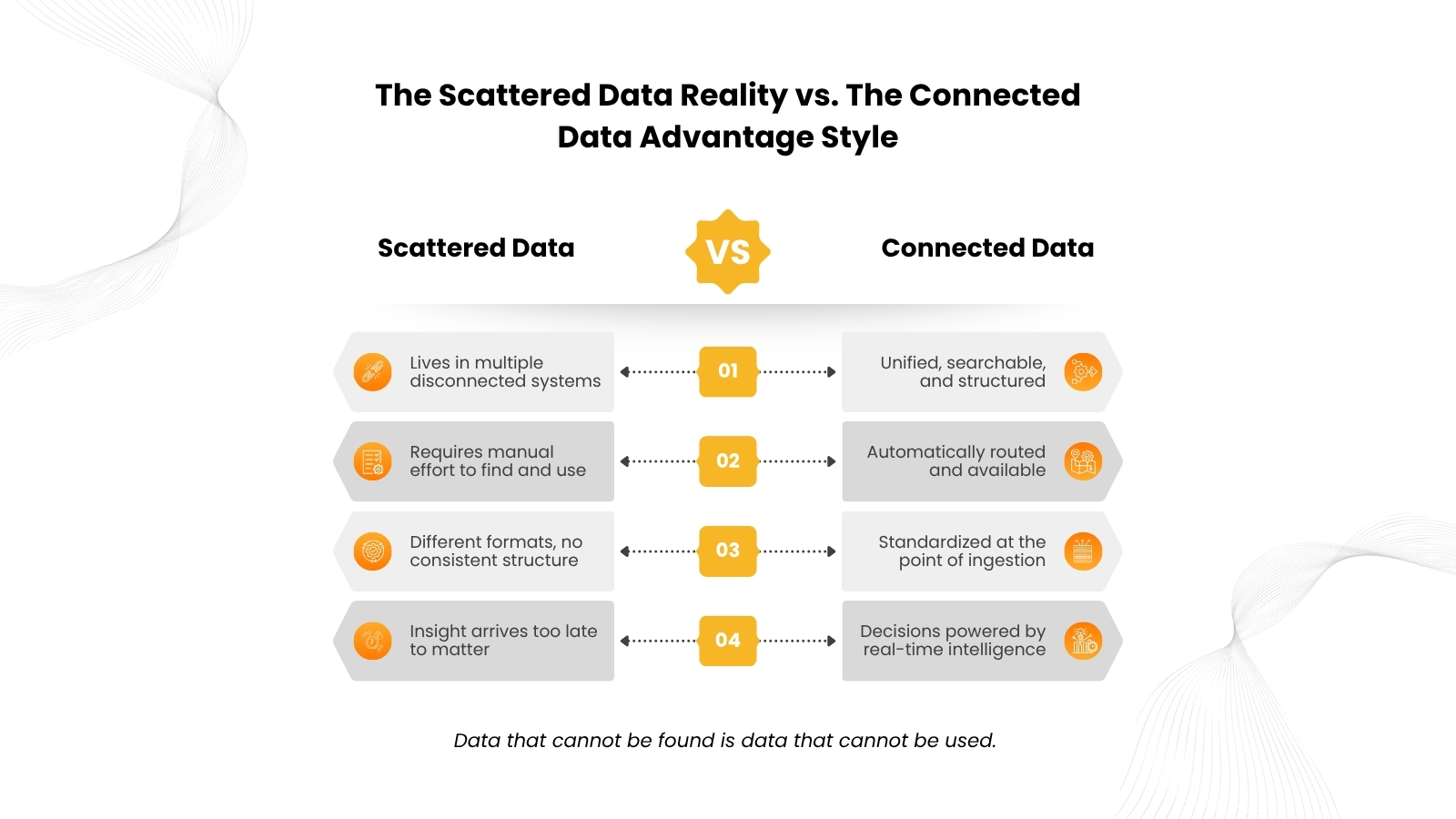
Think about what happens the moment a single invoice enters your organization. It arrives by email, gets forwarded to a shared inbox, is manually entered into a spreadsheet, attached to a purchase order in one system, referenced in an approval thread in another, and eventually filed somewhere in a folder that made sense at the time. The data is not missing, but it is everywhere, and that is precisely what makes it unusable.
Multiply that by every contract, report, form, and customer document your organization handles in a year, and the scale of the problem becomes clear. Intelligent Document Processing exists to solve exactly this not by adding another place for data to live, but by making the data that already exists structured, connected, and actionable from the moment it arrives.
The 3 Ways Intelligent Document Processing Puts Your Data to Work
Way 1: It Structures Data at the Source
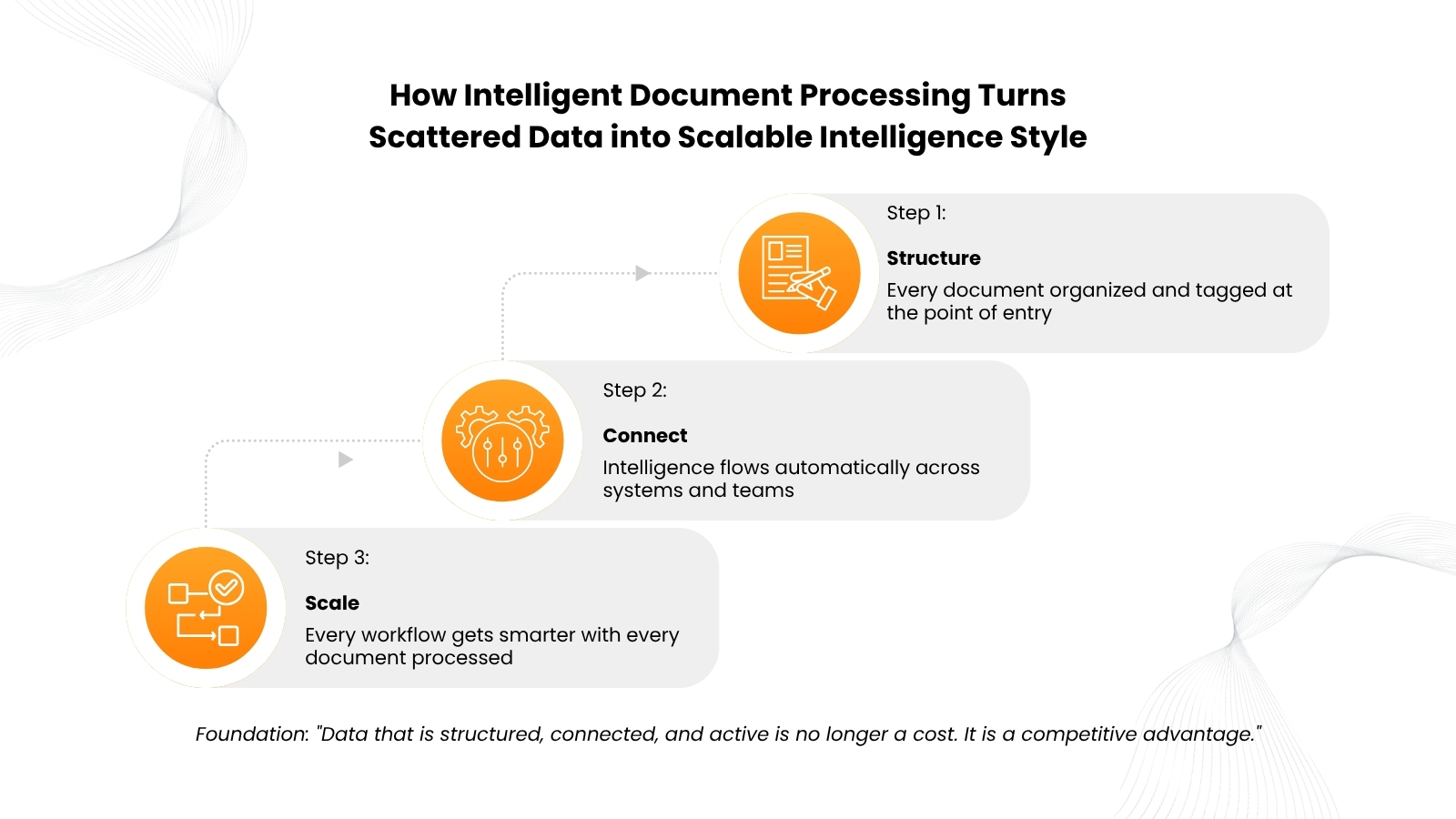
The reason data ends up scattered is that most organizations capture it without organizing it. A document arrives and gets stored. Intelligent Document Processing changes this at the point of entry reading every document, understanding its context, extracting what matters, and tagging it with the information needed to make it findable, usable, and connected to everything relevant. The data stops being a file and starts being an asset.
Way 2: It Connects Data Across Silos
The biggest hidden cost of scattered data is not the search time. It is the decisions that get made without the full picture. Document Automation breaks down the walls between systems by ensuring that when a document enters one part of the organization, the intelligence inside it flows automatically to every part that needs it. Approvals happen faster, exceptions surface sooner, and the right people stop waiting for information that was always there.
Way 3: It Builds Scalable Intelligence Over Time
The organizations that get the most from their data are the ones that have built systems where every document that enters makes the next decision easier. Scalable Intelligence is not a feature you switch on, but what happens when structured, connected data compounds over time, and every workflow gets smarter because the last one did too.
Your Data Has Been Waiting Long Enough
The organizations pulling ahead in 2026 are the ones that decided to stop letting their data sit in silence and started building systems that make it work.
Intelligent Document Processing is not about replacing what your teams do, but about making sure that when they decide, they are working with the full picture, not a fragment of it buried in a folder somewhere.
Your data is and has always been there. The only question worth asking now is how much longer you can afford to leave it scattered.
Every organization faces the same quiet struggle: your data isn’t lost, it’s just trapped. It is sitting in half-finished emails, buried in PDFs, lingering in siloed shared drives, and hidden within thousands of invoices, contracts, and reports.
You have all the information required to make better business decisions, but it is scattered, unstructured, and effectively invisible. You aren’t just dealing with a storage problem; you are facing a massive gap in Document Automation.
The Myth of the "Visible" Enterprise
We often assume our businesses are digital because we work on computers. But if a human still needs to manually read, verify, and re-type information from one system to another, you aren’t truly digital, you’re just busy.
This manual cycle is the hidden barrier to Scalable Intelligence. When your data is locked inside static files, it cannot inform your strategy, it cannot flag risks, and it cannot help you grow. The transition from a “Search and Rescue” culture where teams hunt for files, to one where information works for you starts with Intelligent Document Processing (IDP).
Step 1: Stop Searching, Start Mapping
The first step toward true visibility is recognizing that your documents are not just “files”, they are your most valuable data assets. Before you can automate, you must map how information flows. Which documents hold the answers your team needs every day? By identifying these “knowledge hotspots,” you can stop treating all documents as equal and start focusing on the ones that move the needle.
Step 2: The Power of Contextual Handoffs
Data loses its value the moment it becomes “un-anchored.” A document without context is just noise. True Intelligent Document Processing (IDP) works by wrapping your data in context the moment it hits your system. It’s not enough to extract a name or a number; you need to link that data to the person, the project, and the history behind it. This is how you move from simple storage to Scalable Intelligence.
Step 3: From Visibility to Autonomy
Once your documents are visible and contextually “smart,” you don’t need to hunt for them. Instead, the information is served to the right person at the right time. This is the ultimate goal of Document Automation: not just faster processing but creating an environment where the system handles the routine, allowing your people to handle the exceptions.
Stop Collecting Data and Start Using It
The organizations winning in 2026 are the ones that have built the clearest view of what they have.
When you prioritize visibility, you stop being a custodian of digital clutter and start being an architect of a smarter organization. Your data is everywhere and it’s time to bring it home, organize it, and let it do the heavy lifting for you.
The shift isn’t about working harder; it’s about making your information work for you. Intelligent Document Processing (IDP) is the key to unlocking that potential.