The boardroom is buzzing, budgets are approved, vendors are selected, and pilots are running smoothly. For the first few weeks, everything feels like a step into the future. Leaders talk about transformation, teams finally get the resources they’ve asked for, and the organization feels ready for what’s next.
Then, six months later, the momentum stalls. The model works, infrastructure is solid, and the team is capable, but somehow, the outcomes never match the promise. Exceptions pile up, and the AI that was supposed to speed up decisions quietly becomes another system that needs managing.
What went wrong? It’s rarely the AI itself. The real issue lies beneath the surface, which is the absence of serious Metadata Management. Without it, even the most advanced AI Implementation is built on shaky ground.
AI Doesn’t Fail at the Surface. It Struggles at the Foundation.
Most AI Implementation projects focus on the model, the algorithm, or the interface, but almost none prioritize the quality of the data feeding into the system and that’s where the problems begin.
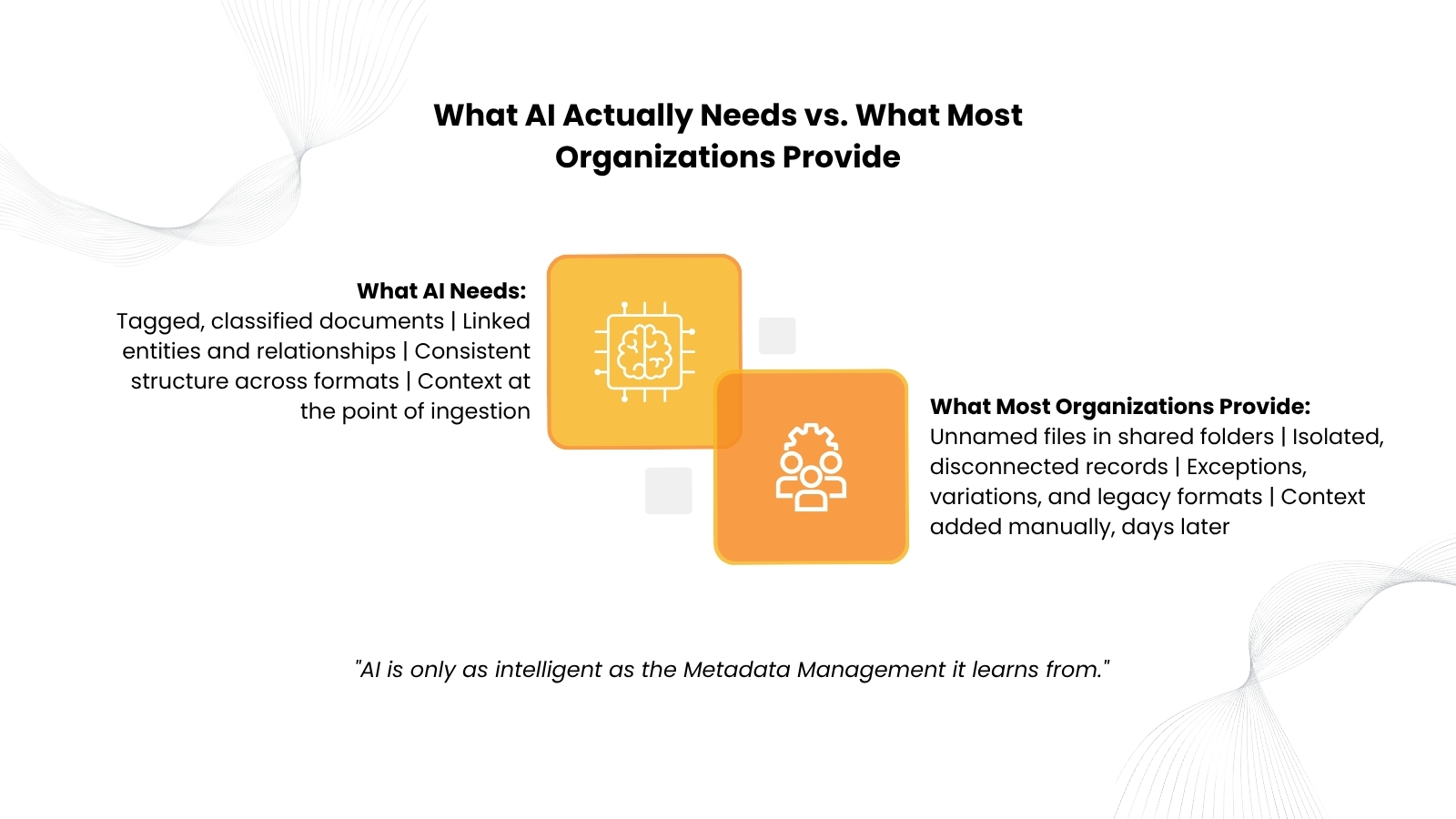
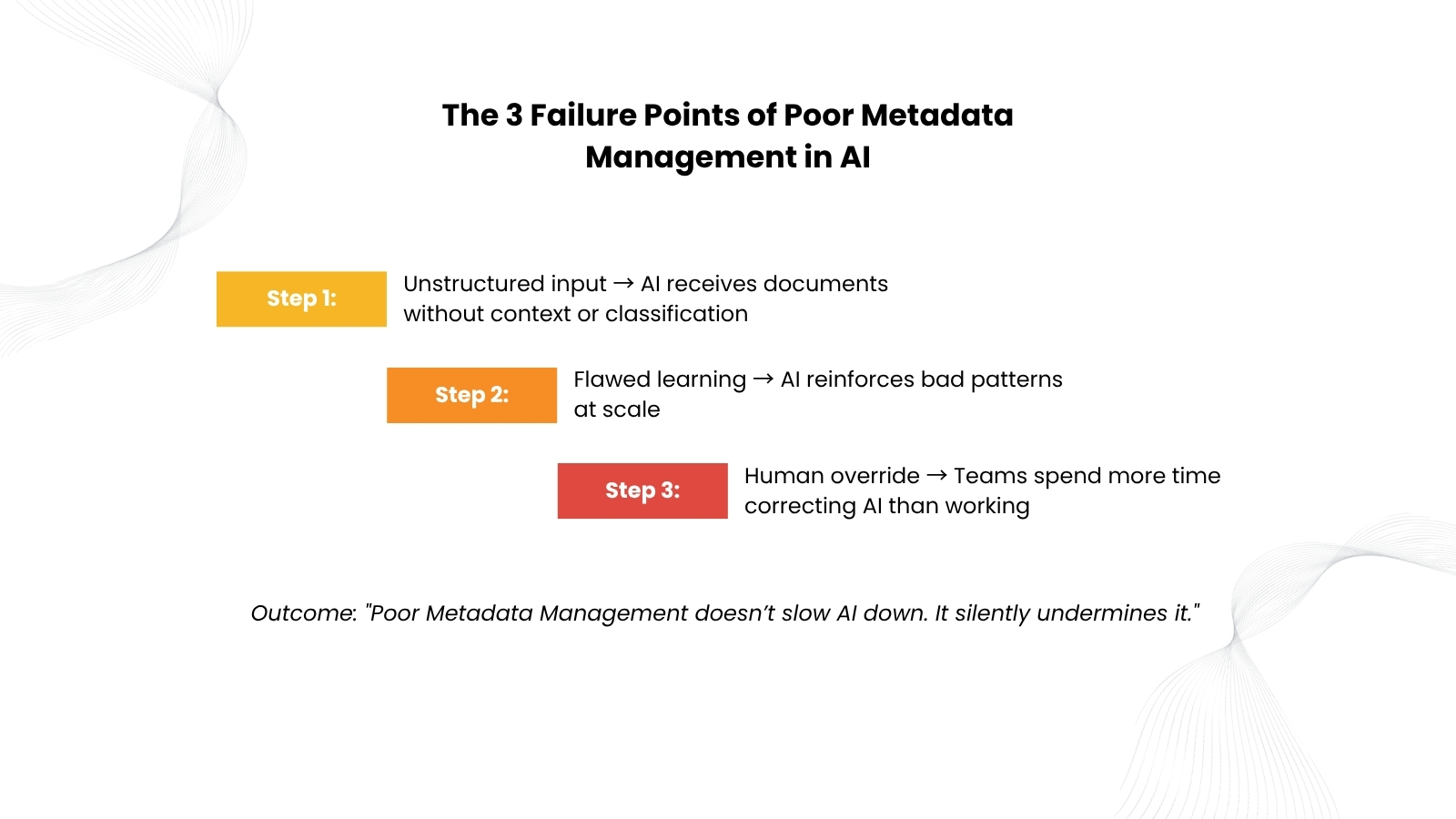
AI doesn’t think in documents. It thinks in structured, tagged, contextual data. When an AI system receives an untagged invoice with no vendor classification, no approval status, and no link to the relevant purchase order, it doesn’t know what to do with it. So, it guesses, flags it as an exception, or processes it incorrectly with complete confidence.
Poor Metadata Management doesn’t just slow AI down, it teaches the system the wrong patterns. The more documents it processes without proper context, the more confidently wrong it becomes.
The 3 Ways Poor Metadata Management Sabotages AI Implementation
The Data Swamp
AI models are only as good as the data they’re trained on. Without Metadata Management, data becomes a disorganized, inconsistent, and unusable swamp. AI Implementation drowns in noise instead of learning from signal.
The Context Void
AI needs context to make sense of data. Without metadata to describe relationships, importance, and meaning, AI systems make decisions in a vacuum. The result? Errors, biases, and poor outcomes that erode trust.
The Scaling Wall
AI pilots often succeed in controlled environments, but 70% fail when scaling because the underlying Metadata Management can’t keep up. Without a system to organize, tag, and connect data at scale, AI Implementation hits a wall.
The Bottom Line
Organizations that invest in Metadata Management don’t just improve their AI Implementation, but they future proof it. They ensure AI systems have the context, structure, and scalability to deliver real-world value.
The invisible barrier to AI success isn’t the technology, it’s the lack of structure. The question is: Can your AI afford to ignore Metadata Management?